

Dublin City University Trains MRI to Spot Alzheimer's Without Expensive PET Scans
A BiomedCLIP-based teacher learns from paired PET-MRI scans, then teaches an MRI-only student to flag amyloid buildup without expensive PET imaging.
 PRO
- New framework predicts amyloid-beta positivity from MRI alone, no PET or clinical variables needed at inference.
- Best AUC of 0.74 on OASIS-3 and 0.68 on ADNI across four MRI contrasts.
- Improves T1w-only AUC by 19.7% over prior MRI baseline (Kim et al., 0.61 to 0.73).
- Uses BiomedCLIP ViT with LoRA, cross-modal attention teacher, and Centiloid-aware triplet mining.
- Code released at GitHub repo; paper on arXiv.
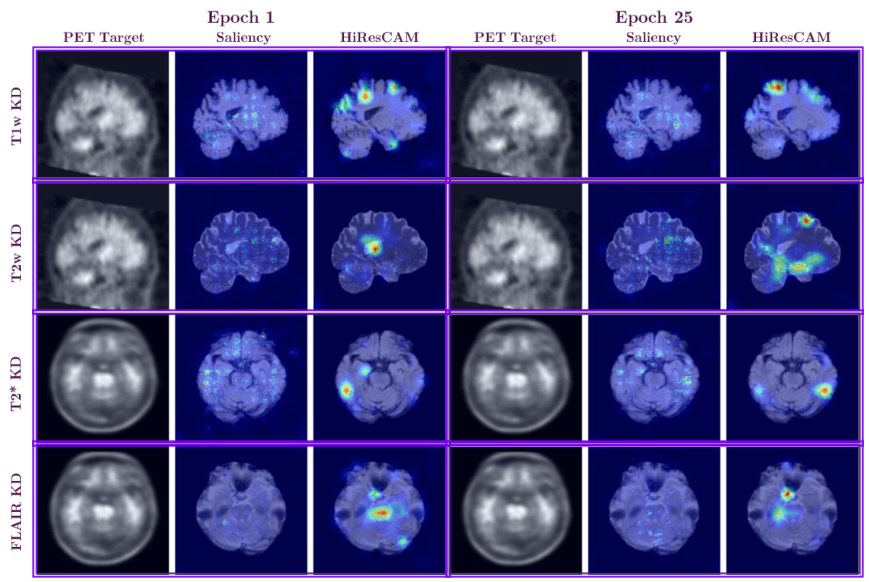
- Saliency maps confirm the model focuses on anatomically plausible cortical regions rather than artifacts.
Detecting the amyloid-beta plaques that mark early Alzheimer's disease usually means booking a PET scan, which is expensive, radioactive, and unavailable in most clinics. A team from Dublin City University has now shown that a knowledge distillation setup can teach a standard MRI model to predict amyloid positivity on its own, hitting an AUC of 0.74 on OASIS-3 and 0.68 on ADNI without any PET or clinical variables at inference time.
Why PET has become a bottleneck
Amyloid PET is costly, invasive, and thin on the ground, which rules it out for population-level screening. With FDA approvals of lecanemab and donanemab (both of which require confirmed amyloid pathology before treatment), projected demand for amyloid PET is growing roughly 20-fold.
MRI is the obvious alternative: non-invasive, cheap, and already part of routine dementia workups. The catch is that MRI can't directly image amyloid, and prior MRI-only models have been mediocre. A 3D EfficientNet baseline from Kim et al. hit just AUC 0.61 on T1w scans. Models that do better tend to lean on non-imaging covariates like APOE genotype or cognitive scores, but those are missing in a huge fraction of real records. Routine APOE testing isn't recommended by ACMG guidelines and is absent for 26% of NACC participants, and cognitive measures are missing from 89% of EHR dementia records.
The three-phase teacher-student setup
The core idea is cross-modal knowledge distillation. A BiomedCLIP-based teacher learns PET-MRI alignment through cross-modal attention and triplet contrastive learning with PET-informed (Centiloid-aware) online negative sampling. An MRI-only student then mimics the teacher through feature-level and logit-level distillation. BiomedCLIP is a Vision Transformer pretrained on 15 million biomedical image-text pairs, which the authors adapt using LoRA on the last six transformer blocks.
This story is for Pro members
You've reached the end of the free preview. Upgrade to AlphaSignal Pro to read the full article - and everything else behind the paywall.
Comments
