
Digital Samba's claude-code-video-toolkit Turns Text Into Full Videos for Under a Dollar
An open-source workspace turns Claude Code into a full video production studio, chaining voiceover, music, images, and clips into a rendered MP4 for cents.
 Pro
Takeaways
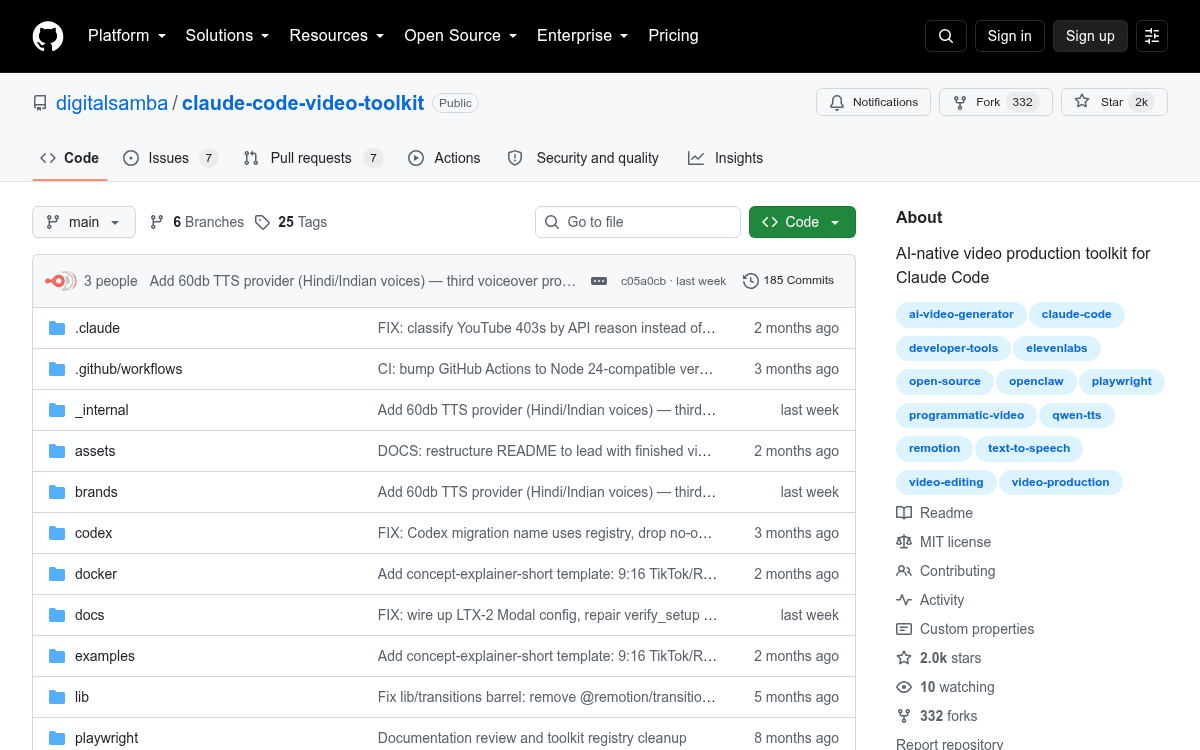
- Digital Samba open-sourced claude-code-video-toolkit, an AI-native video production workspace for Claude Code, now near 2k stars.
- Skills cover Remotion, ElevenLabs, FFmpeg, and Playwright so the agent understands the full production pipeline.
- Eight tools run on Modal or RunPod GPUs, with LTX-2 clips at ~$0.23 and TTS at ~$0.01.
- Templates include sprint reviews, product demos, and 9:16 shorts, all governed by a multi-session project.json lifecycle.
- Brand profiles auto-apply colors, fonts, and cloned voices, and
/publishpushes renders straight to YouTube. - An experimental script also installs the skills into OpenAI Codex via a generated AGENTS.md block.
Tell Claude Code the video you want and it writes the script, generates the voiceover, scores the music, produces the visuals, and renders the MP4. That is the pitch of claude-code-video-toolkit, an open-source workspace from Digital Samba that has crossed 1.9k stars on GitHub. It bundles the skills, slash commands, templates, and Python tools an agent needs to take a clip from concept to final render, leaning on open models so a full short costs closer to a dollar than a subscription.
The full pipeline, wrapped as a Claude Code skill
Under the hood this is a Claude Code project template rather than a single library. It covers voiceover generation, image synthesis, background music, talking head animation, and final composition through Remotion, leaning on cloud GPUs (Modal or RunPod) running open-source models so you avoid local setup or proprietary APIs. Remotion is a React-based framework where you write compositions as JSX and export MP4s, and it is what the agent scaffolds when you kick off a project.
Clone the repo, then run /video inside Claude Code. The command walks you through creating a project interactively, choosing a template, brand, and planning scenes. Claude scaffolds a complete Remotion project with config, voiceover script, and React compositions. You can then preview with npm run studio and render with npm run render. A separate /setup command deploys the AI tools to your own Modal or RunPod account so the agent can call them like local scripts.
What the agent actually knows about
The workspace registers domain-specific skills so Claude reasons in the vocabulary of video production instead of guessing. Those skills cover Remotion, ElevenLabs for AI voiceover, music and SFX, FFmpeg for media processing, and Playwright for browser demo recording. Sitting on top are project templates, brand profiles, guided workflows via slash commands, and a full production lifecycle from script to final render.
On the Remotion side the toolkit ships its own component and transition libraries. You get pre-built transitions like glitch, light leak, clock wipe, and checkerboard alongside Remotion's standard offerings, plus shared components including AnimatedBackground, SlideTransition, and NarratorPiP. It is useful if you are working in a codebase that already leans on these abstractions and you want Claude to respect your custom conventions.
Cents per scene, not dollars per minute
The economic story is the reason this project is getting attention. Eight of the tools run on cloud GPUs and are priced roughly like this:
| Tool | Job | Estimated cost |
|---|---|---|
| qwen3_tts | TTS with 9 speakers plus voice cloning | ~$0.01 |
| flux2 | Image generation and editing | ~$0.02 |
| music_gen | ACE-Step music with 8 scene presets | Free via acemusic |
| sadtalker | Talking head from portrait plus audio | ~$0.10 |
| ltx2 | Text-to-video and image-to-video clips | ~$0.23 |
| dewatermark | Video watermark removal | ~$0.10 |
Modal's Starter plan gives $30 of free compute per month, enough for a handful of shorts. One example in the repo, a 52-second vertical explainer titled Why is the sky blue?, is called out as costing about $0.80 to generate.
Templates, brands, and a project lifecycle
Rather than one-shot generation, the toolkit models video as a multi-session project. Every project carries a project.json tracking scenes, audio, sessions, and the current phase, and the system auto-writes a per-project CLAUDE.md so the agent picks up context when you resume. Config-driven sprint review templates ship with a theme system, pre-built Title, Overview, Summary, and Credits slides, and audio integration. A marketing product demo template arrives with a dark tech aesthetic, animated background, Narrator PiP, browser and terminal chrome, and stats cards with spring animations. A separate 9:16 vertical concept-explainer template runs on pure Python and moviepy, with the whole video derived from a scenes.json of per-scene narration plus visual asset.
Brand profiles under brands/ hold colors, fonts, voice settings, and logos, and the agent applies them automatically at project creation. A /voice-clone command records and saves a cloned voice into a brand, and /publish pushes the finished render to YouTube with metadata pre-filled from the project file.
Where it shines and where it chafes
The strengths line up with structured, script-driven formats. Practical fits observed in the showcase and community writeups include:
- Sprint review and internal update videos with demos, stats, and voiceover
- Product marketing and launch ads, including a Super Bowl-style spot with an LTX-2 animated cameo
- 9:16 shorts for TikTok, Reels, and YouTube with burned karaoke captions and cloned voices
- Product demos, bug reproductions, and onboarding walkthroughs, where the
/record-democommand feeds Playwright recordings into Remotion for post-processing with branded intros, transitions, and captions
The rough edges are the ones you would expect. The toolkit enforces a fixed workspace path and requires JSON progress flags on every GPU command, which feels rigid but keeps long-running jobs visible. You also need Node 18+, Python 3.9+, and a Modal or RunPod account before anything interesting happens, and Remotion carries its own commercial licensing that companies need to check. It is a builder's kit rather than a one-click generator, which is exactly why it appeals to anyone already living inside Claude Code.