DeepSeek's VL2-Tiny Beats Models Twice Its Size on OCR Benchmarks
DeepSeek-VL2-Tiny packs strong OCR, document understanding, and visual grounding into just 1B active parameters using a sparse MoE architecture
 PRO
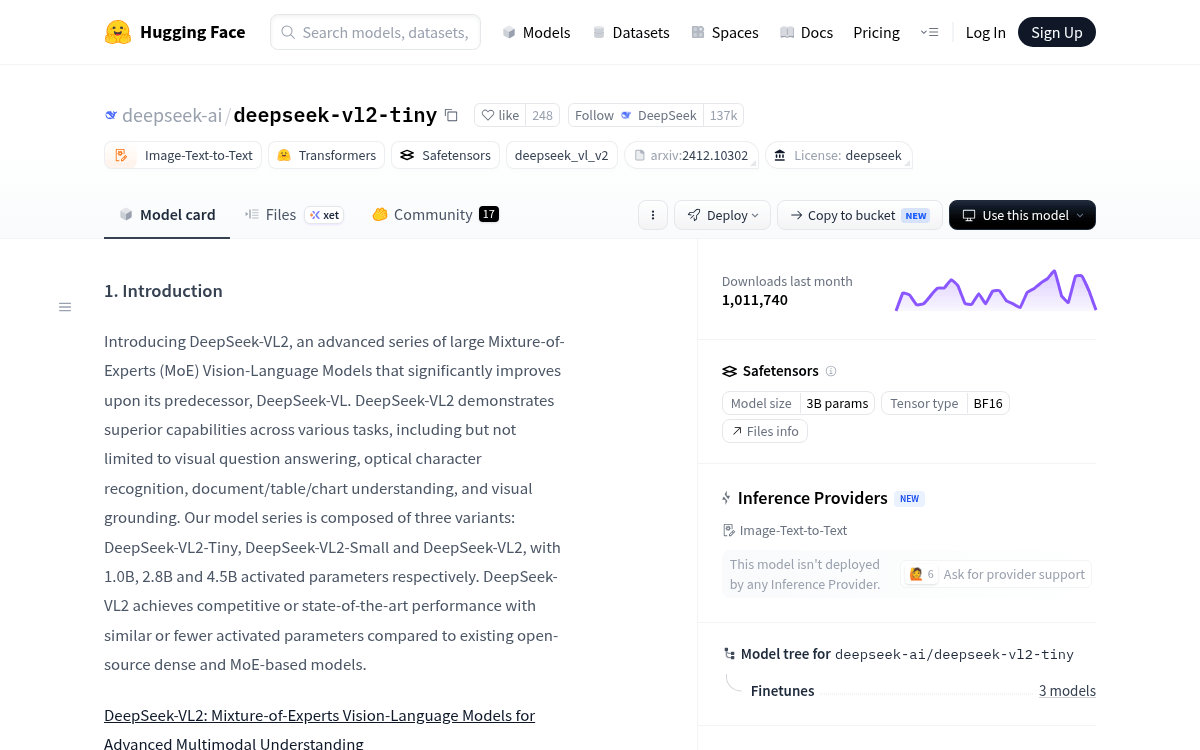
- DeepSeek-VL2-Tiny is a 1B activated-parameter vision-language model using Mixture-of-Experts, free and open-source on Hugging Face.
- It scores 809 on OCRBench, beating GPT-4V (645) and GPT-4o (736) despite being a tiny open-source model.
- Two key innovations: dynamic image tiling for high-res inputs and Multi-head Latent Attention for efficient KV-cache compression.
- Visual grounding is a new capability — the model can output bounding box coordinates for objects described in natural language.
- Runs in ~10GB VRAM; supports commercial use under the DeepSeek Model License with MIT-licensed code.
- Limitations include restricted multi-image context, English/Chinese-only OCR, and weaker reasoning depth vs. larger variants.
DeepSeek-VL2-Tiny is the smallest member of DeepSeek's second-generation vision-language model family, and it punches well above its weight class. With only 1 billion activated parameters, it outperforms several models that activate 2x more compute on key benchmarks, making it one of the most efficient open-source vision-language models available today.
One model, three sizes
The DeepSeek-VL2 series comes in three variants: Tiny, Small, and the full model, with 1.0B, 2.8B, and 4.5B activated parameters respectively. The key word is activated. DeepSeek-VL2-Tiny activates 1.0 billion parameters total, with the base language model activating just 0.57 billion out of a total of 3 billion parameters. This is the magic of Mixture-of-Experts (MoE): a large pool of specialized sub-networks exists, but only a small fraction fires for any given input, keeping inference fast and cheap.
The main difference between DeepSeek-VL2-Tiny, DeepSeek-VL2-Small, and DeepSeek-VL2 is the base LLM , with each variant scaling up the underlying language backbone while sharing the same vision encoder and architectural innovations.
Two key upgrades under the hood
DeepSeek-VL2 significantly improves upon its predecessor through two key upgrades: a dynamic tiling vision encoding strategy designed for processing high-resolution images with different aspect ratios, and a DeepSeekMoE language model with the Multi-head Latent Attention (MLA) mechanism, which compresses the Key-Value cache into latent vectors to enable efficient inference and high throughput.
Let's break those down:
- Dynamic tiling: Instead of squishing every image into a fixed resolution, the model slices high-res images into tiles of 384x384 pixels and processes each tile through a shared vision encoder (SigLIP-SO400M). It supports dynamic tiling for up to 2 images and implements direct padding for 3 or more images at 384x384 resolution. This means tall receipts, wide charts, and square photos all get processed at their natural shape.
- Multi-head Latent Attention (MLA): Standard attention mechanisms store large key-value caches that grow with context length, which is expensive. MLA compresses those caches into compact latent vectors, dramatically cutting memory usage and boosting throughput during inference.
This story is for Pro members
You've reached the end of the free preview. Upgrade to AlphaSignal Pro to read the full article - and everything else behind the paywall.
Comments