

DeepSeek's V4-Flash-Vision-Exp Quietly Challenges Anthropic's Opus on Multimodal Agent Tasks
DeepSeek's new experimental vision model bolts image understanding onto V4-Flash at the same price, closing in on Claude Opus 4.8 on multimodal agent tasks.
- DeepSeek launched V4-Flash-Vision-Exp, an experimental multimodal variant of V4-Flash with image understanding.
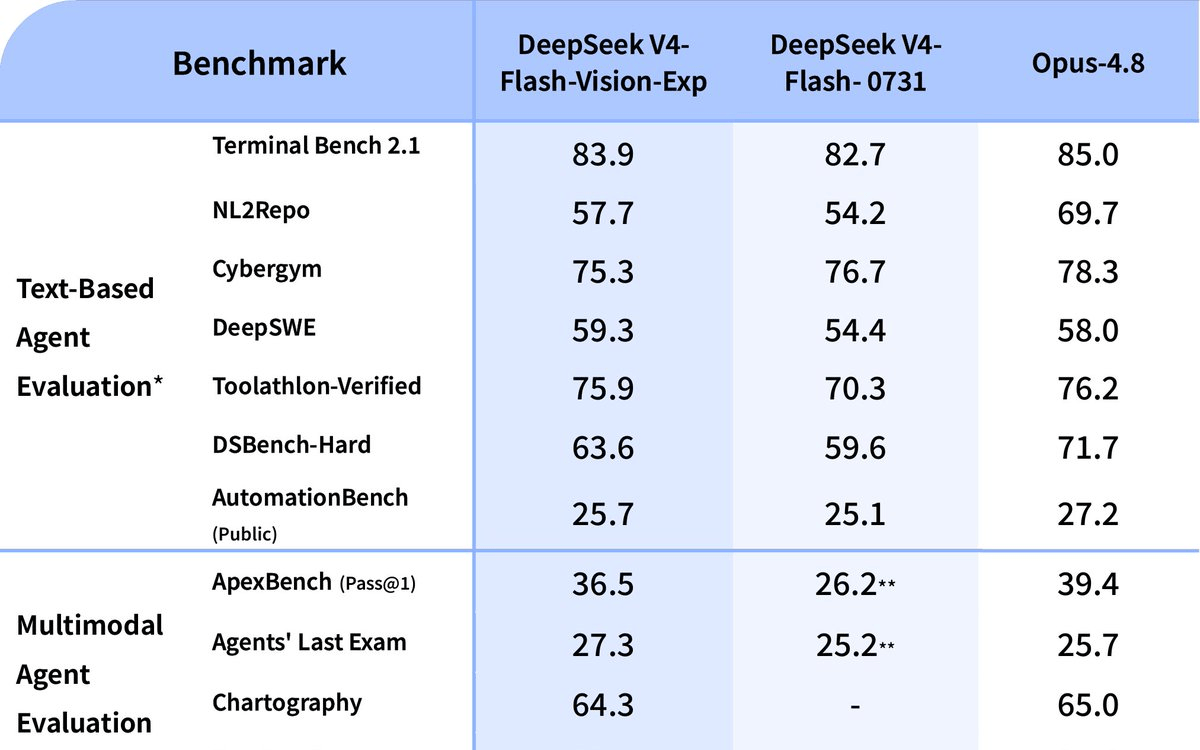
- Claims multimodal agent performance close to Claude Opus 4.8; beats it on 3 of 11 published benchmarks.
- Same text performance as V4-Flash; matches base model on reasoning, agents, and world knowledge.
- Images billed at V4-Flash token rates, capped at 384 tokens per image regardless of resolution.
- New free Files API lets you upload once and reuse via file_id across requests.
- Works with Chat Completions, Anthropic Messages, and Responses APIs via base64, URL, or file_id.
DeepSeek has quietly dropped an experimental multimodal model that turns its cheap-and-fast V4-Flash into a vision-capable agent, and the pitch is that it can hold its own against Anthropic's flagship on several multimodal benchmarks. DeepSeek-V4-Flash-Vision-Exp is now live on the DeepSeek API Platform, matches DeepSeek-V4-Flash on text capabilities including agents, reasoning, and world knowledge, and on multimodal agent benchmarks makes a major leap over V4-Flash, bringing multimodal agent performance close to Opus-4.8.
The model ships alongside a new Files API for image reuse, updated docs, and version 0.1.1 of DeepSeek's agent harness with built-in support.
What actually changed
This is not a new flagship. V4-Flash-Vision-Exp is a fairly narrow addition to the company's lineup, a multimodal variant of DeepSeek-V4-Flash, the smaller and faster of the two models DeepSeek released alongside V4-Pro, and it holds onto the text capabilities of the base model, including agentic behaviour, reasoning and general knowledge, while adding image understanding on top. Think of it as V4-Flash with eyes bolted on, not a rethink of the stack.
Under the hood, the base model is an efficiency-optimized Mixture-of-Experts model with 284B total parameters and 13B activated parameters, supporting a 1M-token context window, designed for fast inference and high-throughput workloads, with hybrid attention for efficient long-context processing.
The benchmark story, minus the marketing
DeepSeek's headline framing is that the model closes in on Opus 4.8 on multimodal agent tasks, but the numbers are mixed. DeepSeek published eleven benchmark results. Its new model beats Opus-4.8 on three of them: DeepSWE by 1.3 points, Agents' Last Exam by 1.6, and ZeroBench by 1.0. On the other eight it trails, and on two the margin is wide, with NL2Repo at 57.7 against 69.7, a gap of 12 points.
On the coding-agent side, V4-Flash-Vision-Exp scores 83.9 on Terminal Bench 2.1 against 82.7 for the older V4-Flash and 85.0 for Opus 4.8, but on DSBench-Hard the new model trails Opus 4.8 by roughly eight points. Two caveats worth remembering: DeepSeek's evaluation was conducted using its internal Harness Minimal Mode, meaning the performance figures have not been independently verified, and the comparison target is Opus 4.8, not the newer Opus 5.
How you actually call it
The API is OpenAI-compatible, and you get three ways to hand the model an image. The deepseek-v4-flash-vision-exp model accepts images alongside text, so you can ask the model to describe pictures, read text from screenshots, analyze charts, and more. Supported formats are JPEG, PNG, GIF, and WebP.
- Base64 inline in a
data:URL, capped by the 48 MiB request body limit - An external
http(s)URL that the model downloads for you - A
file_idreturned by the new Files API, up to 64 MiB per image
A minimal call looks like this:
from openai import OpenAI
client = OpenAI(api_key="...", base_url="https://api.deepseek.com")
resp = client.chat.completions.create(
    model="deepseek-v4-flash-vision-exp",
    messages=[{"role": "user", "content": [
        {"type": "text", "text": "What's in this chart?"},
        {"type": "image_url", "image_url": {"url": "https://...jpg"}},
    ]}],
)
Images get resized before inference. Images with a total pixel count below roughly 384x384 are scaled up while preserving aspect ratio, and larger images are scaled down so the total pixel count is roughly that of an 800x800 image. As a result, there is an upper bound of 384 tokens per image. A 2000x2000 photo and a 5000x5000 photo cost the same after resizing.
Pricing and the Files API
Images are billed at V4-Flash text-token rates, capped at 384 tokens each. On the current published rate card, V4 Flash runs $0.14 per million cache-miss input tokens, $0.0028 per million cached input tokens, and $0.28 per million output tokens with a 1M context and 384K max output (peak/off-peak variants apply depending on time of day).
The Files API is free to use and matters more than it sounds. Upload an image once with the Files API, then reference its file_id in your requests, which is the best option when you reuse the same image across multiple requests, or when the image pushes the request body over the 48 MiB inline limit. For any agent looping over the same screenshot or diagram across dozens of tool calls, that is a real bandwidth win.
Where it fits
The obvious sweet spot is agent workflows that need to look at things: the model can process visual prompts including images and screenshots, and act on the information it interprets. Chart interpretation, GUI automation, screenshot QA, document triage, and any pipeline where a cheap text-agent was previously blind to visual context.
The broader context is that the move comes amid intensifying competition between Chinese and US AI companies, with Chinese models increasingly matching the performance of leading US systems at lower prices. If you were already using V4-Flash for cost reasons and had to punt vision to a separate model, this collapses that pipeline into one call at the same rate. If you care about the strongest possible multimodal reasoning, the trailing benchmarks and the missing Opus 5 comparison say you should still test before switching.
Comments
