

DeepSeek's V4-Flash Now Beats Its Bigger Sibling on Agent Benchmarks
DeepSeek-V4-Flash exits preview with massively upgraded agent skills, native Responses API support, and Codex integration — same price, same architecture, much better performance.

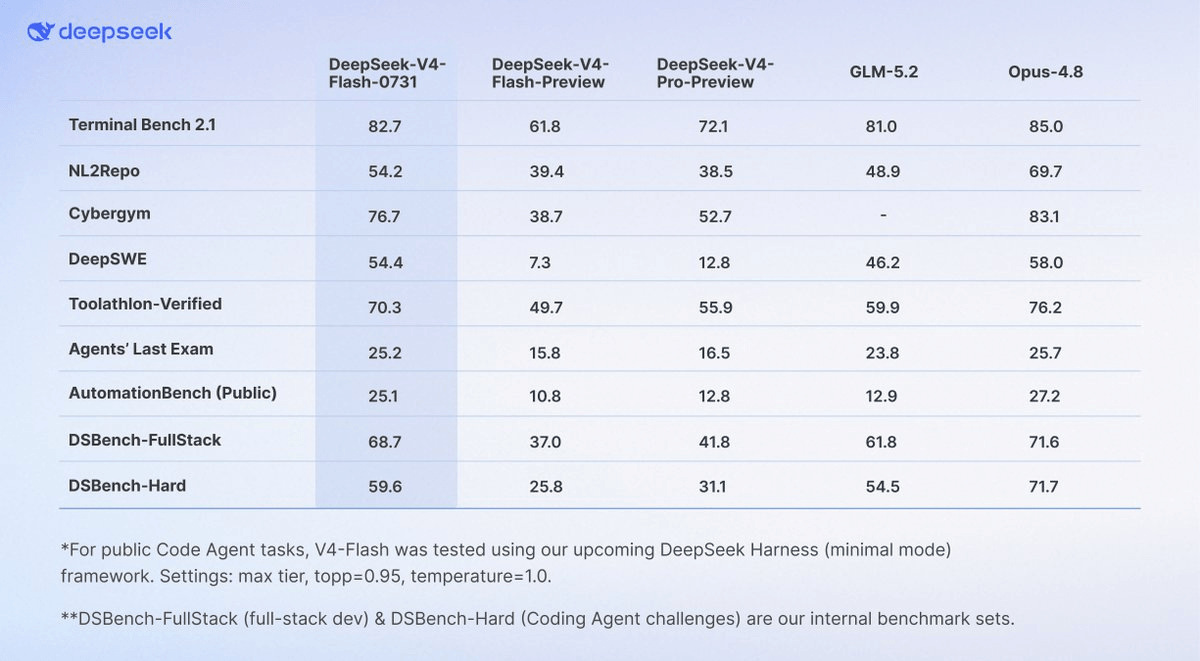
- DeepSeek-V4-Flash-0731 is now in public beta with massively upgraded agent capabilities that DeepSeek claims surpass V4-Pro-Preview on agentic benchmarks.
- Same architecture, new behavior: Model size (284B total, 13B active) and pricing ($0.14/$0.28 per 1M tokens) are unchanged from the preview.
- Native Responses API + Codex support: V4-Flash now works directly as a backend for OpenAI Codex CLI without custom adapters.
- Strong coding benchmark scores: V4-Flash hits 79% on SWE-bench Verified at $0.28/M output — roughly 1/90th the price of Claude Opus 4.8 (88.6%).
- Limitations remain: Text-only (no multimodal), trails frontier models on PhD-level reasoning, and lags V4-Pro on long-horizon multi-step agent tasks.
- V4-Pro GA is next: Today's update only touches the Flash API; the official V4-Pro release is described as coming "ASAP."
DeepSeek pushed DeepSeek-V4-Flash-0731 into public beta with the same architecture and parameter count as the preview, but with agent capabilities strong enough that DeepSeek claims Flash now outperforms V4-Pro-Preview on agentic benchmarks. Flash is the smaller, cheaper model in the family, so that claim carries real weight.
What shipped
The update delivers significantly enhanced agent capabilities, with benchmark results DeepSeek describes as far exceeding V4-Pro-Preview. The DeepSeek API now supports both V4-Pro and V4-Flash through the OpenAI ChatCompletions interface and the Anthropic interface. To switch, set the model name to deepseek-v4-flash. No migration is required if you were already on the preview.
Two additions matter specifically for developers building coding agents:
- Native Responses API support: V4-Flash now speaks the OpenAI Responses API format natively, the same protocol used by tools like OpenAI Codex CLI.
- Codex integration: Codex sends OpenAI Responses requests to Moon Bridge, which routes them to DeepSeek V4. V4-Flash becomes a drop-in backend for Codex-based workflows without custom adapters.
The architecture
DeepSeek V4 Flash is an efficiency-optimized Mixture-of-Experts model with 284B total parameters and 13B activated parameters per token, supporting a 1M-token context window. MoE means only a fraction of the network fires on any given token, keeping inference fast and cheap while retaining the capacity of a much larger model.
The model uses a hybrid attention architecture combining Compressed Sparse Attention (CSA) and Heavily Compressed Attention (HCA), which is what makes a 1M-token context window economical to serve at these prices. Both V4-Pro and V4-Flash support three reasoning effort modes, so you can dial the thinking budget up or down based on task complexity and cost tolerance.
Benchmark performance
On SWE-bench Verified, which measures how well a model autonomously fixes real GitHub issues and serves as the closest public proxy for production coding-agent performance, Flash scores 79.0%. That puts it within 1.6 points of V4-Pro's 80.6%. The agent-focused training in the 0731 release targets multi-step tasks specifically, so that gap may narrow further.
Artificial Analysis clocked Flash at 83.6 tokens per second with a 1.04-second time to first token on DeepSeek's hosted API, well above the median for open-weight models of comparable size.
Where Flash still trails:
- Complex reasoning: Flash scores below Pro on HLE (Humanity's Last Exam, a PhD-level cross-domain reasoning benchmark), and both trail Gemini 3.1 Pro (44.4%) and Claude Opus 4.7 (46.9%). For complex scientific analysis, advanced mathematics, or expert-level research synthesis, closed-source frontier models hold a measurable lead.
- Long-horizon agentic tasks: V4-Flash trails by 8 to 10 points on agentic evaluations. DeepSeek positions Flash as on par with Pro for simple agent tasks but acknowledges that multi-step workflows with 10+ tool calls and deep factual recall are where Pro pulls ahead.
- Multimodal input: Both V4-Flash and V4-Pro are text-only. DeepSeek has said multimodal capabilities are in development, but no timeline has been published.
Pricing
API pricing is $0.14 per million input tokens and $0.28 per million output tokens, with cached input at $0.0028 per million. That cache hit price makes repeated system prompts or long shared contexts nearly free in practice. For comparison, V4-Pro-Max scores 80.6% on SWE-bench Verified at $0.87 per million output tokens. Claude Opus 4.8 scores 88.6% at $25 per million output tokens. Flash at $0.28 per million output sits at roughly one-third of Pro's price and one-ninetieth of Opus 4.8's, while delivering 79%+ on the same coding benchmark.
Who should use this
The 0731 update is most relevant if you are building or running:
- Coding agents using Codex CLI, where native Responses API support removes the translation layer
- High-volume pipelines where cost per call matters
- Long-context workloads requiring a 1M-token window, larger than 96% of tracked models
- Self-hosted inference, where Pro's 1.6T total parameters require multi-node inference even quantized, and Flash's 284B is the practical target
Getting started with the API:
from openai import OpenAI
client = OpenAI(
    api_key="your-deepseek-api-key",
    base_url="https://api.deepseek.com"
)
response = client.chat.completions.create(
    model="deepseek-v4-flash",
    messages=[{"role": "user", "content": "Fix the bug in this function..."}]
)
print(response.choices[0].message.content)
What comes next
This update only upgrades the V4-Flash API. The V4-Pro API and the app and web models are unchanged, with the official V4-Pro GA release expected soon. For teams running the most demanding agentic workloads, that Pro release is worth watching. For the majority of production coding pipelines, Flash at this price-to-performance ratio is already a strong default. See the official Codex integration docs and the Hugging Face model card for setup details.
Comments
