
DeepSeek's Tiny 1.3B Coder Beats StarCoder Running Fully on Your Hardware
DeepSeek's 1.3B instruction-tuned code model offers local, commercial-friendly deployment with 16K context and 80+ language support
 Pro
Takeaways
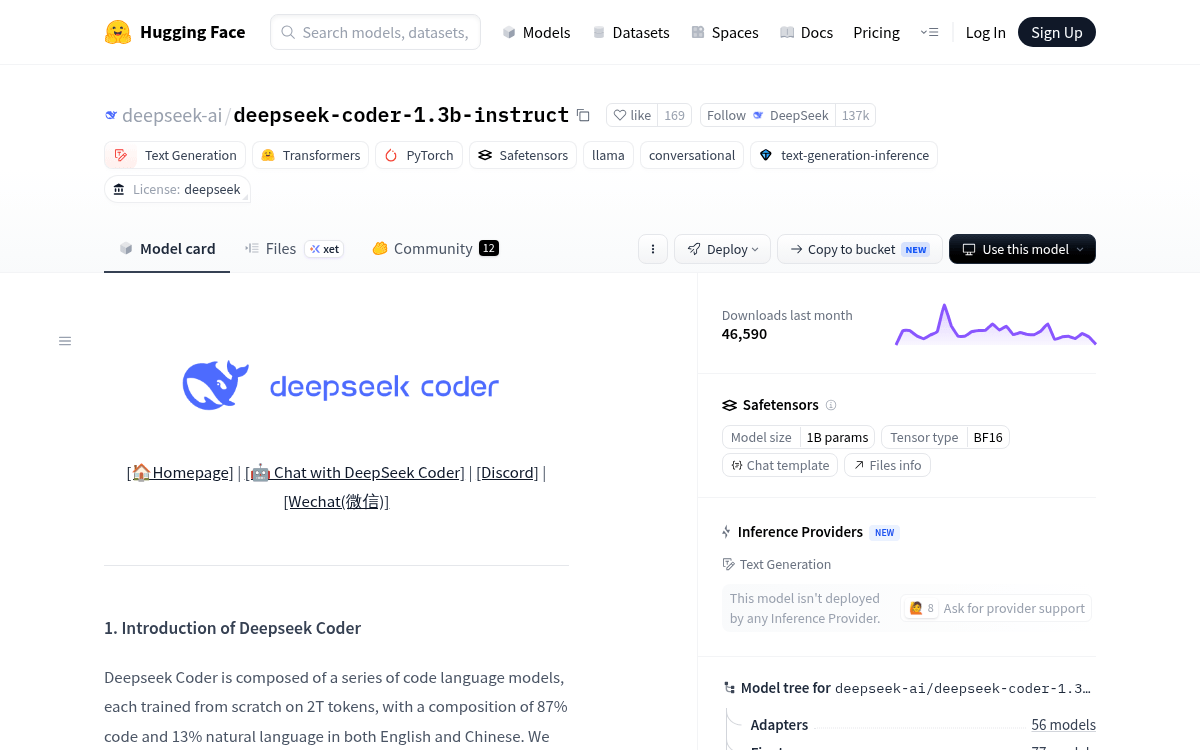
- DeepSeek-Coder-1.3B-Instruct is a compact, commercially licensed coding model available free on Hugging Face with 46K+ downloads.
- Trained from scratch on 2 trillion tokens (87% code), then instruction-tuned on 2B additional tokens for chat-style code generation.
- Scores 65.2% on HumanEval Python in instruct mode, outperforming similarly sized models like StarCoder-1B.
- Supports 80+ programming languages and a 16K token context window for project-level code completion and fill-in-the-middle infilling.
- Best suited for local deployment, IDE plugins, CI/CD pipelines, and fine-tuning on narrow domains like text-to-SQL.
- Lags behind the 6.7B and 33B siblings on complex tasks; aggressive quantization (Q2_K) can degrade output quality.
DeepSeek-Coder-1.3B-Instruct is a compact, instruction-following code model that sits at the smallest end of DeepSeek's coding lineup. With over 46,000 downloads and 3,100+ likes on Hugging Face, it has quietly built a real following among people who want a capable coding assistant they can run locally, fine-tune cheaply, or embed in a product without paying per token.
Tiny model, serious training
The DeepSeek Coder series is composed of code language models trained from scratch on 2 trillion tokens, with a composition of 87% code and 13% natural language in both English and Chinese. That is a massive data budget for any model, let alone a 1.3B parameter one. The instruct variant is initialized from the deepseek-coder-1.3b-base and then fine-tuned on 2 billion tokens of instruction data.
The training dataset is composed of 87% source code, 10% English code-related natural language corpus, and 3% code-unrelated Chinese natural language. The English corpus includes materials from GitHub Markdown and StackExchange, to improve understanding of code-related concepts and handle tasks like library usage and bug fixing. The result is a model that understands not just syntax but the surrounding context of how code is actually written and discussed.
What it can do
The model uses a window size of 16K and a fill-in-the-blank task, supporting project-level code completion and infilling tasks. Fill-in-the-blank (also called Fill-in-the-Middle, or FIM) means the model can insert code into the middle of an existing file, not just append to the end, which is essential for real editor integrations.
- Code completion and generation across over 80 programming languages
- Project-level infilling with a 16K token context window, enabling cross-file reasoning
- Instruction following for natural-language-driven code generation ("write me a quicksort in Python")
- Code review and suggestions for improvement
- Multi-turn dialogue for iterative development tasks
- Fine-tuning base for domain-specific tasks like text-to-SQL or API wrappers
The benchmark picture
The numbers tell a clear story about where this model sits in the hierarchy. On HumanEval (Python), the Instruct-1.3B scores 65.2%, while the Instruct-6.7B reaches 78.6% and the Instruct-33B hits 79.3%. HumanEval measures the fraction of hand-written Python problems a model can solve correctly on the first try.
Scaling behavior is consistent: HumanEval accuracy increases from 34.8% at 1.3B to 49.4% at 6.7B and 56.1% at 33B for the base models, while fill-in-the-middle exact match climbs from 70.4% at 1.3B to 80.7% at 6.7B. So the 1.3B is meaningfully behind the larger siblings, but it punches above its weight class for its size.
In head-to-head comparisons against similarly sized models, DeepSeek-Coder-1.3B outperforms StarCoder-1B. On the Python benchmark, DeepSeek-Coder achieves 30.5% Pass@1 compared to 16.0% for StarCoder.
Where it falls short
While larger models like the 6.7B consistently outperform the 1.3B, neither meets the full demands of real-world development tasks. Complex multi-file refactors, intricate algorithmic reasoning, and tasks requiring deep architectural understanding are better served by the 6.7B or 33B variants.
- Complex codebases: struggles with large-scale, multi-file repository understanding compared to bigger models
- Specialized APIs: lower scores on domain-specific benchmarks highlight the difficulty of generating code that correctly uses specialized APIs and library conventions
- Security by default: baseline outputs can exhibit elevated security defect rates (36.35%) and semantic error rates (60.09%) without additional tooling like static analysis feedback loops
- Quantization sensitivity: performance can degrade when using aggressive quantization methods like Q2_K, which can result in significant quality loss
Getting it running
The model is available right now on Hugging Face under a license that permits both research and commercial applications. It loads with standard Transformers in a few lines:
from transformers import AutoTokenizer, AutoModelForCausalLM
import torch
tokenizer = AutoTokenizer.from_pretrained(
    "deepseek-ai/deepseek-coder-1.3b-instruct",
    trust_remote_code=True
)
model = AutoModelForCausalLM.from_pretrained(
    "deepseek-ai/deepseek-coder-1.3b-instruct",
    trust_remote_code=True,
    torch_dtype=torch.bfloat16
).cuda()
messages = [{"role": "user", "content": "Write a binary search in Python."}]
inputs = tokenizer.apply_chat_template(
    messages, add_generation_prompt=True, return_tensors="pt"
).to(model.device)
outputs = model.generate(
    inputs, max_new_tokens=512, do_sample=False,
    top_k=50, top_p=0.95, num_return_sequences=1,
    eos_token_id=tokenizer.eos_token_id
)
print(tokenizer.decode(outputs[0][len(inputs[0]):], skip_special_tokens=True))
There are also various sizes available ranging from 1B to 33B, so if the 1.3B proves too limited for your use case, you can swap in the 6.7B or 33B with the same API. The community has also produced GGUF quantizations for CPU-friendly inference via llama.cpp, and the model has spawned 55 adapter fine-tunes, 74 full fine-tunes, and 16 quantizations on Hugging Face alone.
Who actually reaches for this
Smaller models like the 1.3B are best suited for local deployment and lightweight tasks, while larger models provide higher precision for large-scale or multi-file repository understanding. The sweet spot is anywhere you need a coding assistant that runs entirely on your hardware, with no API costs and no data leaving your machine.
Practical scenarios where it shines:
- IDE plugins and local copilots where latency matters and cloud round-trips are unacceptable
- CI/CD pipelines for automated code review or docstring generation on every commit
- Fine-tuning base for narrow domains like text-to-SQL generation or API wrapper creation, leveraging the 16K context window for cross-file and long-script reasoning
- Edge and resource-constrained environments where a 33B model simply cannot fit
- Research and experimentation where you want a fast, cheap iteration loop before scaling up
The model is free to use and commercially licensed. The GitHub repository contains training details, evaluation scripts, and fine-tuning guides. For teams that have been renting coding intelligence from a cloud API, this is a credible on-premises alternative at the smallest possible footprint.