

DeepSeek's DSpark Makes V4-Flash Run 85% Faster for Everyone
DeepSeek open-sources DSpark, a speculative decoding module that makes DeepSeek-V4-Flash up to 85% faster per user with zero quality loss
 PRO
- DSpark is not a new model — it's the DeepSeek-V4-Flash checkpoint with a speculative decoding module attached, making generation 60-85% faster per user.
- Zero quality loss — speculative decoding preserves the target model's output distribution exactly; accepted tokens are mathematically identical to standard sampling.
- DeepSpec also released — an MIT-licensed training framework for building custom draft models on Qwen3 and Gemma targets, with full data prep, training, and eval pipelines.
- DeepSeek-V4-Flash is a 284B MoE model (13B active) with a 1M-token context window, priced at $0.14/M input and $0.28/M output via the API.
- Best-in-class coding — V4-Pro-Max scores 93.5% on LiveCodeBench and a 3206 Codeforces rating, but trails on factual recall vs. Gemini-3.1.
- API users get it free — DSpark is already running in DeepSeek's production stack; self-hosters can deploy via vLLM or SGLang.
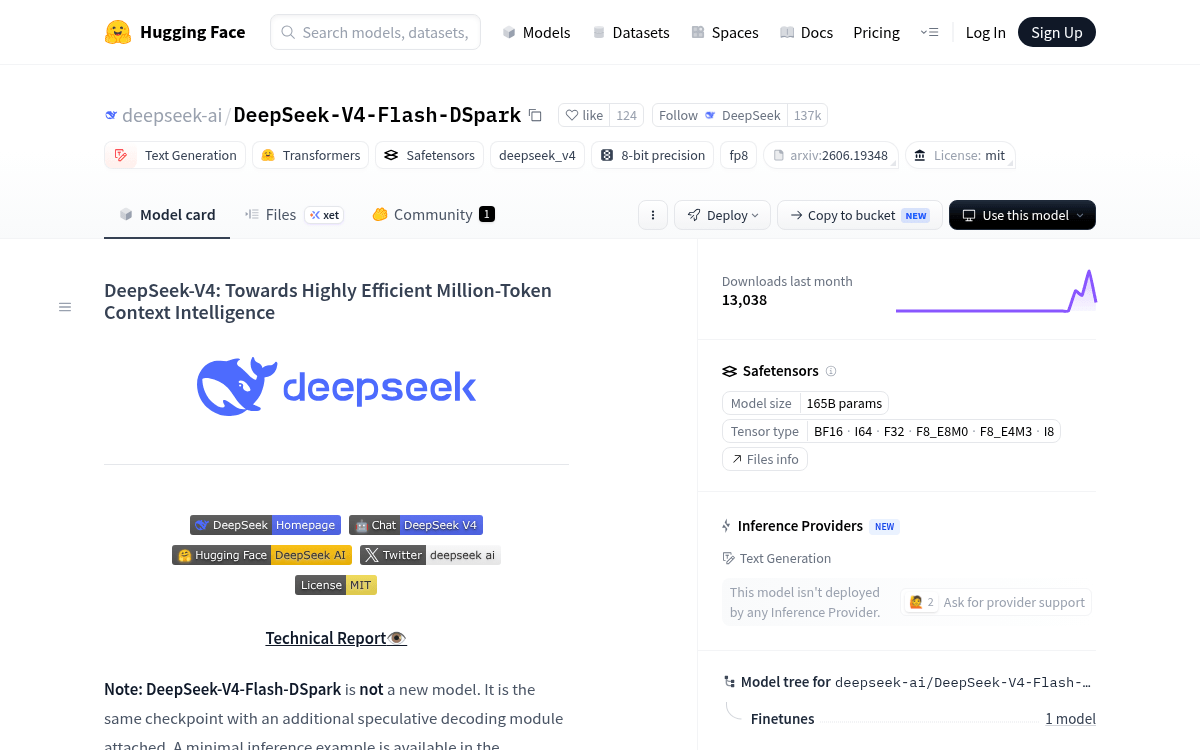
DeepSeek-V4-Flash-DSpark is not a new model. It is the same DeepSeek-V4-Flash checkpoint with an additional speculative decoding module attached. But that framing undersells what actually shipped. Alongside the model checkpoint, DeepSeek open-sourced DeepSpec, a full training and evaluation framework for speculative decoding draft models, along with a paper detailing the technique. The result is a rare release that is simultaneously a production optimization, an open-source research contribution, and a signal about where the inference efficiency race is heading.
What DSpark actually is
Speculative decoding is an inference technique where a smaller "draft" model generates candidate tokens, and the larger target model verifies them in parallel. Accepted tokens come for free; rejected tokens fall back to standard autoregressive sampling. The net result is more tokens per unit of wall-clock time at the same output quality.
The challenge is that naive speculative decoding involves a tradeoff: fully parallel drafters are fast but generate incoherent token sequences that get rejected. Sequential drafters produce better chains but are slow. DSpark, which stands for Confidence-Scheduled Speculative Decoding with Semi-Autoregressive Generation, tries to sit between those two extremes with two key moves:
- Semi-autoregressive generation: Most drafting stays parallel for speed, but a lightweight sequential processing block lets drafted tokens carry context from one position to the next, producing longer accepted sequences.
- Hardware-aware confidence scheduling: At moderate load, the scheduler runs roughly 4-6 verified tokens per request. As concurrency rises, it trims that budget to protect throughput. The system is not just asking whether it can draft more tokens, but whether those tokens are worth spending scarce target-model compute on right now.
This story is for Pro members
You've reached the end of the free preview. Upgrade to AlphaSignal Pro to read the full article - and everything else behind the paywall.
Comments
