
DeepSeek's Coder-7B Trades Code Benchmarks for Stronger Math and Language Skills
DeepSeek-Coder-7B-Instruct-v1.5 blends code and general reasoning in a 7B open-source model that runs locally and supports commercial use
 Pro
Takeaways
- What it is: DeepSeek-Coder-7B-Instruct-v1.5 is an open-source, commercially licensed 7B code model with strong math and NL reasoning.
- Key tradeoff: Slightly lower raw code scores vs. v1 (+10 pts GSM8K, +12 pts MMLU) by starting from a general LLM base.
- Training: Continued pre-training on 2T tokens from DeepSeek-LLM-7B, then fine-tuned with the novel Inverse-Instruct pipeline on 2B tokens.
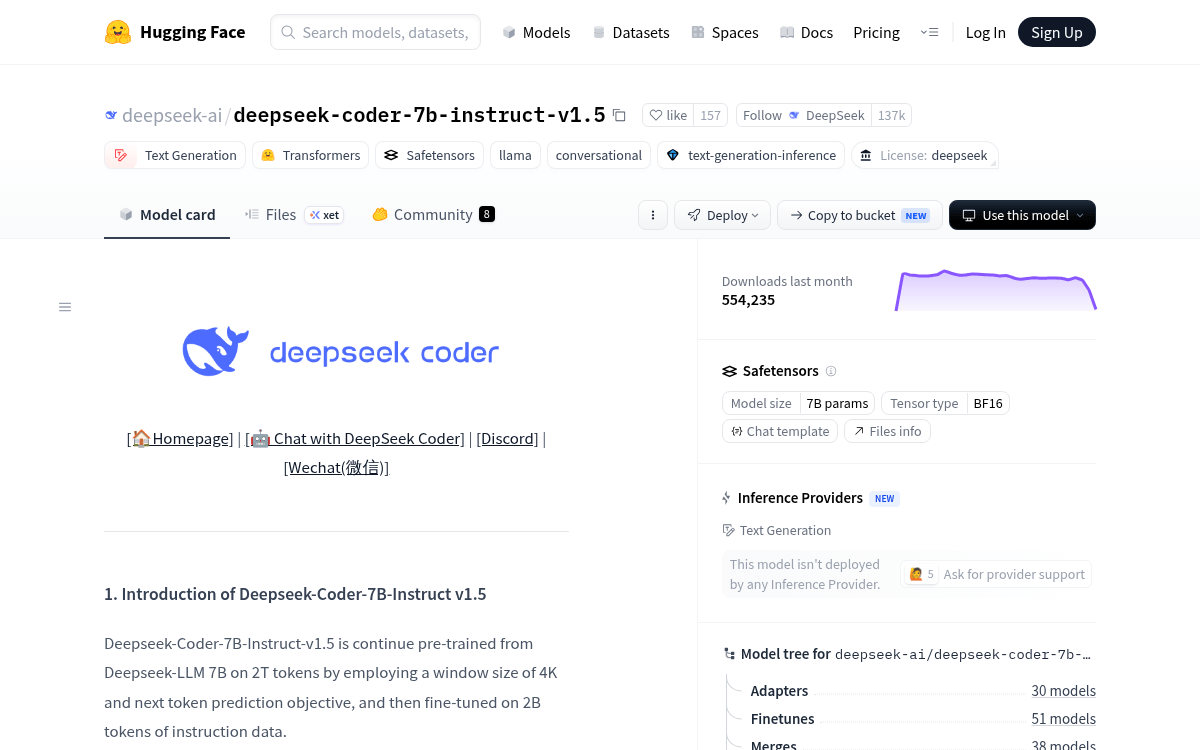
- Availability: Free on Hugging Face with 554K+ downloads; supports Transformers, vLLM, Ollama, and LM Studio.
- Limitation: 4K context window makes it unsuitable for large file or cross-repo tasks; hard coding problems still lag GPT-4.
- Best for: Agentic pipelines and coding assistants that need code generation, math reasoning, and natural language explanation in one model.
DeepSeek-Coder-7B-Instruct-v1.5 is a 7-billion-parameter code model that does something most coding LLMs don't: it trades a bit of raw code benchmark performance for dramatically better math reasoning and natural language understanding. The result is a model that can handle the full stack of a developer's day, not just isolated coding puzzles, and it's free to use commercially.
The model is continue pre-trained from DeepSeek-LLM 7B on 2 trillion tokens, using a 4K context window and a next-token prediction objective, then fine-tuned on 2 billion tokens of instruction data. That starting point matters: rather than training a code model from scratch on code alone, DeepSeek built v1.5 on top of a strong general-purpose language model and then saturated it with code.
The core bet: general LLMs make better code models
DeepSeek-Coder-v1.5 not only maintains its predecessor's high-level coding performance but also exhibits enhanced natural language comprehension. This advancement underscores their belief that the most effective code-focused LLMs are those built upon robust general LLMs. The logic is simple: a model that truly understands your instructions in natural language will write better code to fulfill them.
The DeepSeek-Coder-Base-v1.5 model, despite a slight decrease in coding performance, shows marked improvements across most tasks compared to the original DeepSeek-Coder-Base model. In particular, in the Math Reasoning and Natural Language categories, DeepSeek-Coder-Base-v1.5 significantly outperforms its predecessor across all benchmarks.

The numbers make the tradeoff concrete. On HumanEval (Python code generation), the instruct v1.5 scores 64.1% versus 66.1% for the original instruct model, a small regression. But on GSM8K (grade-school math word problems solved via code), v1.5 jumps from 62.8% to 72.6%. On MMLU (a broad knowledge benchmark), it goes from 37.2% to 49.5%. On HellaSwag (commonsense reasoning), from 55.0% to 72.2%. That's a meaningful upgrade in general intelligence at the cost of roughly 2 points on pure code benchmarks.
How it was built
The training recipe for v1.5 is a deliberate two-stage process:
- Continued pre-training: The model is continued from DeepSeek-LLM-7B with a 2T-token code and general language mix, using a single 4K context window. The data mix is roughly 70% source code, 10% Markdown and StackExchange, 7% natural language related to code, 7% natural language related to math, and 6% bilingual Chinese-English text.
- Instruction fine-tuning: The model leverages a two-stage instruction tuning process, including an innovative Inverse-Instruct pipeline and pseudo-feedback optimization, to achieve competitive pass@1 scores.
The Inverse-Instruct pipeline is the most interesting part of the fine-tuning story. Instead of only pairing instructions with code, starting from an instruction-code dataset of 110K pairs, all code blocks are extracted, cleaned, and summarized by the base model into 10 diverse instructions per code snippet. This generates a much richer and more varied set of training signal, teaching the model to understand many different ways a human might ask for the same piece of code.
What it's good at
The model covers a wide surface area for a 7B model:
- Code generation across languages: DeepSeek-Coder-Base-7B reaches the performance of CodeLlama-34B on multilingual code benchmarks, punching well above its weight class.
- Math reasoning via code: The model solves math problems by generating programs, scoring 72.6% on GSM8K and 34.1% on the harder MATH benchmark in instruct form.
- Natural language understanding: With a 49.5% MMLU score, it's competitive with general-purpose models at this scale, not just code-specialized ones.
- Multi-turn dialogue: DeepSeek-Coder-Instruct is developed by enhancing the base model through instruction-based fine-tuning using high-quality data, comprising helpful and impartial human instructions structured by the Alpaca Instruction format.
- Chain-of-Thought (CoT) prompting: Adding a step-by-step outline directive before the coding prompt measurably improves performance on harder problems.
Where it falls short
Performance on high-difficulty, few-shot, or compositional tasks remains below the leading proprietary LLMs. On LeetCode-style hard problems, even the 33B instruct variant only manages around 9% pass@1, compared to GPT-4-Turbo's 25%. The 7B v1.5 model also operates with a 4K context window, which is tight for large codebases. For code-centric long context and cross-repo use, the 16K/FIM variant is preferred; for interleaved code, natural language, and math tasks, v1.5 is optimal.
Getting it running
The model is available on Hugging Face with over 554,000 downloads and is licensed for commercial use under the DeepSeek model license. You can run it locally with Transformers in a few lines:
from transformers import AutoTokenizer, AutoModelForCausalLM
tokenizer = AutoTokenizer.from_pretrained(
    "deepseek-ai/deepseek-coder-7b-instruct-v1.5",
    trust_remote_code=True
)
model = AutoModelForCausalLM.from_pretrained(
    "deepseek-ai/deepseek-coder-7b-instruct-v1.5",
    trust_remote_code=True
).cuda()
messages = [{"role": "user", "content": "Write a quicksort in Python."}]
inputs = tokenizer.apply_chat_template(
    messages, add_generation_prompt=True, return_tensors="pt"
).to(model.device)
outputs = model.generate(inputs, max_new_tokens=512, do_sample=False)
print(tokenizer.decode(outputs[0][len(inputs[0]):], skip_special_tokens=True))
For production serving,
the model supports efficient local deployment with INT8 quantization and low-latency inference.
You can also spin it up with vLLM using vllm serve "deepseek-ai/deepseek-coder-7b-instruct-v1.5", which gives you an OpenAI-compatible API endpoint. Quantized versions are available for llama.cpp, Ollama, and LM Studio if you need to run it on consumer hardware.
Who should reach for this
This model is a strong fit if you need a single model that can handle code generation, explain its own output in plain English, and reason through math problems, all without hitting an API. The 4K context window is the main constraint to plan around. If your use case involves large files or repo-level context, the original DeepSeek-Coder 6.7B with its 16K window is the better pick. But for agentic pipelines, coding assistants, or educational tools where the model needs to both write code and explain its reasoning, v1.5 is the more capable choice at this size.