

DeepSeek LLM 7B Doubles LLaMA 2's Code Score on a 2T Token Budget
DeepSeek's 7B base model, trained on 2T tokens from scratch, is a commercially free, bilingual foundation for fine-tuning and research
 PRO
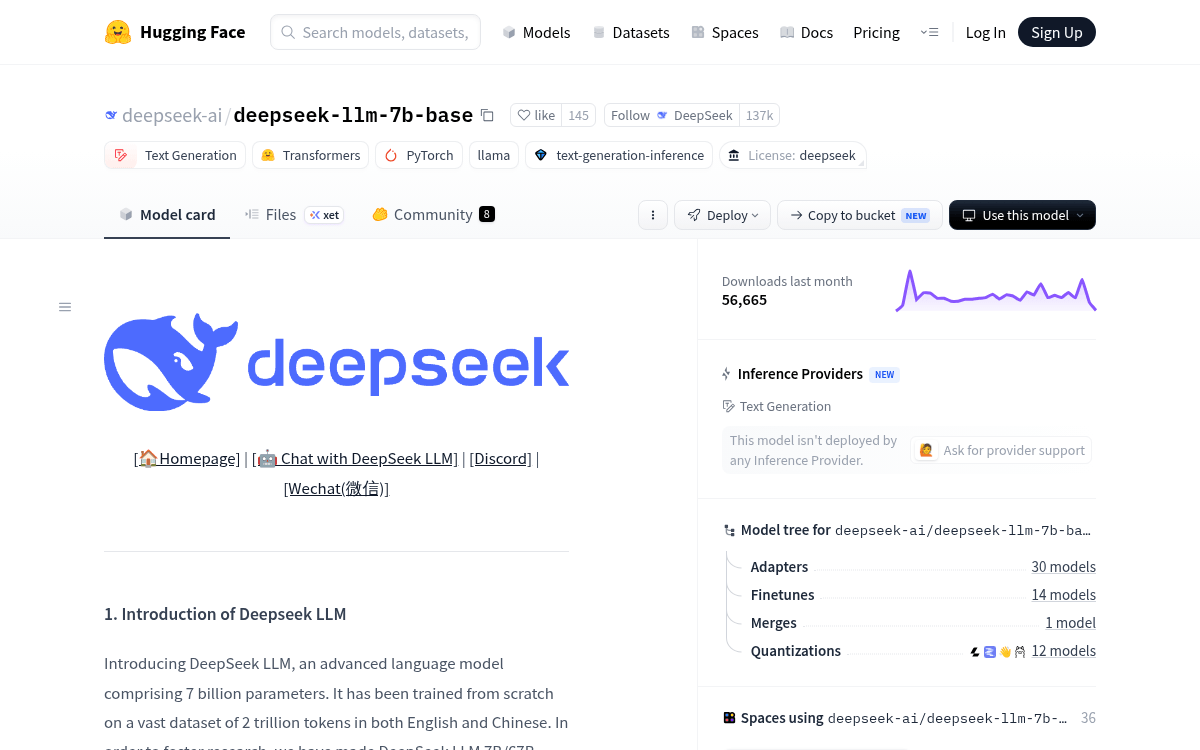
PRO- Open-source base model: DeepSeek LLM 7B Base is a 7B-parameter model trained from scratch on 2 trillion English and Chinese tokens, available for free commercial use.
- Strong code generation: Scores 26.2 on HumanEval (0-shot), nearly double LLaMA 2 7B's 14.6, with large gains on Chinese benchmarks too.
- Scaling-law guided training: DeepSeek derived their own scaling laws showing higher data quality favors investing more compute in model size, not data volume.
- Broad deployment support: Works with Transformers, vLLM, SGLang, llama.cpp, Ollama, and LM Studio; 12 quantized variants available on Hugging Face.
- Limitations: Knowledge cutoff at May 2023, weak on non-English/Chinese languages, and requires fine-tuning for instruction-following tasks.
- Ecosystem traction: 56,700+ downloads, 7.1k GitHub stars, with 29 adapters and 14 fine-tunes already built on top of it.
DeepSeek LLM 7B Base is a fully open-source, 7-billion-parameter language model trained from scratch on 2 trillion tokens of English and Chinese text. It is the smaller sibling in DeepSeek's first-generation LLM family, sitting alongside the 67B version, and it is one of the most downloaded foundation models in its class on Hugging Face, with over 56,000 downloads and 3,100+ likes. If you are building a pipeline that needs a capable, commercially licensable base model you can fine-tune on your own data, this is worth knowing about.
Built on Scaling Laws, Not Guesswork
The rapid growth of open-source LLMs has been remarkable, but the scaling laws described in prior literature presented conflicting conclusions, creating uncertainty around how to efficiently scale models. DeepSeek's team dug into this directly, arriving at their own findings that guided the design of models in two sizes: 7B and 67B. The result is not just a model release, but a principled engineering effort.
A key finding from their scaling law research: data quality significantly influences the optimal strategy for allocating compute between model size and data size. Higher-quality data leads to a larger model-scaling exponent, meaning it becomes more beneficial to invest compute in scaling the model rather than simply adding more tokens. This insight shaped how they built their training pipeline.
What's Under the Hood
DeepSeek LLM 7B Base is trained from scratch on a massive dataset of 2 trillion tokens, supporting both English and Chinese. The architecture uses Rotary Embeddings for positional encoding, and the 7B model is a 30-layer network using standard Multi-Head Attention (MHA), while the larger 67B variant uses Grouped-Query Attention (GQA) to reduce inference costs.
The training data was carefully curated, not just scraped raw:
- The training process involved extensive datasets covering a wide array of topics and languages, with diverse sourcing to ensure comprehensive language understanding.
This story is for Pro members
You've reached the end of the free preview. Upgrade to AlphaSignal Pro to read the full article - and everything else behind the paywall.
Comments
