

DeepSeek Harness Hits 160K Stars Challenging Claude Code's Closed Stack
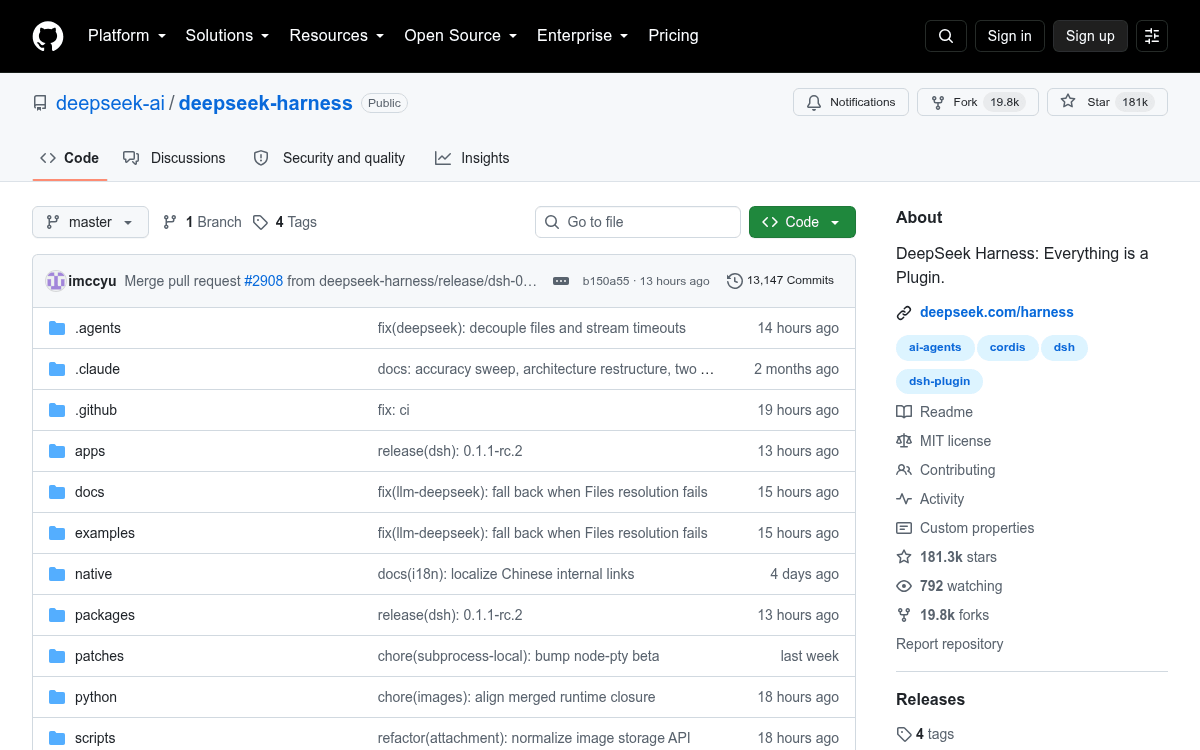
DeepSeek open-sourced dsh, a plugin-based coding agent framework where the model, tools, sandbox, UI, and even the agent loop itself are all swappable.

 PRO
PRO- DeepSeek open-sourced deepseek-harness, a plugin-based coding agent framework under MIT license.
- Launch with one command:
npx @deepseek-ai/dsh webboots a local web UI on port 3080. - Model, tools, sandbox, UI, and agent loop are all swappable plugins via Cordis.
- Compatible with DeepSeek, Claude, GPT, Gemini, or any custom endpoint through
ctx.llmadapters. - Repo has crossed 160,000 stars in days, with a durable event log enabling fork, resume, and replay.
- Status is developer preview with rapidly breaking APIs, so pin versions before production use.
DeepSeek quietly dropped an open-source coding agent framework and it has already blown past 160,000 GitHub stars. DeepSeek Harness, or dsh, positions itself as the raw layer underneath products like Claude Code or Cursor, released under an MIT license that lets you wire it up to whatever model provider you want.
Everything is a plugin, including the model adapter, the tool registry, the session log, and the agent loop itself, so every part is replaceable from configuration. No privileged core sits waiting to be forked. You extend the harness by dropping another plugin next to the existing ones and reloading.
One command, local web UI
If you have Node installed, you can boot the full web interface with a single command:
npx @deepseek-ai/dsh webThat starts the Web UI at http://127.0.0.1:3080 by default and opens it in the default browser for a local launch. A headless profile handles one-shot runs with no server, and a Python SDK drives the agent programmatically over JSON-RPC when running benchmarks.
Model support is provider-agnostic. Point it at DeepSeek's own APIs, Claude, GPT, Gemini, or any other endpoint by registering an adapter on the ctx.llm service. No vendor lock, no monthly subscription attached to the harness itself.
The Cordis trick
What makes the plugin story more than marketing is that dsh is built on Cordis, a spatiotemporal composition framework. Plugins contribute services, typed events, and reversible effects to a shared context. When a plugin unloads, its registrations unwind automatically. That property is what makes swapping the agent loop or the sandbox at runtime actually safe rather than a stack of monkey patches.
This story is for Pro members
You've reached the end of the free preview. Upgrade to AlphaSignal Pro to read the full article - and everything else behind the paywall.
Comments
