
DeepSeek Drops V4-Pro-Base Open Weights Behind Its 1.6T Flagship Model
DeepSeek drops the raw base weights for its 1.6T-parameter V4-Pro, unlocking fine-tuning on the strongest open-source foundation model built to date
 Pro
Takeaways
- Base weights released: DeepSeek drops the raw pre-trained checkpoint for DeepSeek-V4-Pro-Base, a 1.6T-parameter MoE model, enabling fine-tuning and alignment research.
- Strongest open foundation model: V4-Pro-Base outperforms V3.2-Base and V4-Flash-Base across knowledge, reasoning, coding, and long-context benchmarks.
- Radical attention efficiency: New CSA+HCA hybrid attention cuts KV cache to 10% and inference FLOPs to 27% of V3.2 at 1M-token context.
- Trained on Huawei silicon: V4 is the first frontier model confirmed to run on Huawei Ascend 950PR chips, bypassing NVIDIA entirely for training.
- Muon optimizer at scale: DeepSeek replaces AdamW with the Muon optimizer across 33 trillion training tokens -- the largest production deployment of Muon to date.
- MIT license, massive hardware bar: Weights are free and commercially usable, but the 1.6TB model file requires serious cluster infrastructure to self-host.
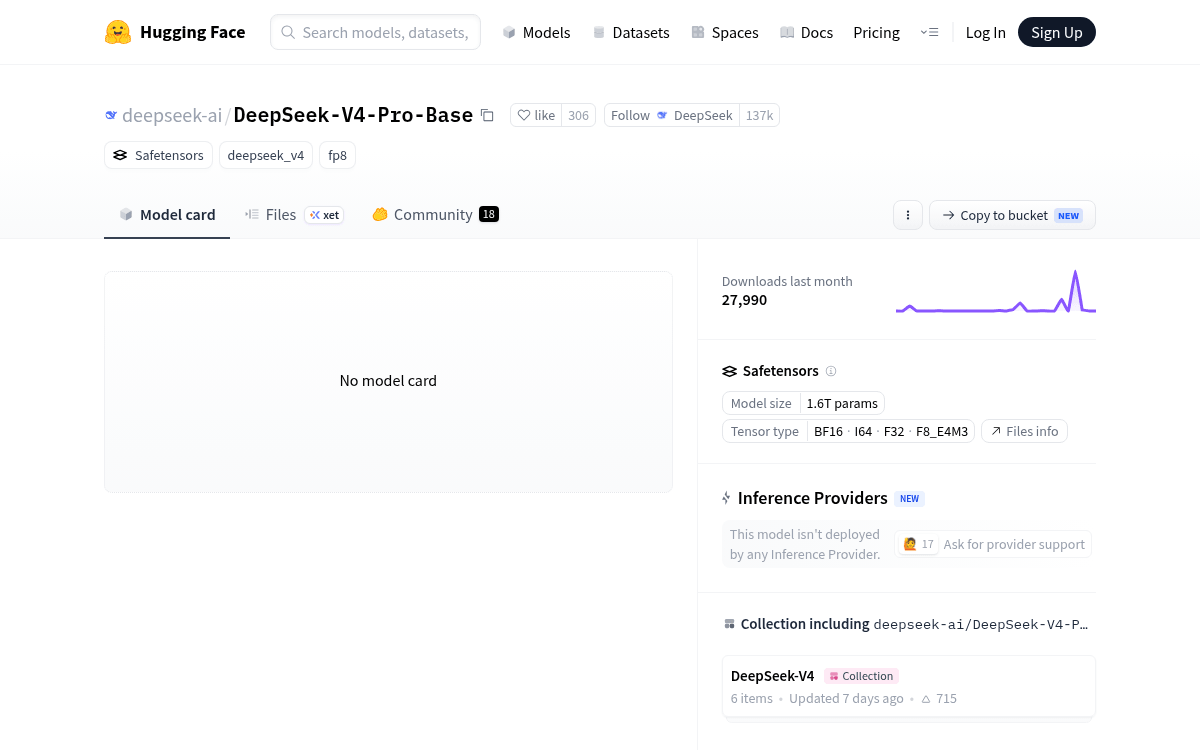
DeepSeek-V4-Pro-Base just landed on Hugging Face, releasing the unaligned pre-trained weights behind DeepSeek's flagship V4-Pro model. This is the raw foundation before any instruction tuning or reinforcement learning from human feedback has been applied -- the kind of checkpoint researchers and fine-tuning teams actually want. It joins the already-released instruct variant and completes the full V4-Pro model family.
The model behind the weights
DeepSeek-V4-Pro is a Mixture-of-Experts (MoE) language model with 1.6T total parameters and 49B activated per token, supporting a context length of one million tokens. MoE means the model has a large pool of specialized sub-networks ("experts"), but only a small fraction of them activate for any given token -- so you get the knowledge capacity of a 1.6T model at roughly the compute cost of a 49B dense one.
The V4 series is DeepSeek's first two-tier lineup and introduces a new architecture -- the first from the lab since V3. DeepSeek-V4-Pro-Base demonstrates a decisive leap in capability, establishing near-universal dominance over both DeepSeek-V3.2-Base and DeepSeek-V4-Flash-Base. With improvements across almost all categories, it reaches new performance highs among DeepSeek base models on the most demanding benchmarks. On knowledge-intensive evaluations, it delivers dramatic gains, while also substantially advancing long-context understanding. On most reasoning and code benchmarks, DeepSeek-V4-Pro-Base also exceeds both previous models -- confirming it as the strongest foundation model in the DeepSeek series.
Three architectural bets that paid off
V4's architecture is a meaningful departure from V3. Three innovations do the heavy lifting:
- Hybrid Attention (CSA + HCA). V4 introduces a two-layer hybrid: Compressed Sparse Attention (CSA) handles long-range token selection via learned sparsity patterns, while Heavily Compressed Attention (HCA) applies extreme rank reduction to the local-window cache. The combined effect is that V4-Pro running a 1M-token prompt consumes 27% of the FLOPs and 10% of the KV cache memory required by V3.2 at the same context length. That is not a marginal improvement -- it is the difference between 1M context being a demo and being a production feature.
- Manifold-Constrained Hyper-Connections (mHC). mHC replaces conventional residual connections -- the plumbing that lets gradients flow cleanly through deep networks. At trillion-parameter scale these can become unstable. DeepSeek's report describes mHC as a reinforcement of residual pathways that keeps signal propagation stable without giving up expressivity. It is the kind of change that does not move benchmarks dramatically on its own, but makes the rest of the training run possible.
- Muon optimizer. Muon, originally proposed by Keller Jordan in 2024, applies orthogonalized matrix updates that converge faster on transformer weights; DeepSeek's adoption at frontier scale is the most prominent production validation of the optimizer to date. DeepSeek trains most of V4 with Muon, which applies Newton-Schulz orthogonalization to the weight updates so that gradient steps stay well-conditioned. Embeddings are trained with the more conventional AdamW. Using Muon for the bulk of the network and AdamW for embeddings is a deliberate split rather than a single global choice.
How it was trained
DeepSeek-V4-Pro was pre-trained on 33 trillion tokens. Both V4-Pro and V4-Flash were pre-trained on more than 32 trillion tokens of diverse, high-quality data -- nearly double DeepSeek-V3's estimated 18T pre-training tokens, representing a substantial investment in training compute and data curation.
V4 applies FP4 Quantization-Aware Training (QAT) to its MoE expert weights and to the CSA indexer, with FP8 used elsewhere. Training the experts directly in a 4-bit aware regime, rather than quantizing only after the fact, keeps the very large expert pool affordable to store and serve while limiting the accuracy loss that naive post-training quantization would cause. The base weights on Hugging Face are stored in FP8 throughout.
Then there is the hardware story. Reuters confirmed in April 2026 that V4 runs on Huawei's Ascend 950PR chips, making it the first frontier-class AI model built on Chinese domestic semiconductor infrastructure. DeepSeek deliberately gave Huawei early optimization access while denying it to NVIDIA and AMD. The training-side shift to Huawei silicon is significant -- it establishes that frontier-class models can now be trained on non-NVIDIA hardware at scale. That changes the geopolitical calculus around US chip export controls. For developers running inference, the open weights work on NVIDIA GPUs, and the API works the same regardless of what hardware runs it.
What the base model is actually for
The instruct variant is what you call via API for chat, coding, or agentic tasks. The base model is a different tool entirely -- it is the pre-RLHF checkpoint researchers use to build new things on top of. The pattern DeepSeek itself established with V3-Base led directly to R1: fine-tune the base with a small amount of cold-start data, apply reinforcement learning, and get a reasoning model. DeepSeek has ignited a wave of open-source innovation, with researchers and developers extending their models in creative ways.
Practically, the base model is the right starting point for:
- Domain-specific fine-tuning (legal, medical, scientific corpora) where you want to inject knowledge before instruction tuning
- Alignment research -- testing new RLHF or DPO recipes on the strongest available foundation
- Building reasoning models in the R1 tradition from a stronger starting point than V3-Base
- Distillation: generating high-quality synthetic data to train smaller, deployable models
That said, V4-Pro-Base carries official weights around 1606 GB -- a 1.6TB-class model file. V4-Pro local deployment is only practical for organizations with significant GPU infrastructure. V4-Flash is the accessible option for individuals and small teams. Most teams fine-tuning on a budget should target a distilled variant and use the V4 API for evaluation and synthetic data generation.
Where the instruct model stands -- and where it falls short
DeepSeek-V4-Pro-Max scores 80.6% on SWE-bench Verified, the highest open-weights entry, tied with Gemini 3.1 Pro. SWE-bench Verified tests autonomous resolution of real GitHub issues -- a much harder bar than synthetic code generation. Per output token, V4-Pro is 28.7x cheaper than Claude Opus 4.8 and 34.5x cheaper than GPT-5.5.
The honest limitations are worth knowing:
- V4-Pro-Max trails Gemini 3.1 Pro on most knowledge-heavy benchmarks (MMLU-Pro, SimpleQA, GPQA Diamond, HLE).
- On DeepSWE, a written-from-scratch, contamination-free benchmark, V4-Pro scores 8% pass@1 versus GPT-5.5 at 70% and Opus 4.7 at 54%. The gap between SWE-bench Verified scores and DeepSWE scores is a reminder to read multiple benchmarks before drawing conclusions.
- DeepSeek V4 Pro excels in syntax completion similarity but underperforms in functional correctness of the same category. This pattern indicates heavier reliance on pattern memorization than true semantic understanding -- V4 Pro often produces code syntactically close to the golden solution but functionally incorrect.
- Claude Opus 4.7 still wins long agentic loops, GPT-5.5 still wins multimodal.
Pricing and access
DeepSeek V4-Pro is the cheapest frontier-class coding model in 2026: $0.435/M input, $0.87/M output (75% cut, now permanent), 80.6% on SWE-bench Verified, 1M-token context, open weights on Hugging Face. DeepSeek announced that the 75% discount that originally launched as a time-boxed promo is now permanent pricing.
The base weights are free to download under the MIT license. For self-hosting the instruct model via API, both models run with a 1M-token context window by default, support JSON output, tool calls, and thinking plus non-thinking modes, and expose 384K max output tokens. The API supports both the OpenAI ChatCompletions format and the Anthropic API format.
To call V4-Pro via the DeepSeek API using the OpenAI SDK:
from openai import OpenAI
client = OpenAI(
    api_key="your_deepseek_api_key",
    base_url="https://api.deepseek.com"
)
response = client.chat.completions.create(
    model="deepseek-v4-pro",
    messages=[{"role": "user", "content": "Explain sparse attention in one paragraph."}],
    temperature=1.0,
    top_p=1.0
)
print(response.choices[0].message.content)
What this means for the field
The biggest change in V4 is the attention stack. The DeepSeek team argues that the quadratic cost of standard attention is now the binding constraint on further progress, especially as models run longer agentic loops and chew through bigger document sets. V4 reshapes attention to attack that cost. The fact that a 1M-token context window now runs at 10% of the KV cache of a standard transformer is not just a DeepSeek story -- it is a signal about where the whole field is heading.
Muon has been getting attention across the research community through 2025, and V4 is the largest production deployment of it to date. For anyone training frontier models at scale, this is the validation data point the community was waiting for. Similarly, the training-side shift to Huawei silicon establishes that frontier-class models can now be trained on non-NVIDIA hardware at scale. Two assumptions that seemed settled -- that AdamW is the optimizer of record and that NVIDIA is the only viable training substrate -- now need to be revisited.
DeepSeek is unusually candid in the tech report about V4's remaining limitations. To minimize risk on the biggest architectural changes (mHC, hybrid CSA and HCA, Muon, FP4), V4 retained many previously validated V3 components. DeepSeek describes the resulting architecture as "relatively complex" and says future versions will try to "distill the architecture down to its most essential designs." That kind of transparency is rare at this scale, and it is exactly what makes the base weights valuable to the research community.