

Datalab's Marker Converts Messy PDFs to Clean AI-Ready Text 8x Faster Than LlamaParse
Marker converts PDFs, DOCX, PPTX, and more into clean Markdown, JSON, or HTML — locally, fast, and with optional LLM-boosted accuracy for RAG and document intelligence pipelines.
 PRO
- Marker is an open-source document converter (36k GitHub stars) that turns PDFs, DOCX, PPTX, XLSX, EPUB, and images into Markdown, JSON, HTML, or RAG-ready chunks.
- Built on a pipeline of three Datalab models: Surya (OCR + layout), Texify (math), and a reading-order model — runs locally on GPU, CPU, or Apple Silicon.
- Benchmarks show it outperforming LlamaParse (cloud) and Docling on both accuracy (LLM score 4.24) and speed (2.84s avg vs 23.35s for LlamaParse).
- Optional
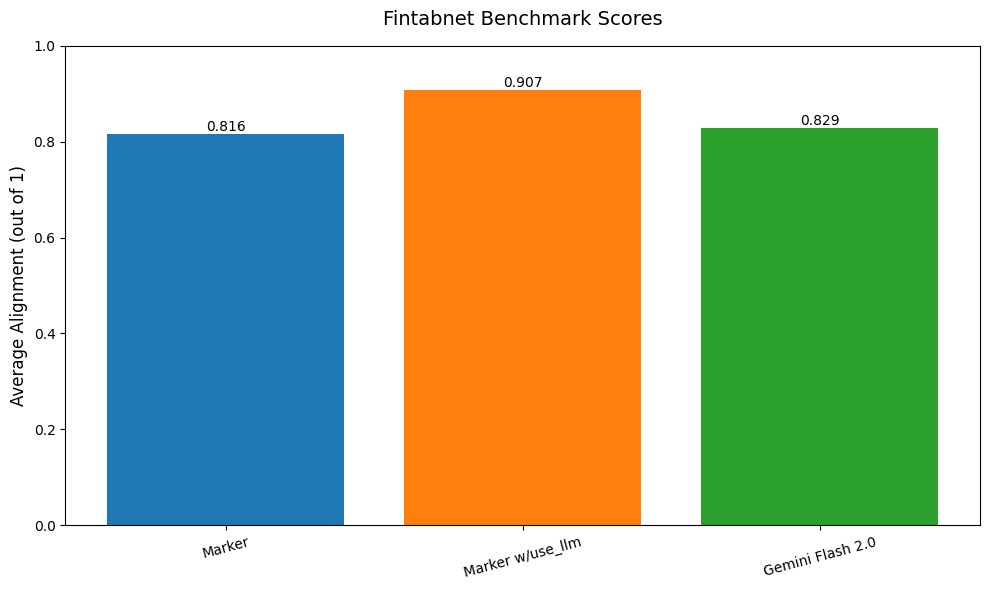
--use_llmflag layers Gemini, Claude, OpenAI, or Ollama on top for harder cases — boosts table extraction from 0.816 to 0.907 on FinTabNet. - Free for research and startups under $2M revenue (GPL-3.0 code, Open RAIL-M model weights); commercial use requires a paid license.
- Install with
pip install marker-pdf; managed API available at datalab.to with $5 free credits.
Marker has quietly become one of the most-starred document conversion tools on GitHub, sitting at 36,000+ stars with 2,500 forks. The pitch is simple: take any document , PDF, DOCX, PPTX, XLSX, EPUB, or image , and get back clean Markdown, JSON, HTML, or chunked output that your LLM pipeline can actually use. No cloud upload required, no vendor lock-in, and a pipeline that runs on GPU, CPU, or Apple Silicon.
The problem it's solving
Raw PDF extraction is notoriously messy. PDF's positioned-glyph format adds noise that hurts retrieval quality , for RAG pipelines, this destroys chunk boundaries and embeddings end up representing positional noise instead of semantic structure. Marker's job is to bridge that gap: parse the document's visual structure, reconstruct reading order, and emit a format that LLMs and vector stores can consume cleanly.
Marker converts documents to Markdown, JSON, chunks, and HTML quickly and accurately. It supports PDF, image, PPTX, DOCX, XLSX, HTML, and EPUB files in all languages, and formats tables, forms, equations, inline math, links, references, and code blocks. It also strips headers, footers, and other artifacts automatically.
How the pipeline works
Marker is a pipeline of deep learning models: it extracts text and runs OCR if necessary using heuristics and Surya, detects page layout and reading order via Surya, cleans and formats each block using heuristics, Texify, and Surya, optionally uses an LLM to improve quality, then combines blocks and postprocesses the complete text. It only uses models where necessary, which improves speed and accuracy.
It bundles three of Datalab's own models , Surya for OCR and layout, Texify for formulas, and a layout/order model , into a tightly-tuned PDF pipeline. Surya handles the heavy lifting of figuring out what's a heading, what's a table, and what's a footnote. Texify converts math expressions into LaTeX. The whole thing is modular: you can swap in custom processors, renderers, or providers without forking the project.
This story is for Pro members
You've reached the end of the free preview. Upgrade to AlphaSignal Pro to read the full article - and everything else behind the paywall.
Comments
