

Databricks Brings Moonshot AI's Kimi K3 Inside Enterprise Security Perimeters
Moonshot AI's 2.8-trillion-parameter open-weight model lands on Databricks with enterprise governance, slashing costs 50-72% vs. proprietary alternatives
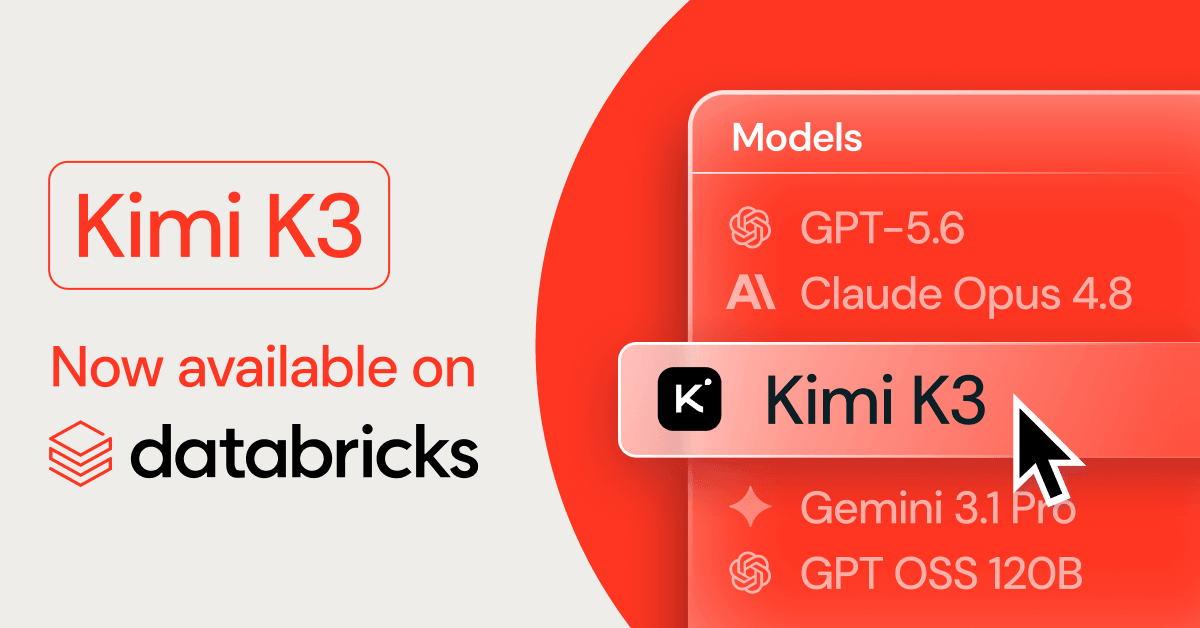
- Kimi K3 on Databricks: Moonshot AI's 2.8T-parameter open-weight model is now available via Databricks Foundation Model API with full Unity AI Gateway governance.
- Frontier-class benchmarks: K3 ranks #5 of 218 models, leads SWE Marathon and Program Bench coding evals, and scores 91.2 on BrowseComp -- beating Claude Fable 5 and GPT-5.6 Sol.
- 50-72% cost savings: Databricks reports Kimi K3 delivers 50-72% lower cost-per-task vs. comparable proprietary models, with ZDR (zero data retention) coverage included.
- Architecture highlights: Sparse MoE with 896 experts (16 active per token), 1M-token context, and novel KDA + AttnRes architecture yielding 2.5x scaling efficiency over K2.
- Enterprise governance: Unity AI Gateway (now GA) provides audit trails, spend controls, safety guardrails, and intelligent model routing across all providers from one control plane.
- US-only for now: Available on AWS and GCP workspaces in the US; more regions are planned. Self-hosting requires at least 64 accelerators.
Kimi K3, Moonshot AI's flagship open-weight model, is now available on Databricks through Unity AI Gateway. Enterprise teams running on the Databricks Lakehouse get direct, governed access to arguably the most capable open-weight model on the market, without routing data through an external provider or rewriting a line of application code.
A 2.8-trillion-parameter shift in the open-weight calculus
Beijing-based Moonshot AI released Kimi K3, a 2.8 trillion parameter model the company describes as the world's first open 3T-class system and the largest open-weight AI model to date. At that scale, K3 comes in roughly 75% larger than DeepSeek's V4 Pro, the previously largest widely used open model.
The model ships with a 1 million token context window, native vision, and activates just 16 of its 896 experts per token, or roughly 1.8% of the pool. That last detail matters for cost. K3 is a sparse Mixture-of-Experts (MoE) model, meaning only a fraction of the network fires for any given token, keeping inference costs far below a dense model of equivalent size.
Two architectural innovations power the efficiency gains. K3 is built on Kimi Delta Attention (KDA) and Attention Residuals (AttnRes), designed to improve how information flows across sequence length and model depth. Its Stable LatentMoE framework scales sparsity by activating 16 of 896 experts, yielding roughly a 2.5x improvement in overall scaling efficiency compared to Kimi K2. KDA is a hybrid linear attention mechanism: KDA layers do most of the work cheaply, while global attention layers preserve the precision needed to retrieve information from far back in the context.
How it benchmarks
Moonshot's self-reported benchmarks have K3 mostly beating Claude Opus 4.8 max and GPT-5.5 high, while losing out to Claude Fable 5 and GPT-5.6 Sol. On independent evaluations, Kimi K3 scores 80.5 out of 100 and ranks #5 of 218 models, with its strongest category being Multimodal and Grounded at #3.
Coding is where K3 really shines. It placed in the top three across six coding benchmarks, led all competitors in SWE Marathon and Program Bench, and trailed only GPT-5.6 Sol in Terminal Bench 2.1 by half a point. On BrowseComp, which evaluates real-world research and browsing, K3 scores 91.2, compared to Claude Fable 5 at 88.0 and GPT-5.6 Sol at 90.4.

What Databricks actually adds
Running a frontier-class open-weight model is one thing. Running it inside an enterprise security perimeter, with audit trails, spend controls, and zero data retention, is another. Databricks is filling that gap.
Unity AI Gateway is the company's governance layer for enterprise AI. Built on Unity Catalog, it extends governance beyond data and AI assets to the runtime interactions between models, agents, MCP servers, skills, and AI tools. Customers including Rivian, Asana, and Edmunds already use it to roll out AI across their organizations, and over a quadrillion tokens have passed through the gateway in the past year.
The integration gives Databricks customers four concrete levers:
- Context: Kimi K3 runs directly against governed enterprise data through Unity Catalog. Agents can query your lakehouse and feature stores, grounding responses in your organization's actual knowledge.
- Control: Identity-aware policies dictate what agents can access and what actions they can take. Prompts, traces, token usage, and tool activity are monitored with Unity Catalog-governed inference tables.
- Choice: Native access to Kimi K3 sits alongside proprietary models from Anthropic, OpenAI, and Google Gemini, all fully governed within the same secure Databricks perimeter.
- Cost: Kimi K3 often delivers 50-70% lower cost per task than top proprietary models. Gateway spend controls let platform teams set budgets per user, team, workspace, and account.
The open-weight moment
The announcement lands during a broader shift in how the industry thinks about open-weight models. A year ago, they were clearly second-tier. That narrative has collapsed. K3 shows open-weight systems competing with closed models on architectural design, enterprise adoption, and operational cost, suggesting a rebalancing of the AI industry grounded in both technical capability and distribution economics.
The open-weight angle matters for a specific class of enterprise use case. Teams can fine-tune, quantize, or run K3 fully air-gapped, which a hosted API cannot offer regardless of pricing. That is a meaningful unlock for regulated industries like healthcare and finance where data never leaves the perimeter.
A counterpoint is worth noting. Running a model of this size requires substantial GPU infrastructure. Inference at 2.8 trillion parameters does not fit on a single server rack, and K3 has a recommended deployment of at least 64 accelerators. For most enterprises, that means relying on a hosted provider, which is exactly what the Databricks integration offers.
Security considerations also apply. Recent evaluations by the UK AI Security Institute and the US CAISI found that while Kimi K3 performs below top-tier US cyber models, it still possesses significant agentic cyber capabilities. Because the weights are open, system-level safeguards can be bypassed. Unity AI Gateway guardrails address this directly, but teams self-hosting the weights will need to implement their own safety layer.
Who wins, and what comes next
The clearest beneficiaries are Databricks customers already paying frontier prices for proprietary models on coding, document processing, or agentic workloads. Kimi K3 delivers state-of-the-art coding, agentic reasoning, and document understanding with the deployment flexibility, cost efficiency, and customizability that open weights provide, all governed through Unity AI Gateway with comprehensive zero data retention (ZDR) coverage.
The pressure lands squarely on Anthropic and OpenAI. A 2.8-trillion-parameter open-source model performing at near-frontier levels creates new options for companies that want to fine-tune, self-host, or build proprietary systems on top of a capable base model, without being locked into API contracts. Databricks is explicitly positioning itself as the platform where enterprises can hedge across both worlds.
Snowflake launched its own Cortex AI Gateway in late July 2026, reflecting the same insight: the governance problem for AI cannot be solved by model providers alone and has to be solved at the data platform layer where enterprise context actually lives. The race to become the enterprise control plane for AI is now fully underway.
Kimi K3 is initially hosted by Databricks in the US, with more regions planned. Teams can try it immediately in the AI Playground with zero setup, configure governance through Unity AI Gateway, or build Kimi-powered agents using Agent Bricks, all without changing existing application code.
Comments
