

D2MoE Cuts Graph AI Memory 73% by Giving Hard Nodes More Compute
D2MoE swaps rigid top-k routing for entropy-driven top-p selection, spending more experts on ambiguous graph nodes and fewer on easy ones.
 PRO
- D2MoE routes graph nodes through a variable number of experts based on predictive entropy, replacing static top-k selection.
- Beats 19 baselines on all 13 benchmarks; up to 7.92% accuracy gain on heterophilous graphs.
- Cuts memory by 73.07% and training time by 46.53% versus the best Graph MoE on large graphs.
- Uses Sigmoid mapping from last-epoch node entropy to a cumulative probability threshold for top-p routing.
- Requires two regularizers: routing entropy minimization for sparsity and load balancing to prevent expert collapse.
- No public code released; limitations include entropy miscalibration under label noise and history storage overhead.
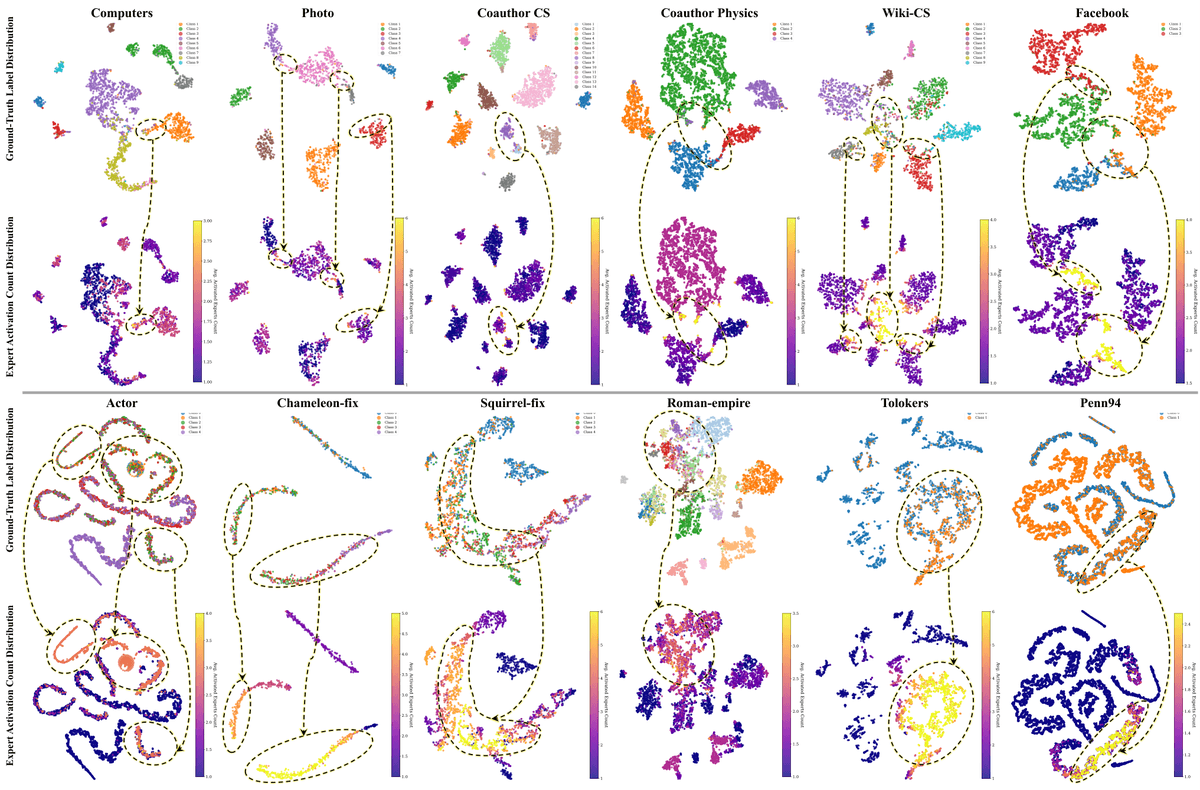
A new mixture-of-experts framework for graph neural networks argues that not every node deserves the same amount of compute. D2MoE (Difficulty-Aware Dynamic Mixture-of-Experts) replaces the fixed top-k routing that dominates current Graph MoEs with an entropy-guided top-p mechanism, giving hard nodes a bigger expert ensemble while letting easy ones coast through with a single expert. The result: state-of-the-art accuracy across 13 benchmarks, up to 7.92% gains on heterophilous graphs, 73.07% less memory and 46.53% less training time on large graphs compared to the best-performing Graph MoE.
The one-size-fits-all problem in Graph MoEs
Mixture-of-Experts has become a popular way to scale GNN capacity without paying the full dense-compute bill, but existing designs are surprisingly rigid. Current Graph MoEs typically rely on static routing strategies that enforce a uniform expert budget or coarse-grained toggles across every node. Frameworks like GMoE use a fixed budget for every node, while Mowst applies binary strong/weak toggles.
The authors ran a motivational study using a vanilla top-k router with six GCN experts, stratifying test nodes into deciles by predictive entropy from an independent teacher. Two patterns emerged consistently:
- Capacity saturation on easy nodes. Adding experts to homophilous, low-entropy nodes did nothing except waste compute and inject noise. A single expert matched or beat larger ensembles.
- Capacity starvation on hard nodes. Nodes sitting at heterophilous boundaries needed larger ensembles (k=3, k=5) to disentangle conflicting neighborhood signals. A small fixed budget capped their accuracy.
This story is for Pro members
You've reached the end of the free preview. Upgrade to AlphaSignal Pro to read the full article - and everything else behind the paywall.
Comments
