

CVPR's Maritime AI Benchmark Reveals Where Autonomous Boats Still Go Blind
The 4th MaCVi Workshop at CVPR 2026 ran five maritime vision challenges spanning buoy association, thermal detection, panoptic segmentation, and multimodal fusion.
 PRO
- MaCVi 2026 ran five maritime vision challenges at CVPR emphasizing accuracy and embedded real-time constraints.
- Vision-to-Chart winner from HD Korea Shipbuilding hit 0.76 overall using skyline estimation and ROI projection priors.
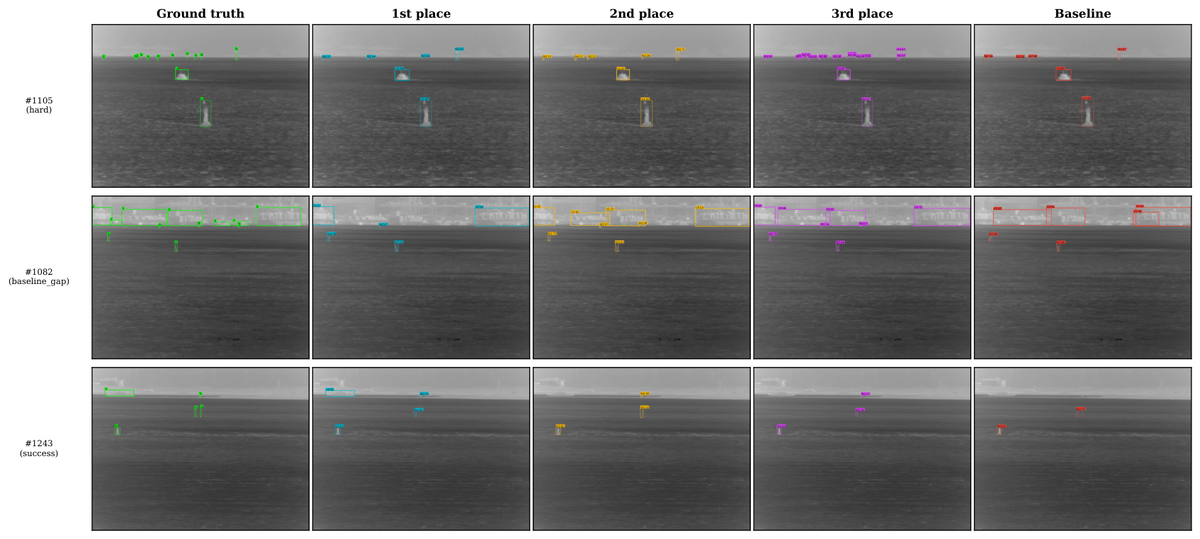
- Thermal detection podium all used 6-11 model ensembles fused with Weighted Boxes Fusion on the Maritime Collision Avoidance Dataset.
- DINOv3 pretrained backbones dominated LaRS panoptic segmentation, with M2F-DINOv3 winning at 53.5 PQ.
- Embedded track exposed that transformer segmentation heads lose 67-82% mIoU after INT8 quantization on Luxonis OAK4.
- Multimodal winner GatedMemorySAM used SAM2 temporal attention for RGB/thermal/LiDAR fusion with nighttime augmentation.
Autonomous boats have to see clearly in conditions that break most vision stacks: sun glare bouncing off waves, rain and fog, thermal cameras at night, and reflections that look exactly like real obstacles. The 4th Workshop on Maritime Computer Vision tackled that gap by running five benchmark challenges at CVPR 2026 that pushed teams on both accuracy and embedded real-time feasibility.
The overview paper compiles quantitative results, cross-challenge analyses, and technical reports from the top teams. Together they offer a snapshot of what actually works in maritime perception right now, alongside a clear picture of where current architectures still fail.
Why maritime vision is its own beast
Unmanned surface vehicles (USVs) can't rely on the same pretraining and priors as driving datasets. The sea has dynamic lighting, mirror-like reflections, tiny distant objects, and safety-critical categories like swimmers and buoys that appear as a handful of pixels. MaCVi exists to standardize evaluation across these conditions so methods can be compared apples-to-apples, and this year added a hard emphasis on models that can actually ship on constrained hardware.
The 2026 edition ran five tracks: Vision-to-Chart Data Association, Thermal Object Detection, LaRS Panoptic Segmentation, Embedded Semantic Segmentation, and Multimodal Semantic Segmentation. A sixth Generalist Meta Challenge was introduced but received no eligible entries this cycle.
Matching camera pixels to nautical charts
The Vision-to-Chart challenge asks a system to look at a monocular RGB frame, detect buoys, and associate each one with the correct marker on a nautical chart. The dataset contains 4,285 training, 904 validation, and 924 test samples, with ranking based on precision, recall, F1, and matched-box mIoU.
This story is for Pro members
You've reached the end of the free preview. Upgrade to AlphaSignal Pro to read the full article - and everything else behind the paywall.
Comments
