

Cursor's Claude Fable 5.1 Hits 73.4% and Catches Its Own Bugs
Cursor added Anthropic's new Fable 5.1 model, which posted a 73.4% score on CursorBench 3.2 and excels at self-verifying long coding runs.
- Claude Fable 5.1 is live in Cursor, scoring 73.4% on CursorBench 3.2 at max effort.
- Cursor's team highlights self-verification as the key upgrade, enabling long unattended coding runs.
- Beats Fable 5 (70.5%) and Opus 5 (70.0%) on Cursor's own multi-file coding benchmark.
- Anthropic's launch shows big gains on Terminal-Bench-Science (52.6% vs 24.7%) and AutomationBench (31.4% vs 17.1%).
- Privacy Mode users must approve the Fable 5.1 data retention policy in the Cursor Dashboard first.
- Best fit for open-ended, multi-hour agent tasks and root-cause debugging where cheaper models stall.
Cursor has switched on Claude Fable 5.1 inside the editor, and the team is calling it the strongest model they have ever benchmarked. On CursorBench 3.2, Fable 5.1 scored 73.4% at max effort, edging out Fable 5 (70.5%) and Opus 5 (70.0%) on the same eval.
What Cursor is really pointing at goes beyond raw benchmark lift. The team found the model especially skilled at verifying its own work, which lets it carry difficult coding tasks from start to finish. In practice, that means fewer moments where an agent claims a task is done, you check the diff, and three tests have silently broken.
Why the self-check changes the game
Cursor's benchmark is built around ambiguous, multi-file coding tasks pulled from real sessions rather than toy problems. Long-horizon agent work has historically failed on the last mile: the model writes code, runs it, hits a partial success, and calls it a win. Self-verification is the loop that catches that failure mode.
Anthropic frames the same capability in root-cause language. In testing by the investment firm Millennium, Fable 5.1 found the cause of a rare crash on their internal systems that none of their engineers, or any other model, had been able to explain after several years of trying. That is the shape of task Cursor is signaling the model unlocks: hours-long, unattended runs where the agent has to keep testing its own assumptions.
Numbers behind the release
Anthropic's launch page puts Fable 5.1 ahead of Fable 5, Opus 5, and GPT-5.6 Sol on several agentic evals. A few that matter for coding work:
- Agentic coding on Terminal-Bench 4.0: 55.8% (60.9% with the Mythos 5.1 safeguards profile), versus 42.0% for Fable 5 and 52.3% for Opus 5.
- Agentic scientific research on Terminal-Bench-Science 0.1: 52.6%, versus 24.7% for Fable 5.
- Business workflows on AutomationBench: 31.4%, nearly double Fable 5's 17.1%.
- CursorBench 3.2.0: 73.4%, versus 70.5% for Fable 5.
The Terminal-Bench-Science jump is the outlier. More than doubling the predecessor's score on a research-oriented terminal benchmark suggests the model is materially better at running its own experiments, reading the output, and adjusting.
What early users are saying
The pattern in Anthropic's partner quotes centers on long, unattended runs holding together. Cognition said it evaluates models and systems on real-world investor workflows, and multiple partners flagged that Fable 5.1 stays coherent across many-step tasks where earlier models drifted. Browserbase reported Fable 5.1 completed 82% of tasks on their hardest browser-agent benchmark, against 74% for Opus 5 and 57% for Fable 5, while burning fewer tokens than either.
Getting in, and the privacy catch
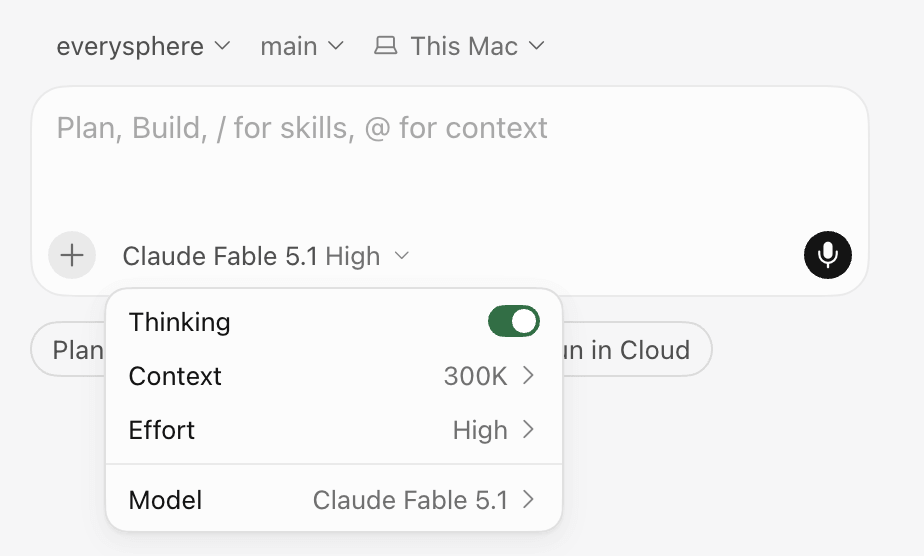
The model is live now in Cursor's picker at multiple effort levels, with a thinking variant and a 300K context window visible in the settings. There is one gate worth knowing about. Fable 5.1 carries the same privacy considerations as other Fable models because of how Anthropic handles data retention. If Privacy Mode is enabled for your account, team, or organization, you will need to approve Fable 5.1's Data Retention Policy in the Cursor Dashboard before you can use the model.
Anthropic's stated policy for Fable-class models is that retained customer data is deleted after 30 days automatically, is not readable by any person by default, and is not used to train Claude. Enterprise customers waiting on stronger guarantees are being routed to the upcoming Enterprise Frontier Safeguards program, which keeps data on the customer's own cloud infrastructure.
When to reach for it
Fable-class models sit at the top of Cursor's capability tier and cost more than Sonnet or Opus alternatives. The rule of thumb Cursor's evals team has publicly used for the Fable line still applies here: if you can already sketch the path from A to B, a cheaper model is fine. If you are at A with no clear route to B, or you are handing off a multi-hour job you do not plan to babysit, Fable 5.1 is the one to try. Concretely, that means:
- Multi-file refactors touching services you do not have fully in your head.
- Root-cause debugging on flaky, rare, or long-standing issues.
- Greenfield prototypes where the model plans, implements, and self-checks over hours.
- Migration work that has to keep passing tests as it moves through a codebase.
For teams already running heavy agent workloads in Cursor, the pitch is straightforward: a higher CursorBench ceiling paired with a model that catches its own mistakes before you do.
Comments
