

Cursor Router Cuts AI Coding Costs 60% by Picking the Right Model
Cursor Router automatically picks the cheapest model that can handle each coding task, delivering frontier quality at up to 60% lower cost for Teams and Enterprise.

- Cursor Router is now live for Teams and Enterprise, automatically routing each coding request to the most cost-effective capable model.
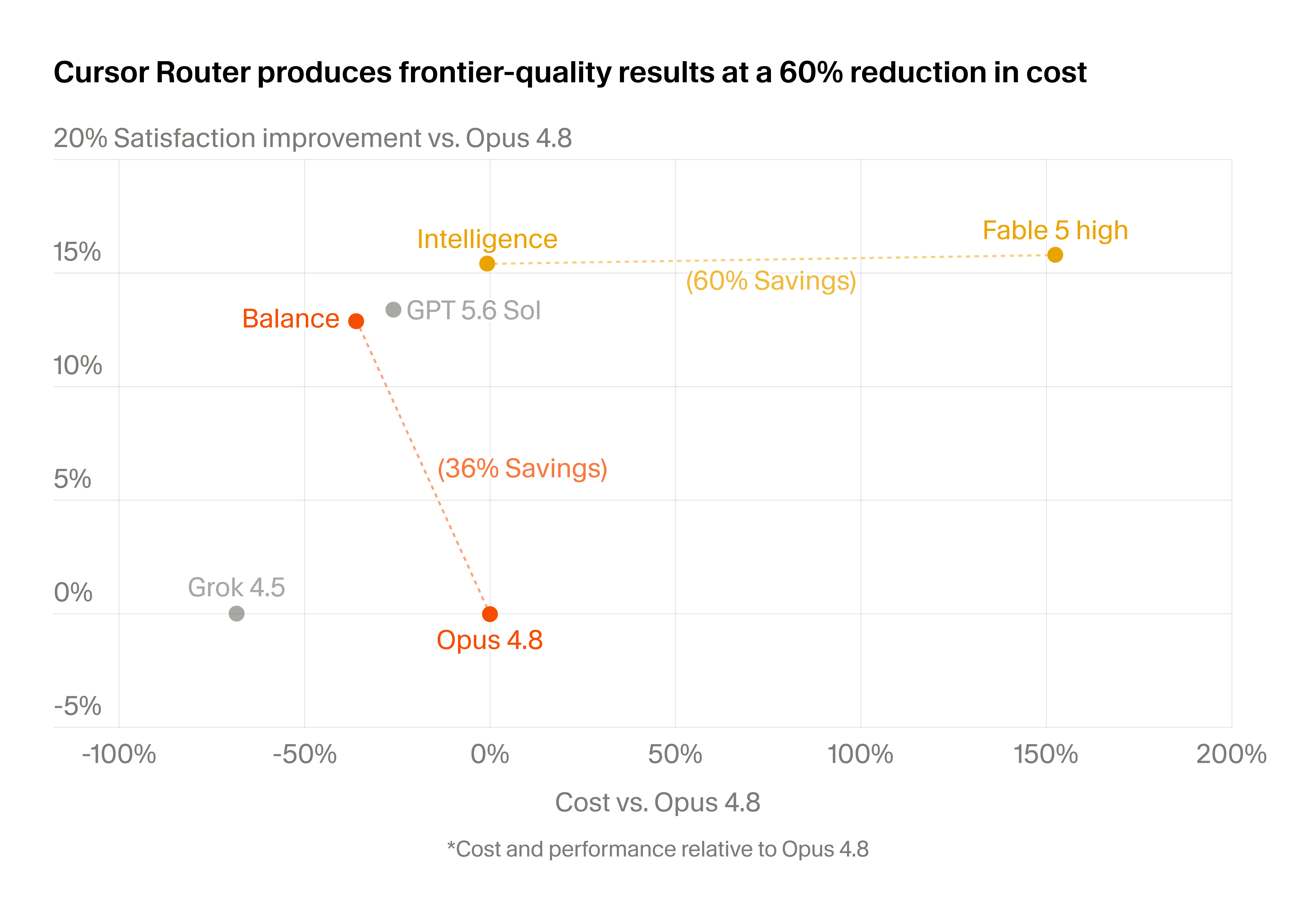
- In A/B tests across millions of requests, Intelligence mode matched Fable-level quality at 60% lower cost vs. routing everything to Opus 4.8.
- The router was trained on 600k+ live requests and evaluated on user satisfaction and code keep-rate, not synthetic benchmarks.
- Early access enterprise customers saw 30-50% cost savings with no quality drop; cost per commit dropped from $12.69 (Fable 5) to $6.76 (Intelligence mode).
- Three modes available: Intelligence, Balance, and Cost; admins can set defaults, restrict modes, and allow or block specific models per team.
- Available now on desktop, web, iOS, CLI, and SDK for Teams and Enterprise plans.
Cursor Router is a built-in model routing system that automatically selects the right AI model for each coding request. Rather than sending every task to the same expensive frontier model, it classifies each request and dispatches it to the most cost-effective model capable of handling it. According to Cursor's A/B tests across millions of live requests, the result is frontier-quality output at 60% lower cost.
Why one model wastes money
About 60% of Cursor users stick to a single model for everything. That means routine tasks like renaming a variable, writing a docstring, or tweaking a CSS class all get billed at the same rate as a complex multi-file refactor. AI spend grows much faster than output quality when every request hits a frontier model regardless of whether it needs one.
The fix is to classify the request first, then route it. Doing this well requires knowing what each model is actually good at, accounting for the cost of switching models mid-conversation (cache misses), and measuring success against real developer behavior rather than benchmark scores.
How the classifier works
Cursor Router is a classifier trained on 600,000+ live requests and evaluated in online A/B tests across millions more, optimizing for user satisfaction as its reward signal. It examines the query, surrounding context, task complexity, and domain before deciding where to send the request.
The routing logic maps task types to model strengths:
- Simple edits and boilerplate go to the most price-efficient models
- UI and design-heavy work goes to the model with the strongest aesthetic judgment
- Complex, long-horizon reasoning tasks go to frontier models like Claude Opus or Fable
The router is cache-aware at every stage. It trains on a dataset where routing produces cache misses, and the reported cost savings in production already include the cost of those misses. Most routing benchmarks ignore the extra latency and cost of switching models mid-conversation; Cursor builds it in from the start.
Cursor validated the router with large-scale online A/B tests rather than offline evals. Offline evals are useful proxies, but they're limited by small sample sizes, distance from real-world usage, and the difficulty of reducing success to a rubric. Cursor measured two signals that directly reflect developer behavior instead:
- User satisfaction (AFC): whether the developer moved on to the next task (positive) or corrected the agent (negative)
- Keep rate: how much agent-generated code actually stays in the codebase over time
Three modes, one dial
Router ships with three optimization modes. Each sits at a different point on the cost-quality tradeoff, where improving one dimension means giving something up on the other:
- Intelligence: Frontier quality, matching the most powerful models available.
- Balance: Strong quality, matching the frontier models most developers use daily.
- Cost: Good quality, reaching the highest available intelligence while minimizing token spend.
Auto Intelligence mode matches Fable on user satisfaction at about 60% lower cost for teams, and lifts satisfaction roughly 15% over Opus 4.8 at nearly the same cost. Auto Balance lands above Opus 4.8 on user satisfaction at about 36% lower cost.
What the numbers look like in production
Three high-volume accounts with thousands of users saved 30–50% on Auto-routed requests compared to routing everything to Opus 4.8, with no drop in quality.
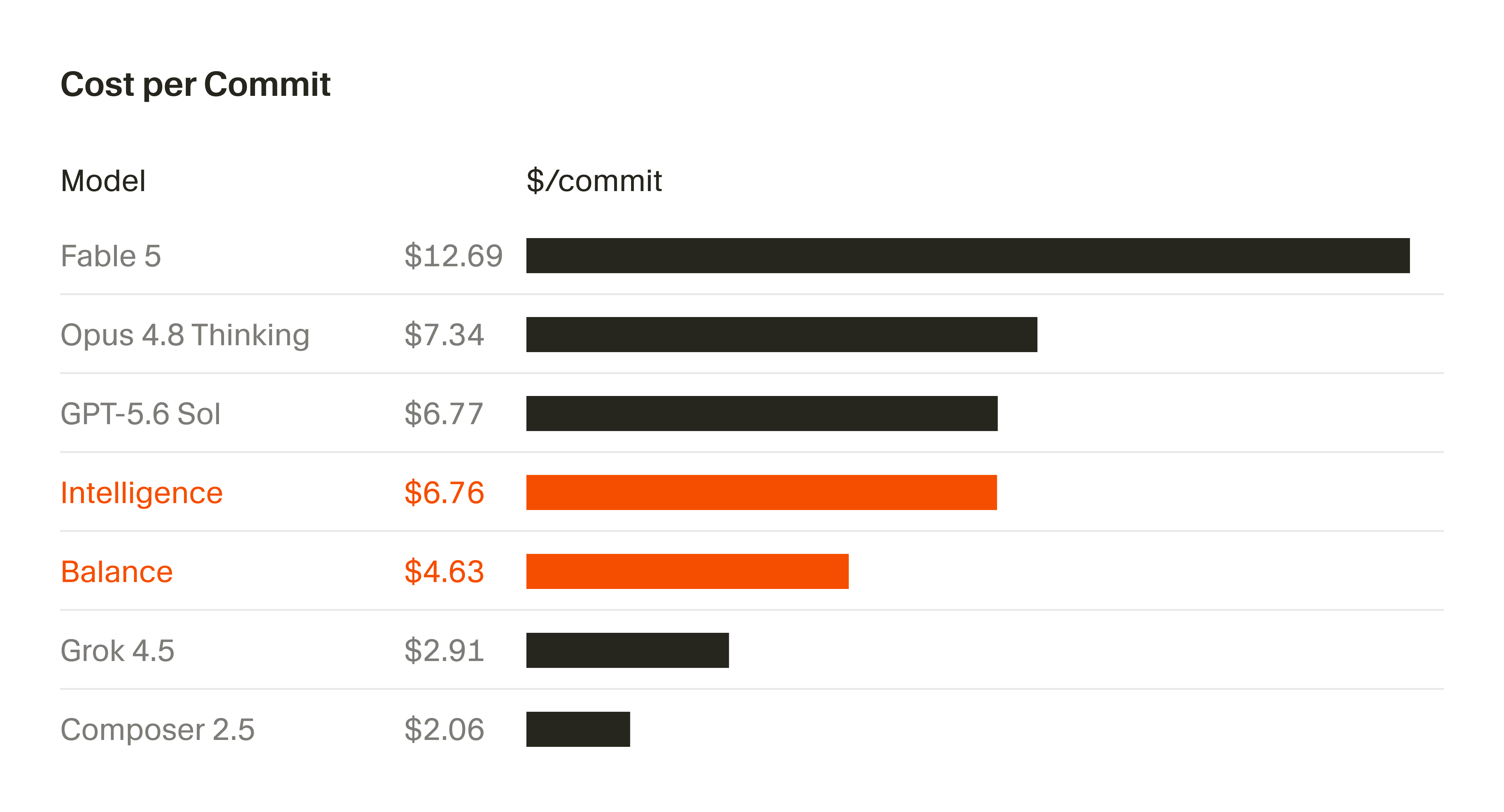
Cost per request is a useful metric, but engineering leaders care about cost per unit of shipped work. Cursor measured cost per commit:
- Intelligence mode: $6.76 per commit
- Balance mode: $4.63 per commit
- Opus 4.8: $7.34 per commit
- Fable 5: $12.69 per commit
- GPT-5.6 Sol: matched Intelligence cost but with lower user satisfaction
Cursor Router keeps hard tasks on the most capable models and moves routine work off frontier pricing. That gap is the practical case for routing.
Admin controls and team rollout
Router is built for organizations. Admins can enable it per team or group, choose which modes members can select, set a default, and allow or block specific models. A platform team can lock everyone to Balance mode while a senior engineering group gets access to Intelligence. Specific models can also be blocked for compliance or cost reasons.
To use it, select Auto in the model picker and choose an optimization mode. Routing happens transparently from there.
What's coming next
Router is part of a broader token efficiency push at Cursor. Dynamic tool calling means most native tool descriptions are no longer loaded into every prompt. The model looks them up the first time it needs them, keeping common tools like read and edit hot while less-used tools only enter the prompt when the agent actually calls them.
Grok 4.5 widens the pool of models Cursor Router can draw from on harder, higher-cost work. Composer continues to improve on everyday tasks so lower-cost turns stay close to frontier quality without paying frontier prices.
Cursor is treating model routing as a durable architectural layer. As new models ship faster and pricing shifts, a well-trained router grows more valuable over time. The routing classifier was designed for a world where models update early and often, so as newer and more powerful models release, the router updates with them.
Cursor Router is available today for Teams and Enterprise plans across desktop, web, iOS, CLI, and the SDK. Read more in the official docs and the changelog.
Comments
