

Concordia's GLOW Beats Knowledge Graph AI by 38% Without LLM Fine-Tuning
GLOW pairs a lightweight graph neural network with an off-the-shelf LLM to answer questions when the knowledge graph is missing facts, beating prior hybrids by up to 53 points.
 PRO
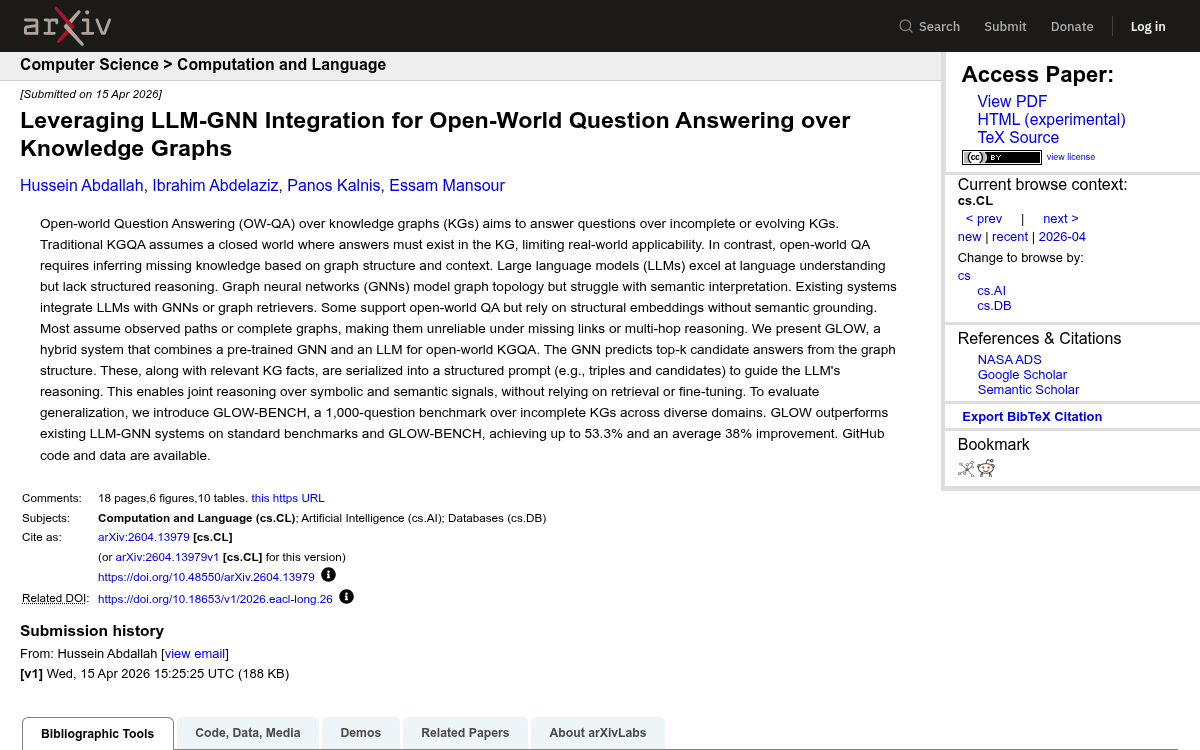
- GLOW combines a pretrained GNN with a frozen LLM for open-world QA over incomplete knowledge graphs. Paper
- Delivers up to 53.3% and average 38% accuracy improvement over AskGNN, GCR, and GoG baselines.
- Introduces GLOW-Bench: 1,000 questions across BioKG, YAGO4, LinkedMDB, CrunchBase with gold answers removed.
- Three variants trade cost for accuracy: GLOW-G (context), GLOW-N (predictions), GLOW-GN (both).
- GNN training takes 1.7 hours versus AskGNN's 23.4 hours, no LLM fine-tuning required.
- Optimal setting is top-k=3 GNN candidates; higher values confuse smaller LLMs.
Most knowledge graph question answering systems make an assumption that quietly breaks in the real world: they assume the answer already lives somewhere in the graph. A team from Concordia, IBM, and KAUST just published GLOW, a hybrid system that pairs a graph neural network with an LLM to reason over incomplete knowledge graphs, along with a 1,000-question benchmark designed specifically to test that setting.
The headline number: GLOW outperforms state-of-the-art LLM-GNN QA and KGQA systems across standard benchmarks and GLOW-Bench, with up to 53.3% and an average of 38% improvement. Here is what is going on under the hood, and when you would want to reach for it.
The closed-world problem nobody talks about
Traditional KGQA pipelines work like a database lookup: parse the question, walk the graph, return the node at the end of the path. That is fine when you are querying Wikidata about the capital of France, but it falls apart in real-world domains like biomedicine, scientific research, and finance, where knowledge is often evolving, implicit, or incomplete. A drug-drug interaction might not be documented yet. A protein family might be unclassified. A collaboration might be latent.
Recent retrieval-based approaches like G-Retriever, GNN-RAG, and GCR try to bridge the gap by pulling graph fragments into the LLM prompt. These methods often fail under open-world conditions, where answer paths are missing or poorly aligned with the question. If the path does not exist, retrieval either returns noise or the LLM hallucinates a plausible-looking answer path that violates the schema.
How GLOW actually works
This story is for Pro members
You've reached the end of the free preview. Upgrade to AlphaSignal Pro to read the full article - and everything else behind the paywall.
Comments
