
Cohere's North Mini Code 1.0 Beats 120B Models With Just 3B Active Parameters
Cohere's North Mini Code is a 30B MoE model with only 3B active parameters that beats 120B+ models on agentic coding benchmarks, free under Apache 2.0
 Pro
Takeaways
- North Mini Code 1.0 is a 30B MoE model with only 3B active parameters, beating 120B+ models on Artificial Analysis' Coding Index with a score of 33.4.
- Released under Apache 2.0, available free on Hugging Face in BF16 (Transformers) and FP8 (vLLM) variants.
- Achieves 2.8x higher output throughput and 30% better inter-token latency vs comparable dense models in Cohere's internal tests.
- Trained with two-stage SFT + RLVR on 70k+ verifiable tasks across ~5k unique repositories, with explicit multi-harness robustness training.
- Supports a 256K context window with 64K max output, designed for repo-level agentic coding, terminal automation, and local private deployment.
- First model in Cohere's new North family; works natively with OpenCode, SWE-Agent, and most coding agent frameworks.
Cohere just released North Mini Code 1.0, an open-weight coding model that challenges the assumption that bigger always means better. The model has 30 billion total parameters, but only 3 billion are active at any given moment. That architectural trick, called a sparse Mixture-of-Experts (MoE), lets it deliver large-model quality at a fraction of the compute cost.
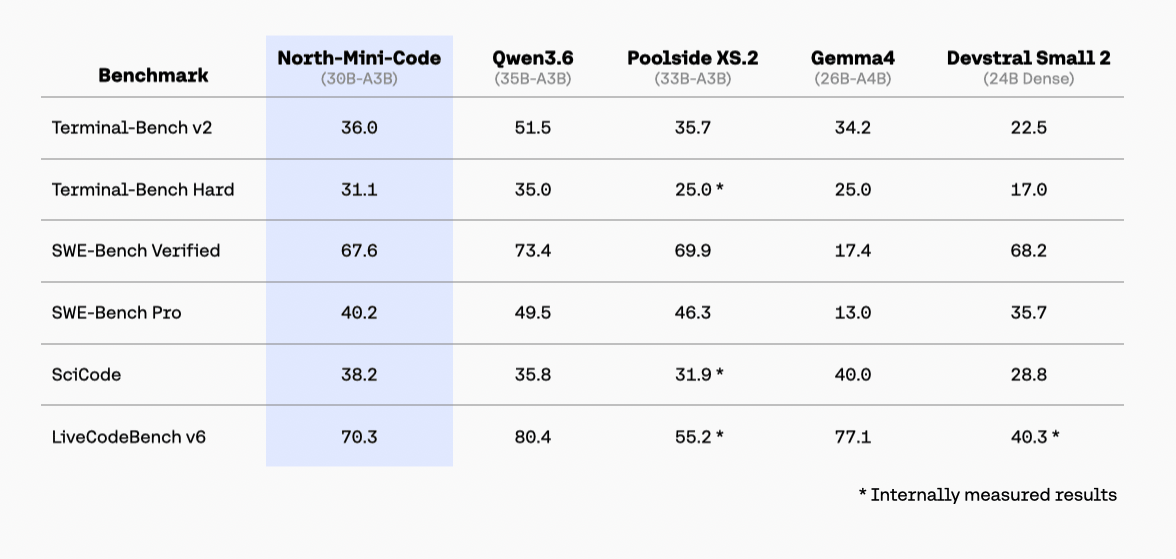
The headline numbers are hard to ignore. On Artificial Analysis' Coding Index, North Mini Code achieves a score of 33.4, outperforming Qwen3.5 (35B-A3B), Gemma 4 (26B-A4B), Devstral Small 2 (24B Dense), and even substantially larger models such as Nemotron 3 Super (120B-A12B), Mistral Small 4 (119B-A6B), and Devstral 2 (123B). A model with 3B active parameters beating models with 10-40x more compute per token is not the norm.
The MoE trick that makes it fast
Sparse MoE works by splitting the model's feed-forward layers into many specialized sub-networks called "experts." Instead of running every parameter on every token, a router picks a small subset of experts for each token. The feed-forward block uses 128 experts, of which 8 are activated per token. Each expert block is an FFN block with SwiGLU activation, and the router applies a sigmoid activation function to the logits before the top-k selection. You get the capacity of a 30B model with the inference cost closer to a 3B one.
The attention mechanism is also worth noting. North Mini Code is a decoder-only Transformer-based sparse Mixture-of-Experts model that uses an efficient attention implementation, interleaved between sliding-window attention with RoPE and global attention with no positional embeddings, in a 3:1 ratio. This hybrid approach helps the model handle both local code structure and long-range dependencies across a massive context window.
The throughput gains are real. In Cohere's internal tests, North Mini Code reached up to 2.8x higher output throughput at identical concurrency and hardware, and showed a 30% edge in inter-token latency.
How it was trained
North Mini Code was post-trained using a two-stage cascaded supervised fine-tuning (SFT) followed by reinforcement learning with verifiable rewards (RLVR), focusing on agentic coding. RLVR is a training technique where the model gets a reward signal based on whether its outputs are verifiably correct, rather than relying on human preference ratings. Think of it as training the model by actually running its code and checking if the tests pass.
The SFT data pipeline was extensive. The first stage focused on broad coding capabilities, with code datasets making up 70% of trainable tokens, split between 43% agentic tool-use data and 27% single-turn competitive programming. The second stage narrowed to 4.5 billion tokens of only agentic and reasoning-driven samples. Critically, Cohere used over 70,000 verifiable tasks across roughly 5,000 unique repositories, and deduplicated against SWE-Bench sources to avoid data leakage.
The RL phase introduced a clever engineering trick to handle the awkward reality of agentic training: coding agent rollouts are long and wildly variable in length. A synchronous training loop would stall waiting for the slowest trajectories. Cohere decoupled sampling from learning, running a vLLM sidecar that generates rollouts continuously while the trainer updates weights every few steps. A windowed FIFO queue drains stragglers without destabilizing training.
Built to work across agent frameworks
One of the more underappreciated design choices here is harness robustness. Most coding models are benchmarked and optimized for a single agent scaffold, which means they can fall apart when dropped into a different tool environment. Cohere explicitly trained North Mini Code across multiple harnesses.
The three harness types it was trained on differ substantially:
- SWE-Agent: Rich CLI interface with specialized bash, str_replace_editor, and submit tools
- mini-SWE-agent: Stripped-down single bash tool with raw stdout as the only feedback
- OpenCode: Fine-grained individually typed tools (edit, grep, todowrite, task) returning structured JSON
By introducing a small amount of additional benchmark harness data (just 6% of the SFT mix) during the second SFT stage, this data mix yields a 10% gain on the evaluation with OpenCode harness while maintaining performance with SWE-Agent on SWE-Bench Verified, demonstrating that cross-harness transfer can be cheaply acquired without degrading benchmark performance.
What it's actually good at
North Mini Code is optimized for complex software engineering workflows, terminal-based agentic tasks, and high-quality code generation. The benchmarks used to evaluate it reflect this focus:
- SWE-Bench Verified: Fixing real GitHub bugs. Tests AI models on 500 real GitHub issues from popular Python repositories, where models must submit code patches that fix the bug without breaking existing tests.
- Terminal-Bench v2 and Hard: Driving shell tools end-to-end across multi-turn tasks
- SciCode: Complex scientific coding problems
- LiveCodeBench v6: Algorithmic reasoning for competitive programming
The RLVR training phase improved the SFT baseline by 7.9 percentage points (absolute) on Terminal-Bench v2 and 3.0 points on SWE-Bench. The human evaluation results were also notable: the final model achieved a 66.1% win rate over the SFT-only checkpoint across code explanation, editing, data visualization, and from-scratch implementation tasks.
What it's not built for
North Mini Code is a text-only model. It has no vision capabilities, so any task requiring reading screenshots, UI mockups, or diagrams is out of scope. It's also worth noting that SWE-Bench Verified, despite being the industry's most cited coding benchmark, has known limitations. OpenAI's audit found that 59.4% of the hardest unsolved Verified problems had flawed test cases, meaning the benchmark itself had quality issues. This is why you should treat SWE-bench Verified as a rough directional signal, not a precise measurement. The model is also currently Python-repository-focused in its benchmark evaluations, so performance on other languages at the agentic level is less characterized.
Getting it running
North Mini Code is a 30B total / 3B active parameter Mixture of Experts model trained specifically for agentic coding, and is the first model in Cohere's North family of code agent models, released under the Apache 2.0 license. It's free to use, modify, and ship commercially.
Two weight variants are available on Hugging Face:
- BF16 (CohereLabs/North-Mini-Code-1.0): For use with Transformers
- FP8 (CohereLabs/North-Mini-Code-1.0-fp8): Optimized for vLLM inference
To use the model in Transformers, use the BF16 model weights. The FP8 checkpoint is designed to be used with vLLM and is not compatible with Transformers due to the quantization algorithm.
For vLLM, you'll need to install from the main branch and add Cohere's cohere_melody parsing library:
uv pip install "git+https://github.com/vllm-project/vllm.git"
uv pip install cohere_melody>=0.9.0
vllm serve CohereLabs/North-Mini-Code-1.0-fp8 \
  -tp 1 \
  --max-model-len 320000 \
  --tool-call-parser cohere_command4 \
  --reasoning-parser cohere_command4 \
  --enable-auto-tool-choice \
  --moe-backend triton
If you want to try it before downloading, you can try out North Mini Code before downloading the weights in OpenCode and the hosted Hugging Face Space. North Mini Code is also available for free on Hugging Face and Model Vault, Cohere's fully managed inference platform.
Why this matters beyond the benchmarks
The real story here is what this release signals about where the open-source coding model space is heading. The assumption that you need a massive dense model to get frontier-level agentic coding performance is being actively dismantled. Qwen, Mistral, and now Cohere are all converging on MoE architectures in the sub-40B active parameter range, and the results are competitive with models that cost 10x more to run.
North Mini Code launches as the first, but certainly not the last, of Cohere's new generation of powerful models, designed for a more sovereign open-source ecosystem. The 256K context window and 64K output length mean it can hold an entire large codebase in memory while generating substantial patches. For teams that want a capable coding agent they can run on their own infrastructure, without API costs or data leaving their environment, this is a meaningful new option.