
Cohere's Command A Vision Beats GPT-4.1 on Documents Running on Just Two A100s
Cohere releases Command A Vision, a 112B open-weights multimodal model that beats GPT-4.1 on document, chart, and OCR tasks while running on just two A100 GPUs.
 Pro
Takeaways
- Open-weights multimodal model: Cohere releases Command A Vision, a 112B vision-language model under a CC-BY-NC license.
- Beats GPT-4.1 overall: Scores 83.1% average across 9 benchmarks vs. GPT-4.1's 78.6%, leading on ChartQA, DocVQA, OCRBench, and TextVQA.
- Runs on 2x A100s: Deployable on just two A100 GPUs, or a single H100 with 4-bit quantization -- unusually efficient for a 112B model.
- Built for documents, not general vision: Excels at OCR, chart parsing, and PDF Q&A; trails GPT-4.1 by ~9.5 points on MMMU general reasoning.
- 128K context, 20 images per request: Supports long multi-image conversations; does not support tool/function calling.
- LLaVA-style architecture: Combines SigLIP2 vision encoder with the Command A 111B text tower via an MLP adapter, trained with RLHF using Contrastive Policy Gradient.
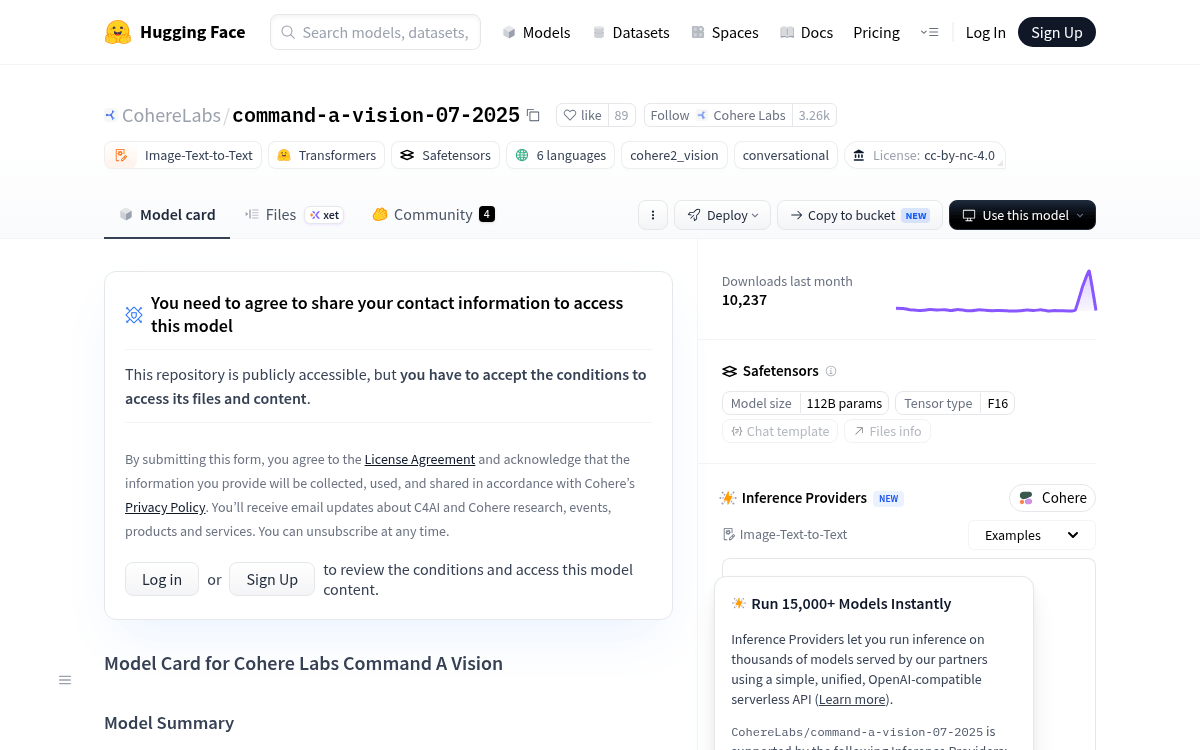
Cohere has released Command A Vision, its first multimodal model and the latest addition to the Command A family. At 112 billion parameters, it is built to do one thing exceptionally well: understand the kinds of images that actually show up in enterprise workflows -- scanned documents, dense charts, tables, and annotated diagrams. The weights are open, the license is CC-BY-NC, and it runs on surprisingly modest hardware for its size.
The enterprise vision gap
Most large language models these days are multimodal, but enterprises generally use more graphical documents such as charts and PDFs, so extracting information from these unstructured data sources often proves difficult. That is the gap Command A Vision is designed to close. It empowers businesses to automate tedious tasks, unlock valuable insights from visual data, and make highly accurate, data-driven decisions through document OCR and image analysis.
With Deep Research on the rise, the importance of bringing in models capable of reading, analyzing and even downloading unstructured data has grown. Cohere is betting that enterprises want a self-hostable option for this -- one that does not require sending sensitive documents to a closed API.
How it is built
Command A Vision integrates a SigLIP2 vision encoder with the existing 111B Command A text tower to produce a model that processes documents, charts, and tables at competitive accuracy with far lower deployment costs than closed API alternatives. The architecture follows the LLaVA pattern -- a well-established approach where a vision encoder feeds into a language model through a lightweight connector layer (called an MLP adapter).
Command A Vision is an enterprise-focused multimodal large language model that excels at understanding and interpreting visual data (images, charts, documents) alongside text. Here is how images are processed under the hood:
- Each image is split into up to 12 tiles of 512x512 pixels, plus one global thumbnail tile
- The SigLIP2 vision encoder converts each tile into visual features
- A pixel shuffle operation compresses each tile down to 256 tokens
- All tokens are passed into the Command A text tower for reasoning
- A single image can consume up to 3,328 tokens in total
Training happened in three stages. First, vision-language alignment: the vision encoder and language model weights are frozen, and only the adapter is trained to map visual features into the language model's embedding space. Second, supervised fine-tuning (SFT): all components are trained jointly on a diverse set of multimodal instruction-following tasks. Third, post-training with reinforcement learning -- specifically, multiple RLHF algorithms such as online Contrastive Policy Gradient (a method that aligns model outputs to human preferences using sequence-level reward signals) were used to align the model with enterprise and safety needs.
Cohere also applied multimodal model merging across several expert models -- the same technique used in Command A -- to balance the data mixture and reflect the relative importance of different enterprise use cases.
Benchmark numbers
Command A Vision delivers leading multimodal performance, surpassing models such as GPT-4.1, Llama 4 Maverick, Mistral Medium, and Pixtral Large across standard vision benchmarks. The results across nine benchmarks tell a clear story:
| Model | ChartQA | DocVQA | OCRBench | MMMU | Avg |
|---|---|---|---|---|---|
| Command A Vision | 90.9% | 95.9% | 86.9% | 65.3% | 83.1% |
| GPT-4.1 | 82.7% | 88.6% | 83.4% | 74.8% | 78.6% |
| Llama 4 Maverick | 90.0% | 94.4% | 80.0% | 73.4% | 80.5% |
| Mistral Medium 3 | 82.6% | 95.3% | 75.7% | 65.0% | 78.3% |
The one area where Command A Vision trails is MMMU -- a benchmark testing college-level multi-discipline reasoning from images. Its MMMU score of 65.3% puts it behind both GPT-4.1 (74.8%) and Llama 4 Maverick (73.4%). MMMU measures college-level multi-discipline reasoning from images -- the kind of task where document specialization does not help. This is not a general-purpose visual reasoner; it is a specialist.
Where it shines, where it does not
With a 128K context length and support for up to 20 images per request, Command Vision excels at enterprise use cases including document analysis, chart interpretation, optical character recognition (OCR), and processing images featuring multiple languages. The model officially supports English, Portuguese, Italian, French, German, and Spanish, though Cohere notes it understands at least 23 languages in practice.
Concrete use cases where it performs well:
- Extracting data from financial tables and reports
- Reading and answering questions about scanned PDFs
- Parsing charts and infographics into structured insights
- OCR on images with mixed text and graphics
- Interpreting product manuals with complex diagrams or analyzing photographs of real-world scenes for risk detection
Where it falls short: the model does not compete as well in general visual reasoning. Its MMMU score of 65.3% puts it behind both GPT-4.1 and Llama 4 Maverick. Also worth noting: tool use is not supported with this model, which limits its use in agentic pipelines that rely on function calling.
The deployment story is the real headline
A 112B model that runs on two A100s is not something you see every day. Command A Vision integrates a SigLIP2 vision encoder with the existing Command A text tower, and is deployable on 2x A100 GPUs -- or a single H100 with 4-bit quantization. For enterprises that want to self-host a frontier-class vision model without a rack of H100s, this is a meaningful unlock.
Cohere is offering Command A Vision in an open weights system, in hopes that enterprises looking to move away from closed or proprietary models will start using its products. The CC-BY-NC license makes it free for research and non-commercial use; commercial deployments require going through Cohere's sales team.
How to get started
The model maintains the same API interface as other Command models, making it easy to integrate vision capabilities into existing applications. You can try it immediately in the Hugging Face Space or via the Cohere playground. To run it locally, install transformers from source and use the standard AutoModelForImageTextToText interface:
pip install "transformers[dev-torch]@git+https://github.com/huggingface/transformers.git"
import torch
from transformers import AutoProcessor, AutoModelForImageTextToText
model_id = "CohereLabs/command-a-vision-07-2025"
processor = AutoProcessor.from_pretrained(model_id)
model = AutoModelForImageTextToText.from_pretrained(
    model_id, device_map="auto", torch_dtype=torch.float16
)
messages = [
    {
        "role": "user",
        "content": [
            {"type": "image", "url": "https://example.com/chart.png"},
            {"type": "text", "text": "Summarize the key trends in this chart."},
        ],
    }
]
inputs = processor.apply_chat_template(
    messages, padding=True, add_generation_prompt=True,
    tokenize=True, return_dict=True, return_tensors="pt"
).to(model.device)
gen_tokens = model.generate(**inputs, max_new_tokens=300)
print(processor.tokenizer.decode(
    gen_tokens[0][inputs.input_ids.shape[1]:], skip_special_tokens=True
))
Command A Vision sits in an interesting position in the current landscape. Closed models like GPT-4o and Gemini Ultra are more capable at general visual reasoning, but they come with data privacy trade-offs and no self-hosting option. Command A Vision trades some breadth for depth -- and for teams whose workflows revolve around documents, that is a trade worth making.