Cohere's Command A+ Beats Google Translate on 48 Languages Running on 2 GPUs
Cohere's Command A+ is a 218B open-weight MoE model that beats Google Translate and outperforms closed models on multilingual benchmarks — all on just two H100s
- Command A+ released open-source under Apache 2.0 — a 218B sparse MoE model with only 25B active parameters at inference time.
- Beats Google Translate and Claude Opus on WMT24++ multilingual benchmarks across French, Spanish, German, and major non-Latin languages.
- Arabic gap is +10 points over DeepSeek V4 Pro; tokenizer redesign cuts token count by 20% for Arabic, 18% for Japanese, 16% for Korean.
- Runs on 2x H100s via W4A4 quantization with near-lossless quality; also available on a single NVIDIA B200.
- Consolidates four prior models (Command A, Reasoning, Vision, Translate) into one, with 48-language support up from 23.
- Available now on Hugging Face and via the Cohere API at $2.50/$10 per million tokens input/output.
Cohere just shipped what may be its most consequential open-weight release to date. Command A+ is a 218-billion-parameter Sparse Mixture-of-Experts model, released under a full Apache 2.0 license, that runs on as few as two NVIDIA H100 GPUs. But the headline buried in the launch thread is about language: Command A+ is now beating Google Translate, Claude Opus, and every major open-source peer on multilingual benchmarks , and the gaps in non-European languages are striking.
One model to replace four
Command A+ unifies capabilities from four prior models , Command A, Command A Reasoning, Command A Vision, and Command A Translate , into a single scalable model. That consolidation matters operationally. Teams that were previously juggling separate model endpoints for translation, vision, and reasoning can now route everything through a single deployment.
It supports 48 languages and a 128K context window, ships with native citation grounding, and is positioned for sovereign, on-prem enterprise agentic workflows. The previous generation, Command A, covered only 23 languages. Command A+ significantly expands multilingual capability, broadening language coverage from 23 to 48 languages and recording gains in machine translation and multilingual reasoning.
The translation numbers that turn heads
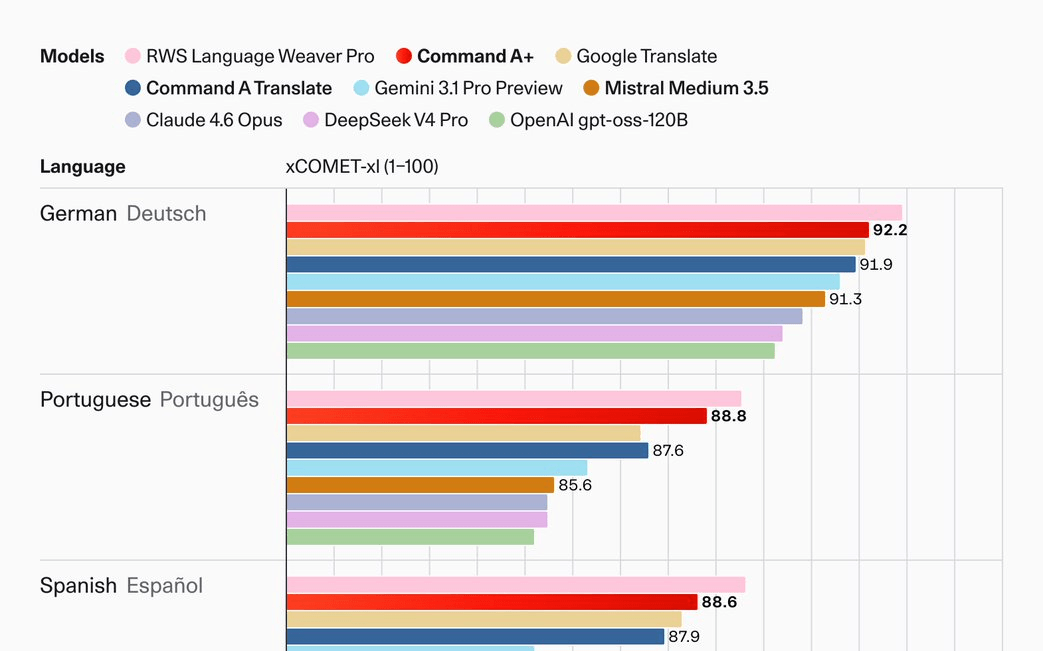
Cohere evaluated Command A+ on WMT24++ using xCOMET-XL , a widely-used public benchmark for machine translation quality that scores output using a learned neural metric rather than n-gram overlap. The results across major European languages show a consistent lead:
- French: +2.4 points over the next-best competitor
- Spanish: +1.9 points
- German: +0.9 points
Command A+ is presented as setting a new benchmark for machine translation capabilities, outperforming several general-purpose and specialist systems on WMT24++ (xCOMET-XL). The post cites score advantages across major European languages and notes a collaborative role with RWS on another high-performing model. RWS is a professional translation services company , Cohere built a specialized system with them that scores even higher, but Command A+ is the open-weight model that ships to everyone.
The more dramatic numbers are in non-Latin scripts. Command A+ outperforms Mistral Medium 3.5 in Korean, Japanese, Hebrew, Chinese, and Arabic. For Arabic specifically, the gap reaches +5 points over Mistral Medium 3.5 and +10 points over DeepSeek V4 Pro. Cohere specifically improved Arabic dialect matching and non-European-language efficiency in this release.
Why the non-European gains are bigger
The tokenizer is a big part of the story. The W4A4 quantization contributes an additional 47% increase in speed and a 13% reduction in latency. But beyond raw speed, Cohere redesigned the tokenizer itself. Command A+ is the first model to use their latest tokenizer, which delivers substantial compression improvements , meaning fewer tokens are needed to represent the same content. Tokenization efficiency improved by 20% for Arabic, 16% for Korean, and 18% for Japanese.
This matters more than it might seem. Non-European languages have historically been penalized at inference time because their scripts tokenize inefficiently , a sentence in Arabic might consume 3x the tokens of its English equivalent. Fixing the tokenizer reduces both cost and latency for these languages, which directly improves translation quality by giving the model more effective context budget to work with.
The architecture behind the efficiency
Command A+ is a decoder-only Sparse Mixture-of-Experts Transformer with 218B total parameters and 25B active parameters. It has 128 experts, of which 8 are active per token, and a single shared expert is applied to all tokens. In a MoE model, each token is routed through only a subset of expert sub-networks rather than the full parameter set, keeping active compute at 25B-parameter scale at inference time.
The practical consequence: a 218B model that behaves like a 25B model at inference. With as few as 1 x B200 or 2 x H100s required to deploy the model, and up to 110% throughput increase and 30% decrease in latency over Command A Reasoning, the model is designed for production-grade deployments. Cohere also applied speculative decoding , a technique where a smaller draft model predicts tokens that the main model then verifies in parallel , optimized specifically for the MoE architecture, delivering an additional 1.5–1.6x inference speedup.
The model ships in three quantization levels on Hugging Face:
- BF16 , full precision
- FP8 , 8-bit, minimal quality loss
- W4A4 , 4-bit weights and activations, described as near-lossless, enables the 2x H100 deployment
What it's actually good at
Cohere reports significant improvements across enterprise-focused benchmarks and internal agentic evaluations, including gains in agentic question answering, spreadsheet analysis, memory-based reasoning, document understanding, and multilingual reasoning. On their internal North platform evaluations, agentic question answering accuracy improved by 20% and spreadsheet analysis quality improved by 32% over Command A Reasoning. Memory performance , testing the model's ability to reason across conversations and stored data , jumped from 39% to 54%.
On multimodal tasks, it achieved 63% on MMMU Pro and 75.1% on MMMU, compared with 65.3% for Command A Vision on the latter. MathVista scores improved from 73.5% to 80.6%, and CharXiv reasoning improved from 46.9% to 52.7%.
The agentic benchmarks are where the story gets more interesting. τ²-Bench Telecom scores improved from 37% to 85%, and agentic coding performance on Terminal-Bench Hard reached 25% from 3%. Command A+ scored 37 on the Artificial Analysis Intelligence Index, outperforming other leading open models.
Where it still falls short
It does not match the absolute frontier of closed models on every benchmark, particularly on the hardest reasoning tasks. But it closes most of the gap to within single-digit benchmark points, and it gives you full weight ownership, sovereign deployment, and Apache 2.0 licensing , none of which closed-weight providers can match.
The sovereign AI angle
The Apache 2.0 license is not a footnote. Command A+ is fully Apache 2.0 licensed; commercial, government, and military use is permitted without restriction. This is Cohere's first frontier model under that license, and it's a deliberate strategic move. The company has been positioning itself as the enterprise alternative to US hyperscalers for regulated industries and governments that cannot route data through third-party APIs.
In April 2026, Cohere announced the acquisition of and merger with Aleph Alpha , combined valuation approximately USD 20 billion, with a USD 600 million strategic investment from the Schwarz Group. This creates a transatlantic sovereign-AI platform with a German footprint. Command A+'s multilingual strength, particularly in EU languages, lands at exactly the right moment for that positioning.
With availability through Microsoft Foundry Managed Compute, enterprises can combine the flexibility of open-source AI with the operational benefits of managed deployment infrastructure. Command A+ is now available in Microsoft Foundry as a Managed Compute offer.
How to get started
The weights are available now on Hugging Face in BF16, FP8, and W4A4 formats. Command A+ is now available for all Cohere users through the standard API endpoints. There is a free trial tier for prototyping. For the managed API, pricing follows the same structure as Command A at $2.50 per million input tokens and $10.00 per million output tokens. Self-hosted deployments under Apache 2.0 are free.
The model supports vLLM and transformers out of the box. A minimal inference call looks like:
import cohere
co = cohere.ClientV2(api_key="YOUR_API_KEY")
response = co.chat(
    model="command-a-plus-05-2026",
    messages=[{"role": "user", "content": "Translate to Arabic: The contract is binding."}]
)
print(response.message.content[0].text)
For self-hosted deployments, the official documentation includes vLLM configuration guides and quantization-specific deployment instructions. The practical use cases where Command A+ earns its keep are multilingual RAG pipelines, document processing across mixed-language corpora, agentic workflows that need grounded citations, and any deployment where data sovereignty rules out a managed API.
Comments