

Cognition Ships Claude Fable 5 Across All Devin Tiers, Doubling Top Benchmark Scores
Cognition integrates Anthropic's new Mythos-class model into Devin Cloud, Desktop, and CLI — and it tops their own FrontierCode benchmark

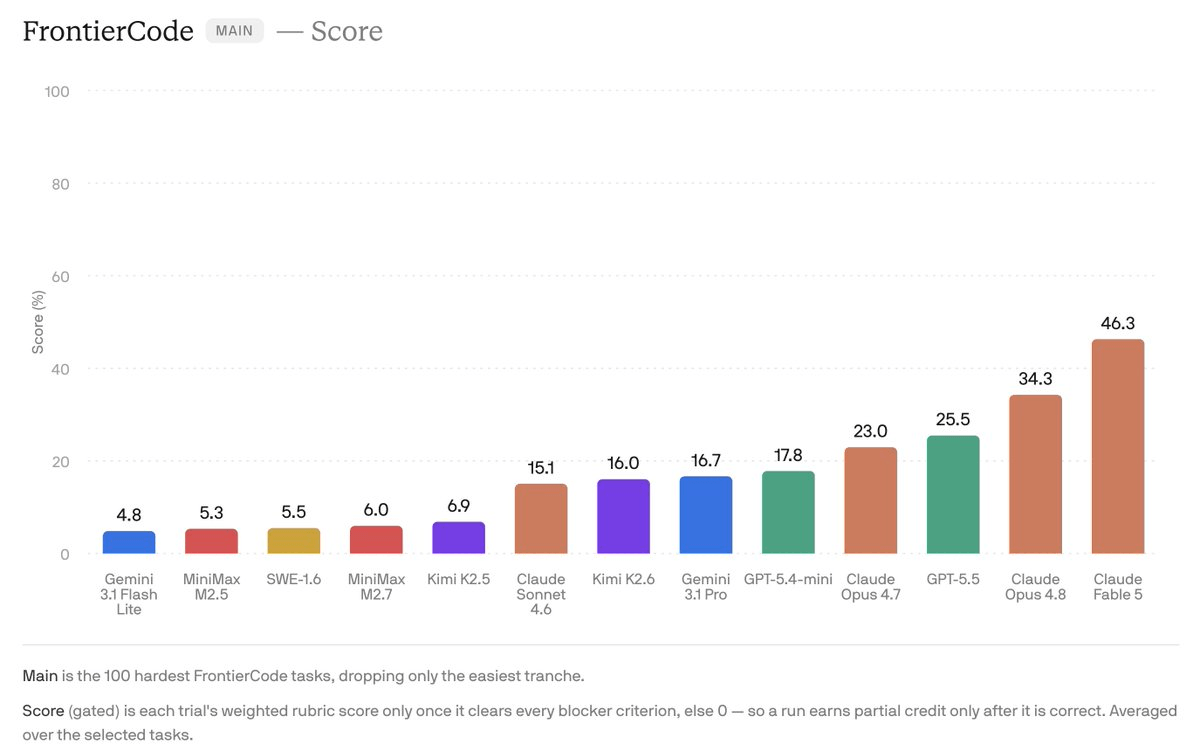
- Cognition has integrated Claude Fable 5 into Devin Cloud, Desktop, and CLI, available now.
- Fable 5 is Anthropic's first publicly available Mythos-class model — the same capability tier as the gated Mythos Preview, with safety guardrails added.
- It earns the #1 spot on Cognition's FrontierCode benchmark, scoring 29.3% on the Diamond tier vs. 13.4% for Opus 4.8 and 5.7% for GPT-5.5.
- In Devin Cloud, Fable 5 powers the new Ultra agent tier, designed for long-horizon tasks and debugging, at ~40% cost premium over the default agent.
- Fable 5 is priced at $10/M input tokens and $50/M output tokens; free on paid Anthropic subscription plans through June 22, then usage credits required.
- Guardrails redirect less than 5% of sessions to Opus 4.8 for high-risk topics (cybersecurity, biology, chemistry) — most engineering workflows are unaffected.
Cognition just added Claude Fable 5 to its entire Devin lineup. The model is now live in Devin Cloud, Devin Desktop, and Devin CLI , and according to Cognition's own benchmark, it's the best model available for real-world engineering tasks.
The timing is notable. Anthropic announced Claude Fable 5 as a Mythos-class model available to enterprise customers and paid subscribers just today, and Devin is already shipping it across every product tier. Fable 5 is a Mythos-class model made safe for general use, with capabilities that exceed any model Anthropic has ever made generally available, showing exceptional performance in software engineering, knowledge work, vision, and scientific research.
What Mythos-class actually means
To understand why this matters, a bit of context: Mythos-class models are a tier of Claude models that sit above the Opus class in capability. The first, Claude Mythos Preview, was released through Project Glasswing. That preview was gated to a handful of cybersecurity partners because of its advanced ability to find and exploit vulnerabilities. Fable 5 is the public-safe version of that same tier , it uses the same tier of technology as Mythos but is safe for use by the public because of safeguards and limits placed on the technology.
In high-risk areas like cybersecurity, biology, chemistry, and distillation, the model blocks responses and falls back to Claude Opus 4.8. These safeguards trigger, on average, in less than 5% of sessions. For most engineering workflows , the kind Devin handles , you'll never notice the guardrails.
Topping FrontierCode
Cognition built FrontierCode as their own benchmark for evaluating models on real-world engineering work. Unlike SWE-Bench, which grades functional correctness, FrontierCode asks a harder question: it evaluates the quality of AI-generated code, moving beyond simple correctness to assess real-world "mergeability" into production environments , answering whether AI can write code that human maintainers would actually accept.
To achieve this, FrontierCode introduces novel grading methods: "Reverse-Classical" testing ensures AI-written tests fail on the original buggy code; "Code Scope" enforces constraints on which files can be modified; and "Adaptive Classical Grading" uses LLMs to evaluate open-ended solutions flexibly.
The benchmark is genuinely hard. On the Diamond subset , the hardest 50 tasks , Fable 5 scores 29.3%, compared with 13.4% for Claude Opus 4.8 and 5.7% for GPT-5.5. That's more than double the previous leader.
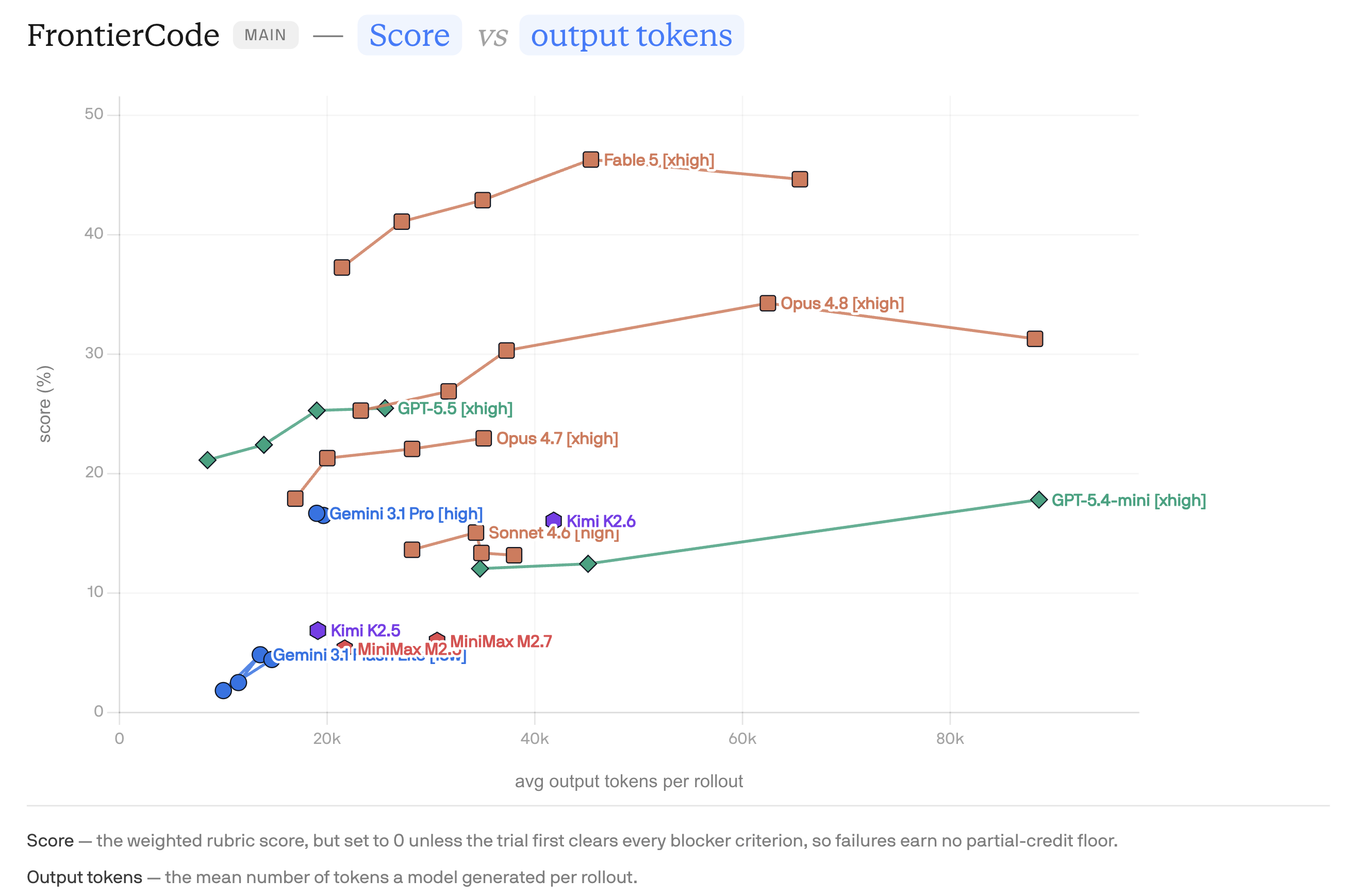
Fable 5 is also more token-efficient than past Claude models: on FrontierCode, it scores highest among frontier models even at medium effort. That token efficiency matters a lot in an agentic context where a single Devin session can involve hundreds of model calls.
Where it lives in Devin
Cognition is rolling out Fable 5 across three surfaces:
- Devin Cloud (Ultra agent): Fable 5 powers the Ultra tier, Devin's most capable agent mode, designed for long-horizon tasks and complex debugging. Cognition tuned the harness so Ultra costs only ~40% more than the default Devin agent.
- Devin Desktop: Available now for local, IDE-integrated workflows.
- Devin CLI: Available now for terminal-based and CI/CD-integrated use cases.
The Ultra agent is the natural fit for Fable 5's strengths. The longer and more complex the task, the larger Fable 5's lead over other models. Tasks like large-scale migrations, multi-file refactors, and multi-day autonomous sessions are where the model's advantage compounds.
What it's actually good at
Beyond the benchmark numbers, early enterprise testing gives a clearer picture of what Fable 5 can do in production:
- Stripe reported that Fable 5 completed a codebase-wide migration in a 50-million-line Ruby codebase in one day , a task that would have taken a team over two months manually.
- On SWE-Bench Pro, which measures ability to complete difficult software engineering tasks, Fable 5 and Mythos 5 reach 80.3%, vastly outperforming GPT-5.5 at 58.6%.
- Fable 5 is the new state-of-the-art for vision tasks , it can extract precise numbers from detailed scientific figures and perform complex vision-based tasks like rebuilding a web app's source code from screenshots.
- On Hebbia's Finance Benchmark for senior-level reasoning, Fable 5 has the highest score of any model, with substantial gains in document-based reasoning, chart and table interpretation, and problem solving.
The cost picture
Fable 5 is priced at $10 per million input tokens and $50 per million output tokens, with the existing 90% input token discount for prompt caching. That's double the price of Opus 4.8, but the token efficiency gains may offset the difference for long-running agentic tasks. Cognition's ~40% premium for Devin Ultra over the default agent is a reasonable delta given the capability jump.
For developers, Fable 5 is available through the Claude API as claude-fable-5, and is fully available on the Claude API and consumption-based Enterprise plans. For subscription plans, Fable 5 is included on Pro, Max, Team, and seat-based Enterprise plans at no extra cost through June 22; on June 23, using it will require usage credits.
For teams already using Devin, the upgrade path is straightforward: switch to the Ultra agent in Devin Cloud, or pull the latest version of Devin Desktop or CLI. The model is live now.
Comments
