

Cognition's Devin Hits $48B Valuation as Revenue Nearly Doubles in Four Months
Cognition doubles its valuation in four months as Devin's run rate nearly hits $900M, cementing autonomous coding agents as a real enterprise category.
- Cognition raised over $2B at a $48B valuation, led by a16z and Accel.
- Run-rate revenue jumped from $492M in May to nearly $900M today.
- NVIDIA joined the round as both investor and customer alongside 30+ firms.
- Devin now runs proactive work via Automations, Auto-Triage, and Security Swarm.
- Customers include NVIDIA, GE Aerospace, Citi, Mercedes-Benz, Goldman Sachs, and Modal.
- Cognition opened six new global offices to support enterprise deployments.
The maker of Devin, the autonomous AI software engineer, just pulled off one of the fastest valuation climbs the AI infrastructure market has seen. Cognition announced a Series E of more than $2 billion at a $48 billion valuation, led by new investors Andreessen Horowitz and Accel alongside existing backers Founders Fund, General Catalyst, and Avenir. NVIDIA also joined the round, which stretches to more than three dozen firms including Benchmark, Bessemer, Kleiner Perkins, Greylock, Lightspeed, and T. Rowe Price.
The number that makes the valuation defensible: Cognition says run-rate revenue climbed from $492M in May to almost $900M today, roughly an 80% jump in four months, on top of a year in which ARR grew from around $73M to nearly a billion.
From $10B to $48B in twelve months
Cognition moved through valuation checkpoints of about $350M in early 2024, $2B in April 2024, nearly $4B in March 2025, $10.2B in September 2025, and $26B in May 2026 before landing at $48B now. The jump from $10.2B to $26B alone happened in eight months.
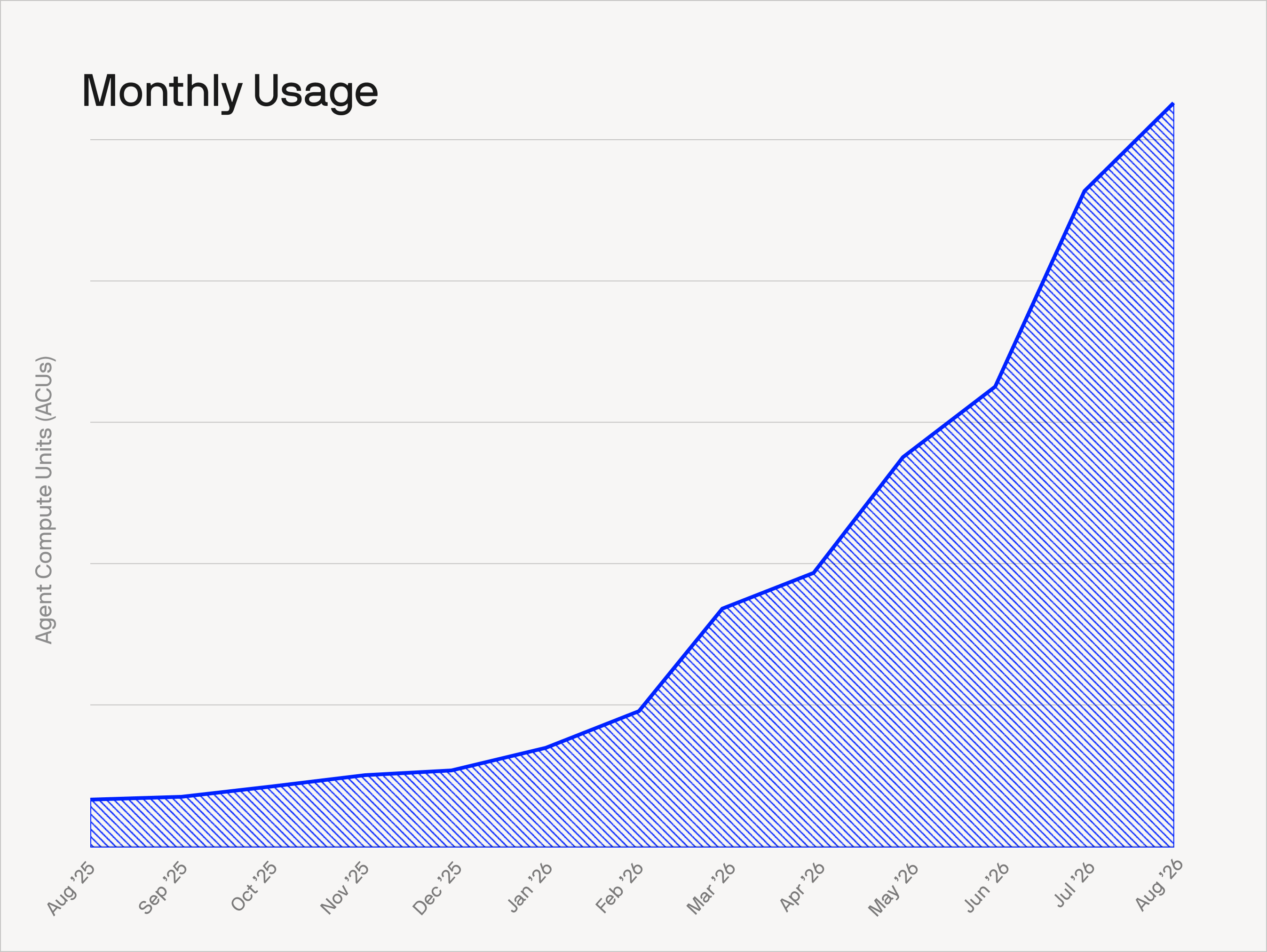
The multiples are eye-watering. At the previous round Cognition traded at roughly 53x revenue, well above normal public SaaS and premium software peers, and looked expensive even against Cursor, whose ~$29B valuation on $1B+ ARR implied roughly 29x. The new $48B tag on ~$900M ARR keeps the multiple in a similar zone, meaning investors are underwriting continued hypergrowth rather than a plateau.
What Devin actually does now
Devin launched as a chat-driven agent that could take a ticket and ship code. Where code completion tools suggest lines while a human writes, Devin operates as a full coding agent: it takes a task description and produces working software autonomously, planning, writing, debugging, and deploying code across complex multi-step workflows. The Series E announcement makes clear the product has moved beyond that reactive loop into proactive, event-driven work.
Three capabilities Cognition is pushing as the next surface area:
- Devin Automations watches Slack, GitHub, Linear, and similar systems for triggering events and kicks off work without a human opening a chat.
- Devin Auto-Triage takes a first pass at incident investigation, reading alerts and proposing remediation steps.
- Devin Security Swarm scans and maps large codebases to find and triage multi-step exploits.
The pitch is that engineers act as architects setting goals and priorities while swarms of agents grind through execution. Cognition also says compute budgets will start to self-allocate toward the highest-impact tasks, an idea that only holds up if agents can reliably judge their own ROI.
Enterprise logos and the Windsurf acquisition
The customer list is what makes this look like infrastructure rather than a demo. Cognition names chip design at NVIDIA, aviation at GE Aerospace, financial services at Citi, automotive at Mercedes-Benz, and AI infrastructure at Modal. Earlier reporting added Goldman Sachs and the U.S. Army and Navy.
Getting there required the Windsurf acquisition. Cognition bought the AI coding startup in July 2025, just days after Google poached its CEO, co-founder, and research leads. The deal broadened the product surface considerably: Devin handles the asynchronous agent layer while Windsurf adds a synchronous IDE layer, turning Cognition from a single-agent company into a wider coding platform.
Why stay independent
The strategic rationale in the announcement is blunt: Cognition wants to remain an independent agent lab so it can mix and match the best underlying models, including its own, rather than tie customers to a single provider. The biggest competitive threat is bundling. Microsoft/GitHub, OpenAI, Anthropic, and Google need only make autonomous coding a default feature of the stacks developers already pay for, not outperform Devin feature by feature.
Raising $2B buys time and optionality to run model training, product development, and go-to-market in parallel. It also funds an aggressive geographic push. In the past year Cognition opened offices in Washington D.C., Tokyo, Singapore, London, São Paulo, and Madrid on top of its San Francisco, New York, and Austin hubs. That is a field-sales footprint, not a self-serve one, consistent with the enterprise contracts driving the ARR curve.
Who feels the pressure
The clearest beneficiary beyond Cognition is the thesis that independent agent companies can survive alongside frontier labs. A year ago most signals pointed to model makers absorbing this market themselves; this round is a large counter-bet. NVIDIA participating as both investor and customer reinforces it.
The pressure lands on any coding-agent startup that cannot show a comparable revenue slope, and on point-solution vendors in incident response and application security whose workflows Devin is absorbing. For teams evaluating tooling, the practical shift is that autonomous agents are moving out of chat windows and into Slack alerts, CI pipelines, and security review loops. Cognition is betting that production-grade is now, not later.
Comments
