

CMD Fixes the Hidden Flaw Quietly Holding Back Fast Video AI
A new distillation method fixes a subtle mismatch between how teacher and student models see time in fast, controllable video generation.
 PRO
- New method Context-Matched Distillation fixes teacher-student information mismatch in fast autoregressive video generation.
- Replaces bidirectional full-clip teachers with a causal teacher that only sees past frames and controls.
- Prefix Scoring evaluates each target under the student's own cached rollout prefix for on-policy supervision.
- Prefix Corruption perturbs unreliable early-training prefixes to stabilize the distillation loop.
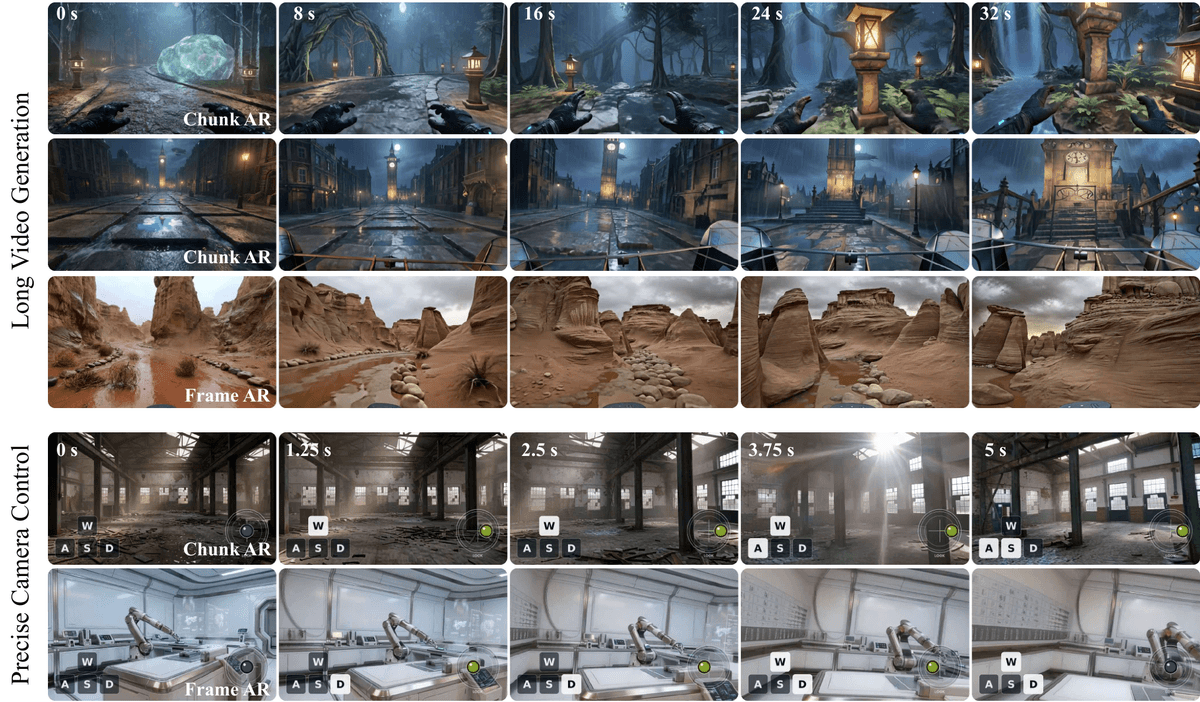
- Reports 5.68-point VBench Total gain on short videos and much better time-varying camera control adherence.
- Extends naturally to frame-wise, chunk-wise, long video, and camera-conditioned autoregressive distillation.
Fast video generation has a training problem nobody quite named until now. When you distill a big, slow video diffusion model into a fast few-step autoregressive one, the teacher usually looks at the whole clip at once while the student is forced to generate frame by frame with no view of the future. That mismatch has been quietly holding back interactive video models, and a new paper called Context-Matched Distillation (CMD) proposes a clean fix.
The core claim is simple. Teacher supervision should be restricted to the same information the student actually had when it produced a frame. By aligning the causal teacher's supervision with the student's available information, the method reports a 5.68-point increase in VBench Total scores for short videos and significantly reduces camera-pose errors in controlled generation.
The mismatch nobody was fixing
To understand why this matters, it helps to know how the current pipeline works. Distribution Matching Distillation (DMD) is the standard trick for turning a many-step diffusion model into a few-step one. It compares the gradients of a real-data score model and a fake-data score model on the student's outputs, pulling the student's distribution toward the teacher's. The generator can be a causal model while the teacher is bidirectional and bigger, and while DMD was originally proposed for step distillation, recent works have adapted it for causal video distillation.
That is exactly where things go sideways. Interactive video needs frames that depend only on past frames and past control inputs, because at inference time the future does not exist yet. But the teachers used to score those frames during training are bidirectional, meaning they attend to the entire clip including future frames the student could never have seen. The score signal ends up leaking information the student cannot use, so the gradients pull the student toward behavior it cannot actually reproduce at rollout time.
This story is for Pro members
You've reached the end of the free preview. Upgrade to AlphaSignal Pro to read the full article - and everything else behind the paywall.
Comments
