

Claurst Hits 10K Stars as Open-Source Rust Coding Agent Rivals Claude Code
Kuber Mehta built Claurst, a Rust-native terminal coding agent with 10k+ stars that reimplements Claude Code's behavior with multi-provider support and zero telemetry
 PRO
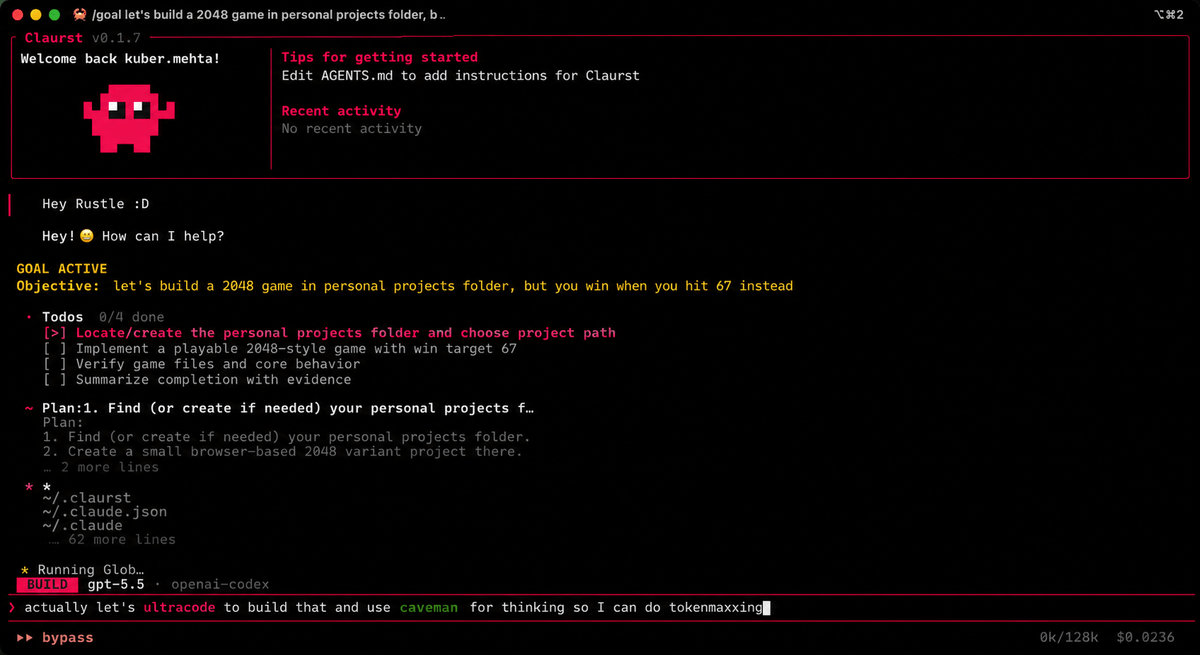
- What it is: Claurst is an open-source Rust terminal coding agent with 10k+ stars, built as a clean-room reimplementation of Claude Code's behavior.
- Origin: Developer Kuber Mehta reverse-engineered Claude Code's behavioral spec (not its source) and rebuilt it from scratch in idiomatic Rust.
- Multi-provider: Supports 30+ providers including Anthropic, OpenAI, Google, Ollama, DeepSeek, Groq, and Mistral — bring your own API key.
- Key features: Memory consolidation, chat forking, plugin system, headless
-pmode, ACP editor integration (Zed, Neovim, JetBrains), and experimental/goalmulti-turn mode. - Cost: Free under GPL-3.0; you only pay for the model provider you connect (or use Ollama locally for free).
- Status: Beta v0.1.7 — core TUI and multi-provider routing are stable; experimental features like
/goaland managed agents still have rough edges.
Claurst is an open-source terminal coding agent built in Rust by developer Kuber Mehta. It started as a clean-room reimplementation of Claude Code's behavior and has grown into a TUI pair programmer with multi-provider support, a plugin system, chat forking, memory consolidation, and a companion named Rustle. It has accumulated over 10,000 GitHub stars and nearly 7,800 forks.
How it came to exist
Claude Code's source code was sitting in plain sight on the npm registry, bundled into the published package as a sourcemap file. Mehta wrote a detailed technical breakdown of what that source revealed, and that analysis became the seed for Claurst. Rather than distributing the original TypeScript, the project used a strict two-phase process:
- Specification phase: An AI agent analyzed the leaked source and produced exhaustive behavioral specs, architecture diagrams, data flow descriptions, and tool contracts. No source code was carried forward.
- Implementation phase: A separate AI agent implemented everything from the spec alone, in idiomatic Rust, never referencing the original TypeScript.
The README cites Phoenix Technologies v. IBM (1984), the clean-room BIOS engineering case, as the legal model for this approach. The result is a codebase that reproduces Claude Code's behavior, not its expression.
This story is for Pro members
You've reached the end of the free preview. Upgrade to AlphaSignal Pro to read the full article - and everything else behind the paywall.
Comments
