

Claude Opus 5 Debugging Benchmark: Does More Reasoning Actually Fix More Bugs?
We ran Claude Opus 5 through 260 debugging attempts at Low, Medium, High, and XHigh effort, then compared its reliability, cost, latency, token use, and patch behavior with nine other models.


- A 260-attempt benchmark of Claude Opus 5 across four effort levels found that moving from Low (93.8% resolve rate) to XHigh (98.5%) improved reliability by only 4.7 percentage points while increasing cost per successful fix by 477% and token usage by 635%.
- Eleven of thirteen debugging tasks were already solved perfectly at Low effort, meaning higher settings added tokens, latency, and cost without producing additional fixes on the majority of bugs.
- Medium effort emerged as the practical sweet spot, matching High's 63/65 resolve rate at 57% fewer tokens, 38% lower latency, and less than half the cost per fix.
- Higher effort levels also changed patch behavior, with XHigh producing an average of 21.9 changed lines versus 11.3 at Low, and generating more over-edit attempts that exceeded expected edit scope.
- In cross-model comparison, Opus 5 at XHigh (64/65) was outperformed on reliability, cost, and latency simultaneously by Grok 4.5, GPT-5.6 Sol, and Fable 5, all of which achieved 65/65.
We ran Claude Opus 5 through 260 debugging attempts at Low, Medium, High, and XHigh effort, then compared its reliability, cost, latency, token use, and patch behavior with nine other models.
Anthropic introduced Claude Opus 5 as a thoughtful, proactive model built for complex coding, agentic work, and long-running tasks. It gives developers five effort levels that control how much work the model puts into a response.
That creates a practical question: how much reasoning should you actually buy? A model that spends more time investigating a bug might find a subtle cause that a faster attempt misses. But deeper reasoning also means more tokens, tool calls, latency, and API cost. If the extra work does not produce more verified patches, the higher setting is simply burning resources.
To measure that tradeoff, we tested Opus 5 at Low, Medium, High, and XHigh effort. Each configuration attempted the same 13 debugging tasks five times, producing 260 scored attempts.
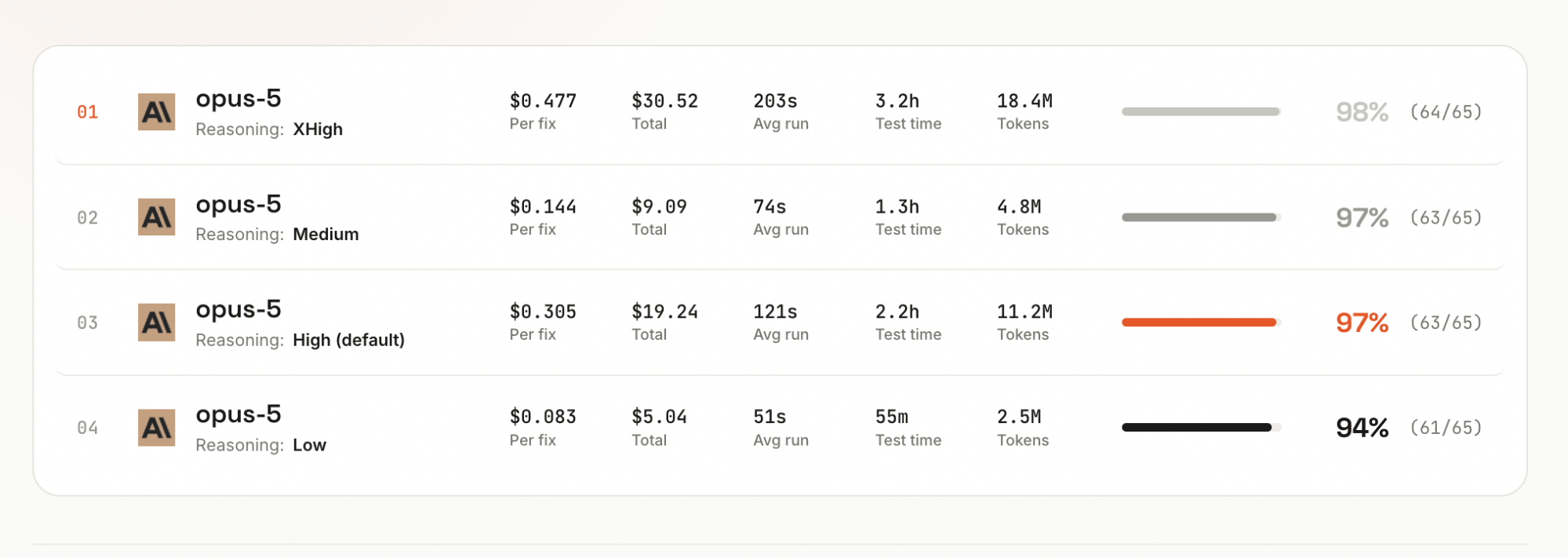
More effort improved reliability, but the gains were small compared with the increase in cost, token use, and latency. Cost per successful fix rose from $0.083 at Low to $0.477 at XHigh. The strongest overall balance appeared at Medium. Eleven of the 13 tasks were already solved perfectly at Low.
Selectively increasing effort outperformed using High or XHigh for every bug. And when compared with other frontier models, Opus 5 at XHigh fixed 64 of 65 attempts while three other models fixed all 65 at lower cost and latency.
What Anthropic claims about Opus 5
Claude Opus 5 supports a one-million-token context window, up to 128,000 output tokens, and adaptive thinking. It is priced at $5 per million input tokens and $25 per million output tokens, matching Opus 4.8's standard rates.
Anthropic makes High the default effort level. According to its documentation, explicitly setting High and omitting the effort parameter produce the same behavior. Developers can lower the setting to save tokens or raise it to XHigh and Max for more demanding work.
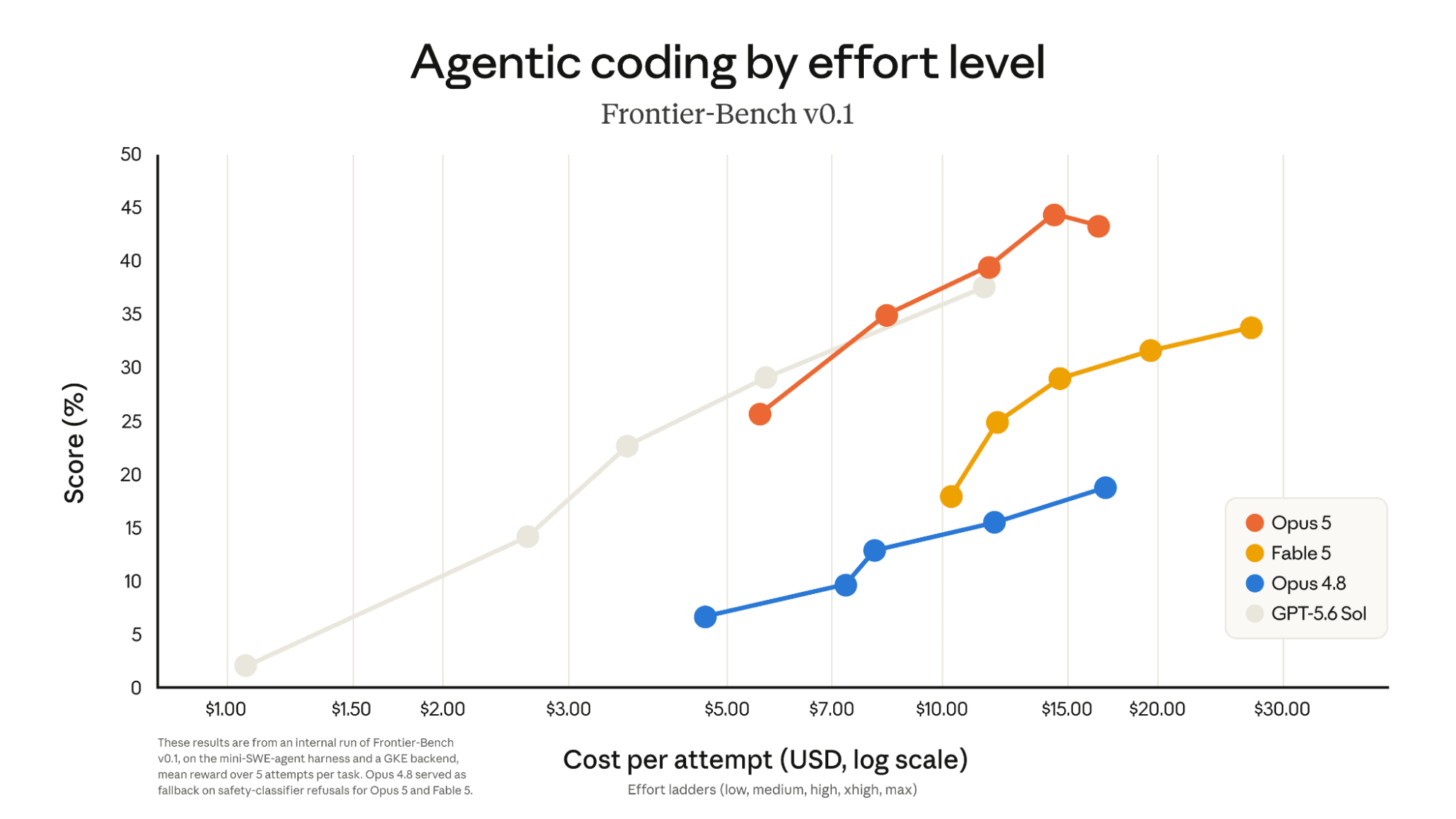
The company positions Opus 5 as a major improvement for software engineering and long-horizon work. Anthropic reports that it more than doubles Opus 4.8's performance on Frontier-Bench at a lower cost per task. At Max effort on CursorBench, it reportedly comes within 0.5% of Fable 5's peak score at around half the cost per task.
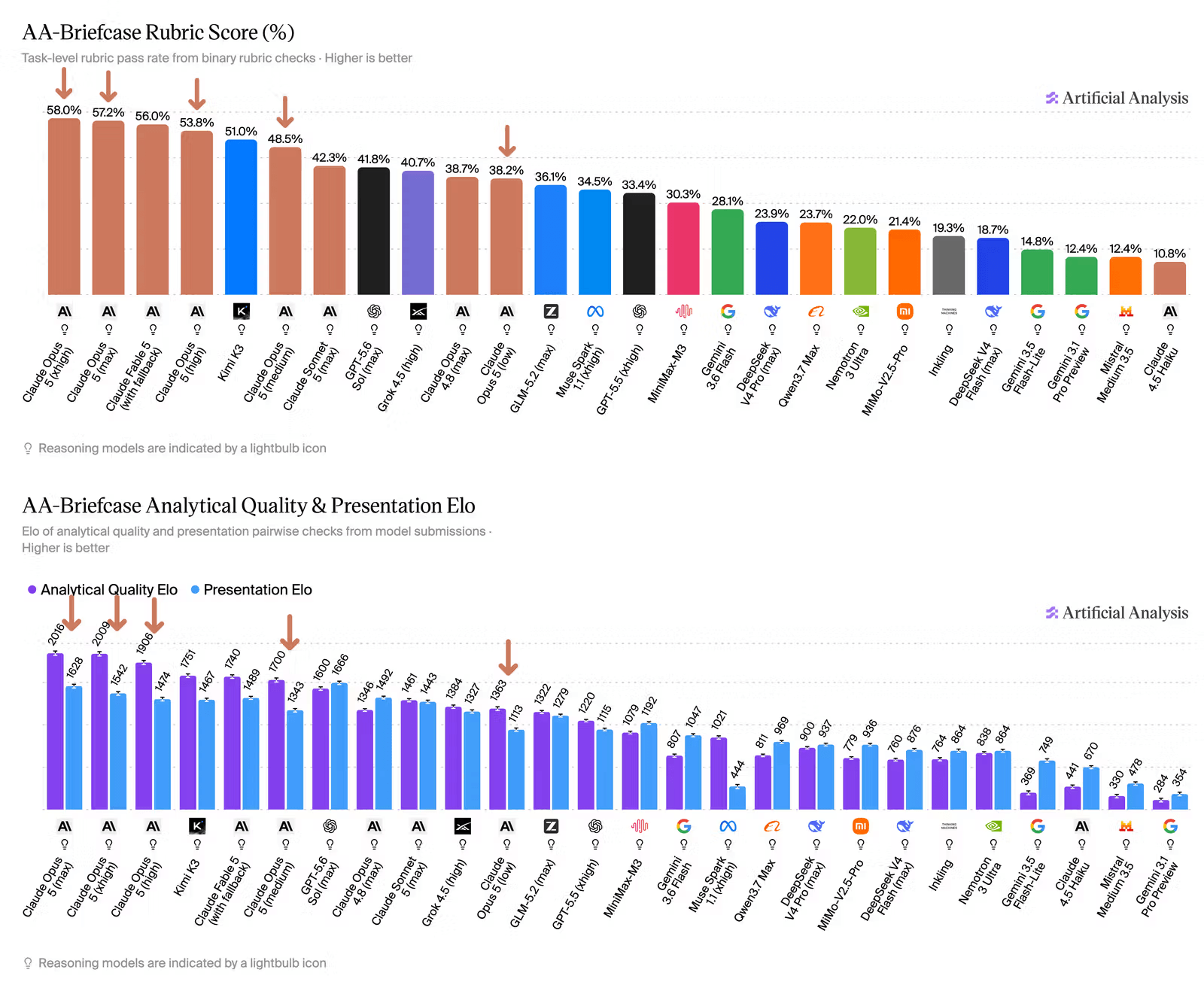
Independent testing supports the capability story, but also reveals the cost of additional deliberation. Artificial Analysis ranked Opus 5 first on its AA-Briefcase agentic knowledge-work benchmark, with its High, XHigh, and Max configurations taking the top three positions. All three averaged more than 25 minutes per task. Max averaged 36.2 minutes and 103 turns, compared with 24.1 minutes and 55 turns for Opus 4.8 at Max.
CodeRabbit found a similar tradeoff in code review. Opus 5 at XHigh produced a more precise set of actionable comments than its production baseline, but caught fewer known issues and generated roughly four times as many nitpicks. It also used about 50% more input tokens and 65% more output tokens than the GPT-5.6 models in the same evaluation.
Those results suggest that higher effort does not improve every part of the model's work equally. It can change how long Opus investigates, how often it checks its work, and how broadly it interprets the task. Whether that helps depends on the bug.
How the debugging benchmark works
The benchmark places a coding agent inside SignalDesk, a private newsletter operations application with roughly 7,000 lines of Python and TypeScript, including a FastAPI data pipeline and a Next.js frontend.
Don't miss what's next in AI
Join 300,000+ engineers and researchers who get the signal, not the noise. Create a free account to read the rest of this story.
- Full access to in-depth AI research breakdowns
- Be the first to know what's trending before it hits mainstream
- Daily curated papers, repos, and industry moves
Comments
