
CJ Pais Built Handy After Breaking a Finger, Now It Has 21K Stars
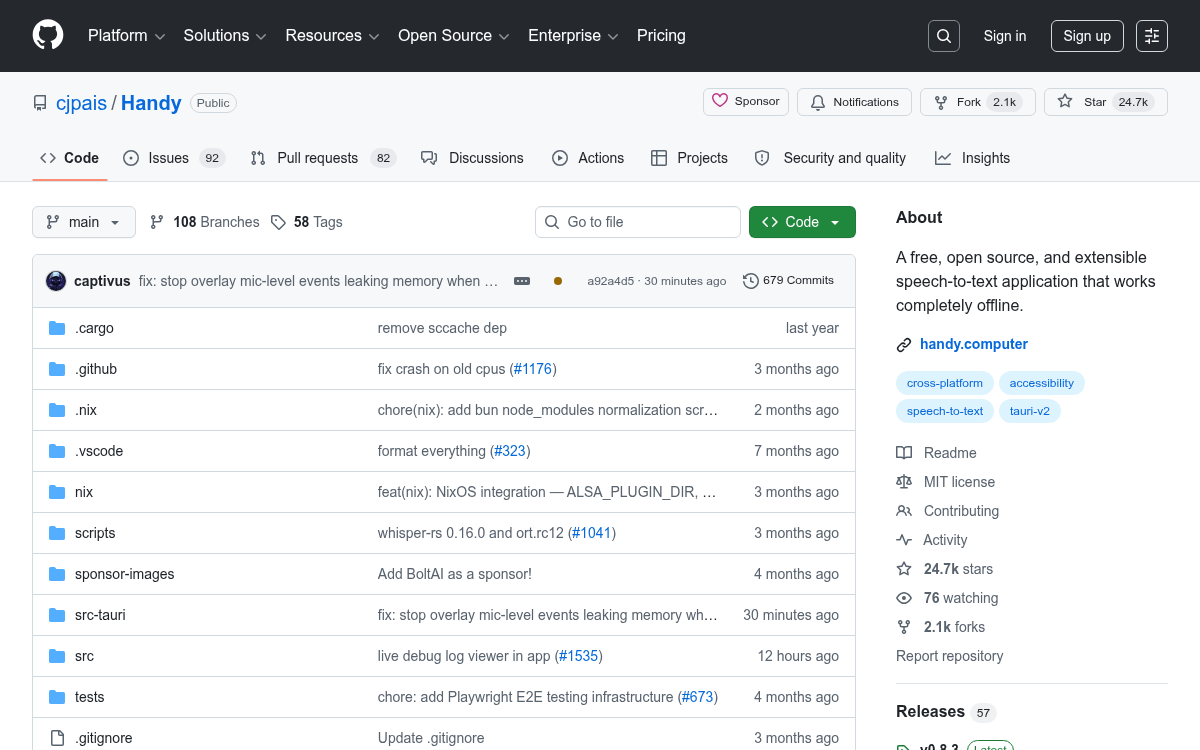
Handy is a free, MIT-licensed, fully offline speech-to-text desktop app built in Rust that pastes transcriptions directly into any text field — no cloud, no account, no cost.
 Pro
Takeaways
- Free and fully offline: Handy is an MIT-licensed, open-source speech-to-text desktop app with no cloud, no account, and no cost.
- Two model backends: Supports OpenAI Whisper (Small/Medium/Turbo/Large) with GPU acceleration, and NVIDIA Parakeet V3 for CPU-only, 25-language transcription.
- Parakeet V3 is the standout: A 600M-parameter model running at up to 5x real-time speed on mid-range CPUs, with automatic language detection across 25 European languages.
- Built lean with Tauri: Rust backend + React frontend; the Windows installer is just 12.6 MB — far lighter than Electron alternatives.
- Linux's best dictation option: Nearly no polished dictation app covers Linux; Handy has been widely adopted there, earning 200+ points on Hacker News.
- Known limits: No real-time streaming (2–5s latency after speaking), occasional Whisper crashes on Windows/Linux, and Wayland requires extra setup tools.
Handy started because its creator, CJ Pais, broke a finger. Stuck in a cast and unable to type properly, he tried the usual suspects , MacWhisper, SuperWhisper , and found them either paywalled or opaque about where audio was going. So he built Handy: a free and open source speech-to-text application that runs on Windows, macOS, and Linux. It has since crossed 21,000 GitHub stars and is still actively shipping.
One shortcut, any text field
Handy lets users start transcription instantly using a configurable keyboard shortcut , press to record, release to transcribe , and automatically pastes the resulting text into any active text field. There is no dedicated editor, no clipboard manager to configure, and no cloud account to authenticate. There is nothing to buy. Handy has no paid tier, no subscription, no word limits, and no account system.
The workflow is intentionally minimal:
- Press your configured hotkey (push-to-talk or toggle mode)
- Speak
- Release , Handy processes locally and pastes the result into whatever app has focus
Two model families, one offline pipeline
Handy's backend leverages OpenAI's Whisper models for GPU-accelerated speech recognition and Parakeet V3 for efficient CPU-only transcription with automatic language detection. Before any audio even reaches the model, Handy integrates Silero's Voice Activity Detection (VAD) for silence filtering, ensuring only speech segments are processed. VAD (Voice Activity Detection) is a lightweight classifier that strips out silence before it hits the heavier transcription model , this keeps latency low and prevents Whisper from hallucinating text during quiet gaps.
The model options available in Handy today:
- Whisper Small (487 MB) , fast, modest accuracy, runs on most hardware
- Whisper Medium (492 MB) , better accuracy, still reasonable speed
- Whisper Large v3 Turbo (1.6 GB) , delivers 6x faster inference than Large v3 by reducing decoder layers from 32 to 4
- Whisper Large v3 (1.1 GB, quantized) , best multilingual coverage, 99 languages
- Parakeet V3 (478 MB) , CPU-optimized, 25 European languages, automatic language detection
Handy v0.8.0 brought speed improvements for the Whisper models , more than 2x as fast on Apple Silicon. The latest release, v0.8.3, also added support for the Cohere Transcribe model, further expanding the model roster.
Why Parakeet V3 is the headline model
Parakeet-tdt-0.6b-v3 is a 600-million-parameter multilingual ASR model designed for high-throughput transcription. It extends the v2 model by expanding language support from English to 25 European languages, and automatically detects the language of the audio without requiring additional prompting. NVIDIA trained it on their Granary dataset , over 670,000 hours of audio , using a FastConformer-TDT architecture.
TDT stands for Token-and-Duration Transducer , an architecture that predicts both what word was spoken and how long it lasted in a single pass, which is what makes it so fast at inference time. This implementation achieves exceptional real-time speeds, outperforming standard Whisper and competing directly with GPU-accelerated faster-whisper implementations while running entirely on consumer CPUs. Handy ships Parakeet V3 as an INT8-quantized ONNX model, which is how it manages to run at up to 5x real-time speed on mid-range hardware.
The tradeoffs between the two model families are real:
- On clean English, Whisper usually trails Parakeet on speed and word error rate, and it can hallucinate text during long silences.
- Whisper Large V3 supports 99 languages, making it the safer default for less common languages. It also runs on Intel Macs, where Parakeet does not.
- Among top models, Parakeet TDT-0.6B-v3 achieves 6.32% word error rate , competitive with much larger models.
Built lean, built to fork
Handy is developed using Tauri (Rust + React/TypeScript), running natively across Windows, macOS, and Linux while performing local speech recognition without sending any audio to cloud servers. That keeps it far leaner than Electron-based dictation tools , the Windows installer is just 12.6 MB.
The explicit goal is forkability. The README states that Handy isn't trying to be the best speech-to-text app , it's trying to be the most forkable one. Handy can auto-discover custom Whisper GGML models placed in the models directory, which is useful for users who want to use fine-tuned or community models not included in the default list. You can also control a running instance entirely from the CLI:
handy --toggle-transcription    # Toggle recording on/off
handy --toggle-post-process     # Toggle with post-processing
handy --cancel                  # Cancel current operation
There is also a Raycast extension that lets you start/stop recording, browse transcript history, manage a custom dictionary, and switch models , all from the Raycast launcher.
Where it struggles
Handy is honest about its rough edges. A few worth knowing:
- No real-time streaming. The model processes audio after you stop, so text lands 2 to 5 seconds later. The first words of a transcription can occasionally get clipped, and auto-paste can land in the wrong app if you switch windows while it processes.
- Whisper crashes on some systems. Whisper model crashes affect certain Windows and Linux configurations, typically due to GPU driver conflicts or insufficient VRAM. Parakeet V3 is the recommended fallback.
- Linux/Wayland friction. Wayland support is functional but requires wtype or dotool installation. X11 users have a smoother experience out of the box.
Who is using it and why
The project holds a 5.0 rating on Product Hunt, and a Hacker News thread about it collected over 200 points, with Linux users especially positive. Linux support is Handy's standout , almost no polished dictation app covers it, and the Linux community has adopted Handy for exactly that reason.
The practical use cases cluster around a few clear patterns:
- Dictating into any text field , chat, email, code comments, docs , without leaving the keyboard
- Offline privacy-focused transcription for meeting notes and quick text input, or in environments where cloud services are restricted or unavailable.
- Accessibility tooling for users with repetitive strain injuries or mobility limitations
- A foundation for building custom voice-driven workflows, thanks to the CLI flags and extensible model support
One user on Hacker News described using it as a front-end for an AI coding agent: "My regular cycle is to talk informally to the CLI agent and ask it to say back to me what you understood." They then switched to Handy with Parakeet V3 and found it worked really well.
Handy is available now, free, under the MIT license. Releases ship frequently , version 0.8.3 landed in late April 2026 , with multiple community contributors per release. You can install it via brew install --cask handy on macOS or winget install cjpais.Handy on Windows, or grab a binary directly from handy.computer.