

Cerebras Runs Kimi K2.6 at 981 Tokens/s, Crushing Gemini 3.5 Flash
Cerebras runs Kimi K2.6 at 981 tokens/sec — 5.4x faster than Google's new speed-first Gemini 3.5 Flash, and fast enough for real-time voice with a trillion-parameter model.
- 981 tokens/sec: Cerebras runs Kimi K2.6 at 981 tokens/sec — 5.4x faster than Google's new Gemini 3.5 Flash (181 t/s) and 6.7x faster than the next-best GPU cloud.
- Near-equal intelligence: Both models score within 2 points on the Artificial Analysis Intelligence Index (53.9 vs 55.3); K2.6 leads on SWE-Bench Pro coding (58.6% vs 55.1%).
- First frontier model for real-time voice: Kimi K2.6 on Cerebras posts 452ms time-to-first-token — the only trillion-parameter model to clear the 500ms voice agent threshold.
- 29x end-to-end speedup: A 10,000-token coding task completes in 5.6s on Cerebras vs 163.7s on the official Kimi endpoint.
- Open weights, multi-provider: K2.6 weights are MIT-licensed and available across 15+ providers ($0.60–$2.15/M tokens blended); Gemini 3.5 Flash is closed and Google-only.
- Enterprise trials now open: Cerebras is accepting enterprise trials for K2.6 inference, targeting agentic coding and production AI workloads. Full benchmark results →
Google made an unusual bet at I/O 2026. Instead of launching a new flagship model centered on intelligence, it launched Gemini 3.5 Flash , a model designed first and foremost for speed. That framing is a tell: the inference speed race is now a first-class product dimension. Earlier this year both OpenAI and Anthropic launched high-speed variants of their leading models, priced 3x higher than the base model. Google has now joined them, making speed the headline feature rather than an afterthought. Cerebras decided to run a head-to-head.
Two near-frontier models, one clear winner on speed
Kimi K2.6 is a one-trillion-parameter Mixture-of-Experts (MoE) model from Moonshot AI, with 32 billion parameters active per token. It is the leading open-weight model among highly capable peers including MiMo V2.5, DeepSeek V4, and GLM-5.1, and is especially popular for coding , notably used as the base model for Cursor's Composer 2.5. MoE means the model routes each token through a small subset of specialized sub-networks ("experts") rather than running the full parameter count every time, which keeps compute costs manageable at trillion-parameter scale.
Gemini 3.5 Flash and Kimi K2.6 make for an ideal comparison pair as they both belong in the class of near-frontier models. On the Artificial Analysis Intelligence Index , a composite of ten benchmarks , the two models are neck and neck, scoring 53.9 (Kimi K2.6) and 55.3 (Gemini 3.5 Flash). On coding specifically, K2.6 tops SWE-Bench Pro at 58.6, outperforming Claude Opus 4.6 and matching GPT-5.4, while leading the field on agentic benchmarks like Humanity's Last Exam and DeepSearchQA.
The numbers that matter
Gemini 3.5 Flash achieves 181 tokens/s on Artificial Analysis's standard benchmark (10,000-token input), significantly faster than Claude Opus 4.8 and GPT-5.5 in the 60 tokens/s range. That already makes it the fastest closed model on the market. Then there's Cerebras.

Kimi K2.6 on Cerebras is in another category entirely. Cerebras clocks in at 981 output tokens per second , 5.4x faster than Gemini 3.5 Flash. Even against Google's own staged demos, which showed Gemini 3.5 Flash running around 280 tokens per second on what appears to be next-gen TPUs, Cerebras is still more than three times faster.
End-to-end response time tells an even starker story. On a standard agentic coding workload with 10,000 input tokens and 500 output tokens:
- Gemini 3.5 Flash: 17.5 seconds total
- Kimi K2.6 on Cerebras: 5.6 seconds total
- Kimi K2.6 on official Kimi endpoint: 163.7 seconds , a 29-fold difference versus Cerebras.
Why Cerebras is this fast
This is achieved by running the model on Cerebras Wafer Scale Engines, which store the entire model on-chip, avoiding the need to load from external memory. Standard GPU inference is bottlenecked by memory bandwidth: every generated token requires fetching model weights from off-chip DRAM. LLM token generation bottlenecks on memory bandwidth , each token requires loading model weights from memory to compute. Cerebras's 21 PB/s on-chip bandwidth eliminates the memory wall that constrains GPU inference.
Artificial Analysis measured Cerebras running K2.6 at 981 output tokens per second , 6.7x faster than the next-fastest GPU-based cloud, and 23x faster than the median inference provider. The wafer-scale approach also has a secondary benefit for MoE models specifically: inter-layer communication runs entirely on the wafer's on-chip network fabric, achieving a physical communication bandwidth over 200 times that of NVIDIA's NVLink in the NVL72 architecture.
The voice agent breakthrough hiding in the benchmark
The most underappreciated result in this comparison isn't the throughput number , it's latency. Voice agents have a hard ceiling: at 500ms time-to-first-token or more, the conversation starts to feel like a walkie-talkie. Until now, frontier-class models couldn't clear that bar.
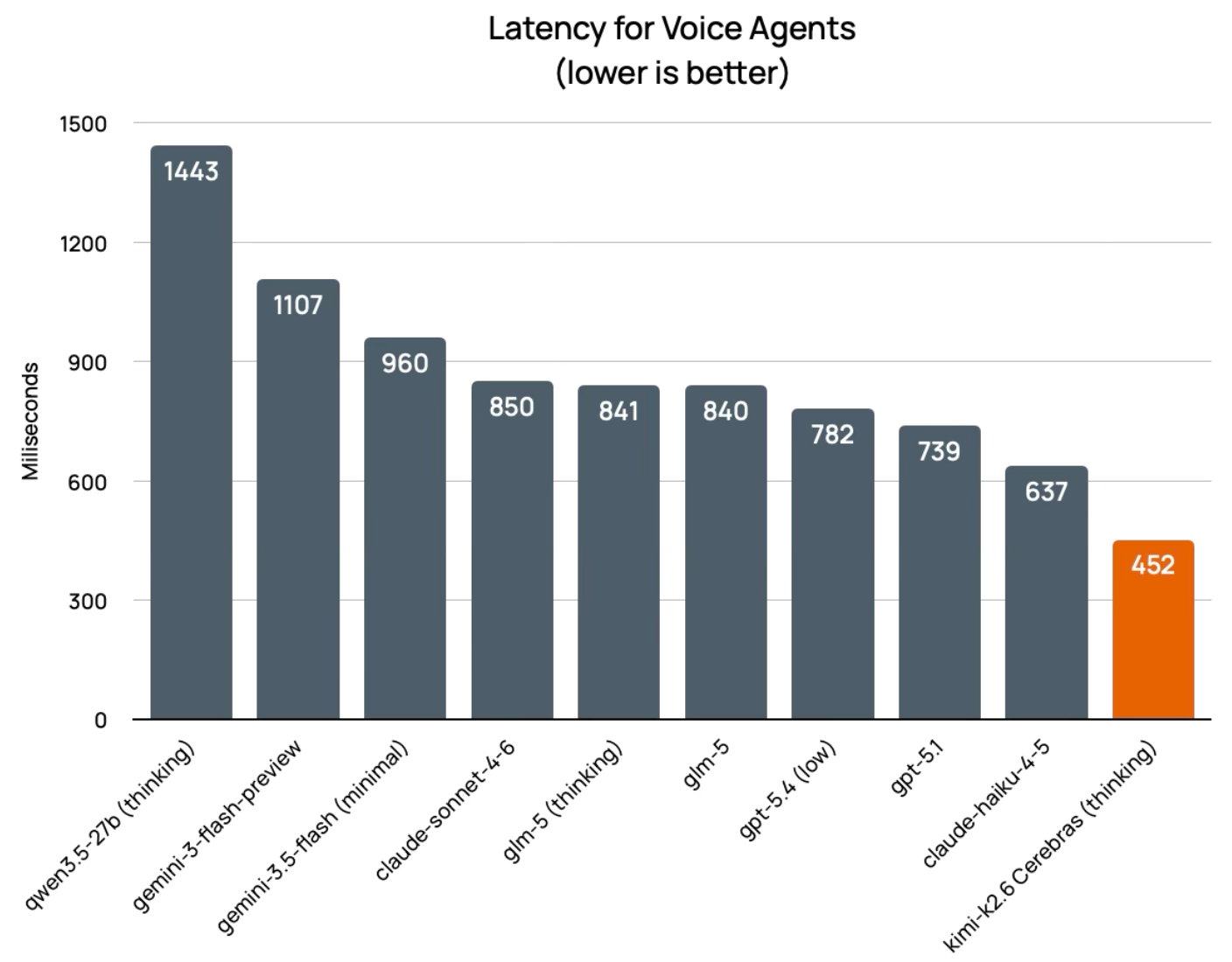
On the aiewf-eval multi-turn voice agent benchmark, Kimi K2.6 on Cerebras posted 452ms time-to-first-token , making it the first trillion-parameter model fast enough for real-time voice with chain-of-thought reasoning enabled. Gemini 3.5 Flash came in at 960ms. Claude Sonnet 4.6 at 850ms. Both are firmly in walkie-talkie territory.
Open weights vs. closed model: the dimension that doesn't show up in benchmarks
Developers have adopted K2.6 as the open alternative to closed-source frontier models , particularly for coding, where its taste for clean front-end design has made it a favorite for full-stack application generation. The 2.6 release extends that capability from front-end into full-stack workflows, including authentication, database operations, and long-horizon agent execution.
The open-weight angle matters for a less obvious reason: the same Kimi K2.6 weights now run on the Moonshot endpoint, on Cerebras wafer-scale inference, on NVIDIA NIM, on Azure AI Foundry, and on GPU clouds like DeepInfra and Spheron , each with a different latency, a different cost per token, and a different ceiling on context length. Gemini 3.5 Flash offers none of that flexibility. If Google changes pricing, deprecates the model, or has an outage, you have no fallback.
Access and pricing
Cerebras is offering enterprise trials of K2.6 to customers today, targeting teams running agentic coding, deep research, or any production AI workload where inference speed is the bottleneck. For the model itself, Kimi K2.6 is available across nine tracked API providers, with blended pricing from $1.15 to $2.15 per 1M tokens on Artificial Analysis. The API is fully OpenAI-compatible , you can swap in model: "kimi-k2.6" and run it in any existing workflow. The weights are also available on HuggingFace under a Modified MIT license for self-hosting with vLLM, SGLang, or KTransformers.
Who should care
The practical use cases where this speed gap becomes a product decision:
- Agentic coding: At close to a thousand tokens per second, Kimi generates code an order of magnitude faster than popular models such as Claude Opus. Developers are able to iterate quickly, get to final solutions faster, and stay focused on one task instead of spinning up multiple agents and switching between them.
- Real-time voice: The only frontier-class model that clears the 500ms latency bar for natural conversation flow.
- Long-horizon agents: For a standard agentic coding request involving 10,000 input tokens, Cerebras delivered the full response , including prompt processing, reasoning, and 500 output tokens , in 5.6 seconds, compared to 163.7 seconds on the official Kimi endpoint.
- Cost-sensitive production: Open weights mean you can fine-tune, self-host, or route across providers to optimize cost without being locked to a single vendor's pricing schedule.
The bigger picture
The inference layer is becoming its own product category. This is the second major axis of model choice that opened up in 2026. The first was which weights to use. The second is which inference provider serves those weights , where Cerebras is 6.7x faster than the next-fastest GPU cloud and 23x faster than the median on this particular workload.
Less than a week after completing the largest tech IPO of 2026, Cerebras Systems is making its most aggressive play yet to dominate the fast-growing AI inference market. The benchmark result is a direct challenge to the assumption that speed-optimized closed models from hyperscalers are the ceiling. With an open-weight trillion-parameter model running at near-1,000 tokens per second, that assumption needs updating. The question now isn't whether hardware-native inference can beat GPU clouds on speed , it clearly can. It's whether Cerebras's platform can absorb the production workloads that follow.
Comments
