

Cerebras Runs Gemma 4 31B at 35x GPU Speed on Its Cloud
Gemma 4 31B hits 1,851 tokens/sec on Cerebras wafer-scale hardware, making real-time multimodal and agentic loops practical for the first time
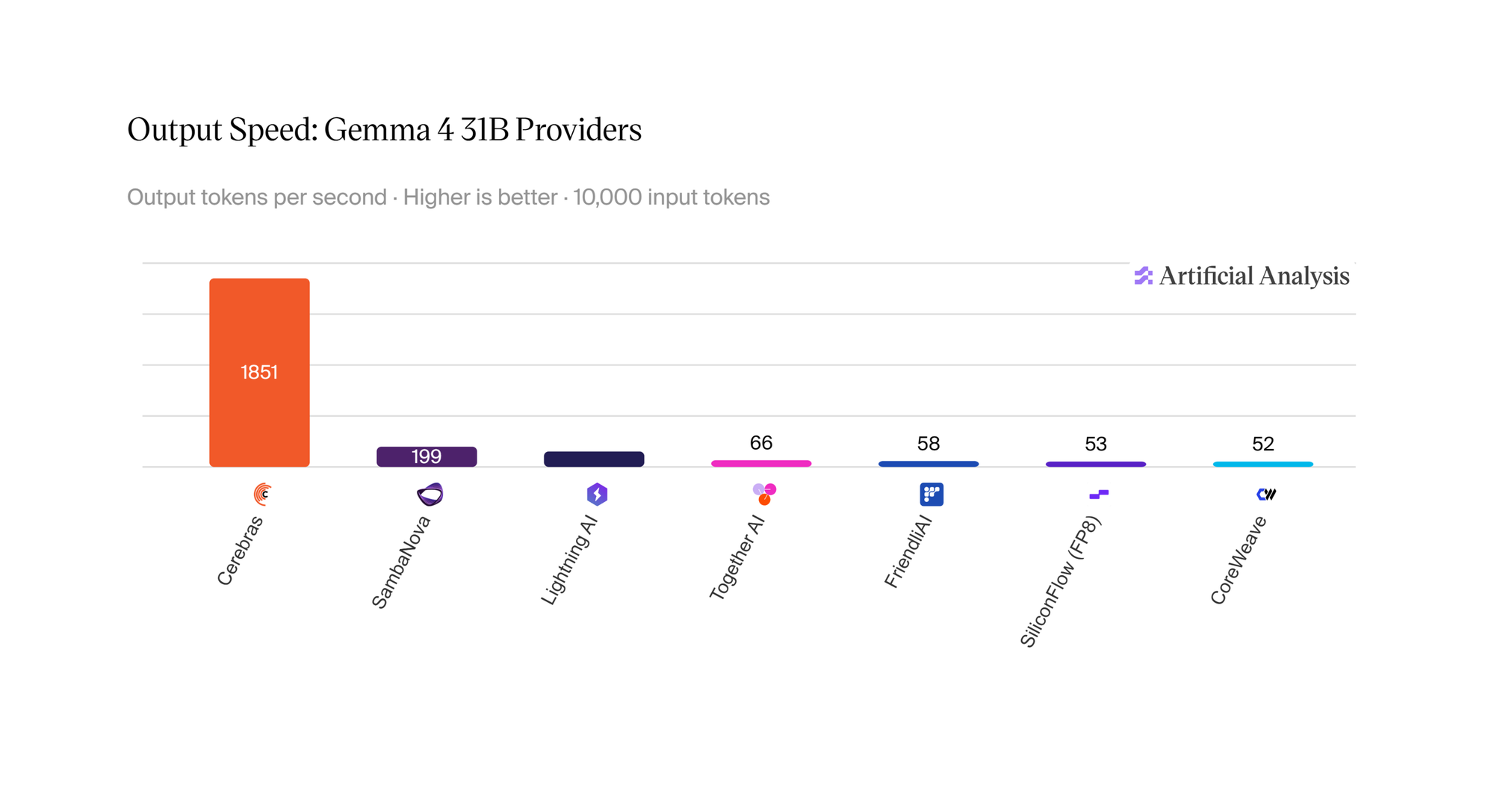
- Speed record: Gemma 4 31B runs at 1,851 tokens/sec on Cerebras, ~35x faster than typical GPU endpoints per Artificial Analysis benchmarks.
- First multimodal model on Cerebras: Gemma 4 is the first image-capable model on the platform, enabling real-time visual and agentic loops.
- Model quality: Scores 84.3% on GPQA Diamond and 80.0% on LiveCodeBench v6, comparable to Claude Haiku 4.5 but open-weight under Apache 2.0.
- How to access: Available now on Cerebras Inference Cloud with a free tier (1M tokens/day, no credit card) and pay-per-token pricing from $10.
- Why it matters: At 1,800+ TPS, multi-step agentic and vision loops become fast enough for real-time product experiences, not just faster batch jobs.
- Platform milestone: Cerebras says multimodal support will expand to additional models, making this the start of a new capability tier on wafer-scale hardware.
Multimodal inference just got a lot faster. Cerebras has launched Gemma 4 31B on its wafer-scale inference cloud, clocking in at a measured 1,851 output tokens per second according to third-party benchmarking firm Artificial Analysis. That is roughly 35 times the speed of a typical GPU endpoint running the same model, and it marks the first time a multimodal model has run at this kind of throughput on any public cloud.
This is not just a speed record for its own sake. The combination of vision support and extreme throughput is what changes what you can actually build.
Why agentic loops hate slow inference
The case for fast inference goes well beyond user experience. As agentic AI workflows proliferate, models are making many sequential calls, reasoning over longer context windows, and driving dramatically higher compute consumption. A single agentic task might call the model five or ten times in sequence: inspect an image, reason over it, call a tool, check the result, retry. As Cerebras CEO Andrew Feldman put it, "speed can become better answers. The longer your reasoning, the more iterations, the better answer you get."
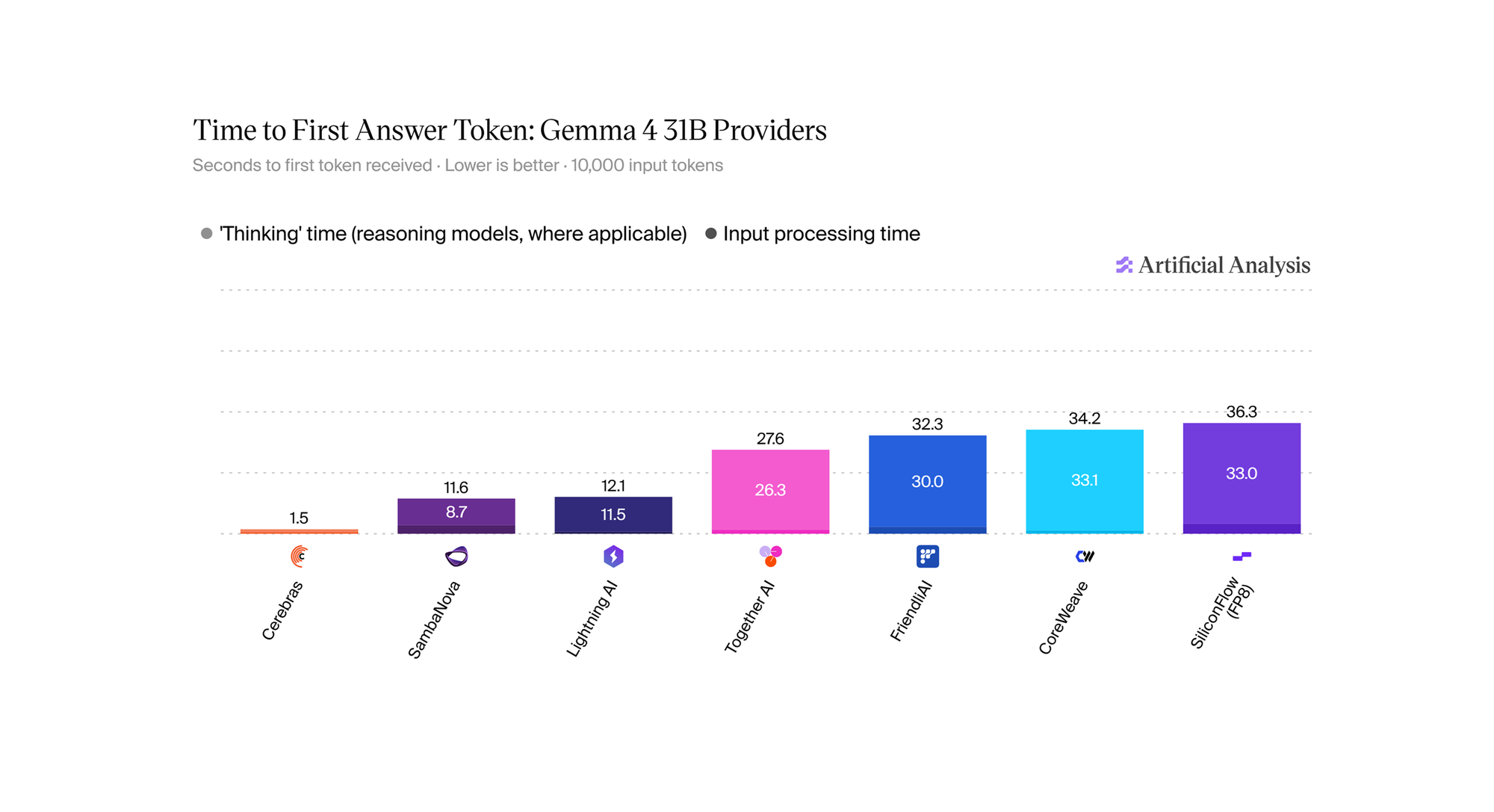
At conventional GPU speeds of 50 to 100 tokens per second, those loops feel sluggish enough that developers design around them. At 1,800+ tokens per second, the loop becomes fast enough to keep a human or another agent in the feedback cycle in real time.
What Gemma 4 31B actually is
Gemma 4 31B is a dense 30.7B multimodal model supporting text, images, and video with a 256K context window, native thinking mode, function calling, and 140+ languages, released under Apache 2.0. Being a dense model (as opposed to a Mixture-of-Experts model, where only a fraction of parameters activate per token) means it achieves high quality without the large memory footprint that MoE architectures require.
The model delivers strong performance across reasoning (89.2% AIME), coding (80.0% LiveCodeBench v6), scientific understanding (84.3% GPQA Diamond), and multimodal tasks (76.9% MMMU Pro). The GPQA Diamond result nearly doubles the 42.4% achieved by the prior Gemma 3 IT 27B, reflecting substantial gains in science reasoning.
On the vision side, image understanding covers object detection, document and PDF parsing, screen and UI understanding, chart comprehension, OCR including multilingual, handwriting recognition, and pointing. The variable image resolution system is a practical addition: you can tune token budgets to match the task, keeping inference fast for simple captioning and switching to high fidelity for OCR or document parsing.
The hardware behind the number
Cerebras's speed advantage is structural, not a software trick. On GPUs, most memory resides outside the silicon in High Bandwidth Memory (HBM), which despite its name becomes the bottleneck for large language models. Most of the GPU's compute capacity sits idle while waiting for parameters to be fetched from HBM to compute cores. The Cerebras WSE packs 44 gigabytes of static RAM directly on the silicon itself, co-located across the wafer close to the compute cores. During inference, parameters are already positioned near the compute, resulting in dramatically faster throughput.
The WSE-3 contains 4 trillion transistors, 900,000 AI cores, and 44GB of on-chip SRAM with 21 PB/s memory bandwidth, roughly 7,000 times that of an H100. The wafer-scale approach trades manufacturing convention for performance characteristics impossible with traditional chips, including a 3,715x interconnect bandwidth advantage over GPU clusters.
Intelligence at Haiku speed
Cerebras positions Gemma 4 31B as a direct alternative to mid-tier closed models. Gemma 4 31B is comparable to Claude Haiku 4.5 in intelligence, scoring 29 and 30 respectively on the Artificial Analysis Intelligence Index. The key difference is that Gemma 4 is open-weight under Apache 2.0, and on Cerebras it runs 18x faster than Haiku.
That framing matters for product design. Logan Kilpatrick of Google DeepMind captured it well: "If every model was doing 2,000 tokens per second, you would probably build different products. You wouldn't build the same product and just have it be faster."
What you can build with this
The use cases that benefit most are ones where the model is called repeatedly or needs to respond to visual input in near-real time:
- Screenshot-to-insight pipelines: Feed a dense dashboard screenshot and get structured output identifying what matters, fast enough to act on it in the same session.
- Document AI: Hand it a research report or technical brief and re-query it in real time rather than waiting for batch processing.
- Agentic coding loops: Give it a broken UI screenshot, the source code, and the console error, and get back a minimal patch with verification steps.
- Computer use and robotics: Visual feedback loops that need to see a UI state, reason over it, and act, all within a latency budget a human can perceive.
- Multi-step RAG: AlphaSense, for example, uses Cerebras speed to search over more documents, giving their customers better answers.
First multimodal model on the platform
Gemma 4 is the first model on Cerebras to support image understanding, enabling workflows combining text with images including screenshots, charts, UI states, scanned pages, forms, and diagrams. It also unlocks computer use and robotics applications. Cerebras says multimodal support will extend to additional models going forward, so this is a platform milestone, not a one-off integration.
Access and pricing
Gemma 4 31B is available now on the Cerebras Inference Cloud in public preview. There is a free tier with API access to prototype prompts, agents, and real-time apps before spending anything. Self-serve pay-per-token pricing is available for higher-volume builders, starting with a $10 deposit and 10x higher rate limits than the free tier. The free tier includes 1,000,000 tokens per day with no credit card required, and it resets daily rather than being a one-time credit.
The API is OpenAI-compatible, so switching is largely a one-line change to your base URL. You can also access it through Hugging Face or OpenRouter if you prefer a unified API surface. Enterprise pricing is available on custom terms for high-volume or on-premises deployments.
The one real limitation to keep in mind: model selection on Cerebras is narrower than on multi-provider platforms because each model must be optimized for the WSE hardware. The trade-off is fewer models, but served blazingly fast. If your workflow requires a specific closed model, Cerebras will not help. But for open-weight workloads where throughput is the constraint, this combination of model quality and inference speed is genuinely hard to match anywhere else right now.
Comments
