

CASIA's Direct Discrepancy Replay Beats Deepfake Detectors While Ditching Stored Faces
A new continual learning approach for deepfake detection stores tiny distribution maps instead of face images, cutting memory 10x while beating prior state of the art.
 PRO
- New CFFD framework replaces stored face images with tiny learnable distribution discrepancy maps.
- Uses characteristic-function matching to condense real-to-fake gap, then DDPM-style composition for replay.
- Achieves 91.08 AA on Protocol 1 with only 50 maps vs 500 stored samples for baselines.
- Works as a plug-in replay module, improving DER, CoReD, DFIL, HDP, and SUR-LID.
- Cuts ArcFace identity linkage from over 24% to 3.91%, reducing privacy leakage risk.
- Paper available on arXiv; no public code released yet.
Deepfake generators keep multiplying, and every new family of forgeries poses the same headache for detectors: how do you teach a model the new manipulation without erasing what it learned about the old ones? A paper from researchers at CASIA and UCAS proposes a cleaner answer than the usual approaches, and it comes with a useful side effect for privacy.
The work introduces Direct Discrepancy Replay, a continual learning framework for face forgery detection that stops storing past face images entirely. It condenses the statistical gap between real and fake faces into a tiny bank of learnable maps, then reconstructs training examples on the fly by combining those maps with real faces from the current task.
Why detectors forget
Continual Face Forgery Detection (CFFD) is the task of updating a detector as new manipulation techniques appear. Continual learning has become the go-to paradigm here because it lets models acquire new knowledge while retaining previously learned capabilities, typically through sample replay, parameter regularization, or gradient projection. Rehearsing a few examples from earlier tasks during new training, known as replay, is the dominant strategy.
Both flavors of replay have real drawbacks:
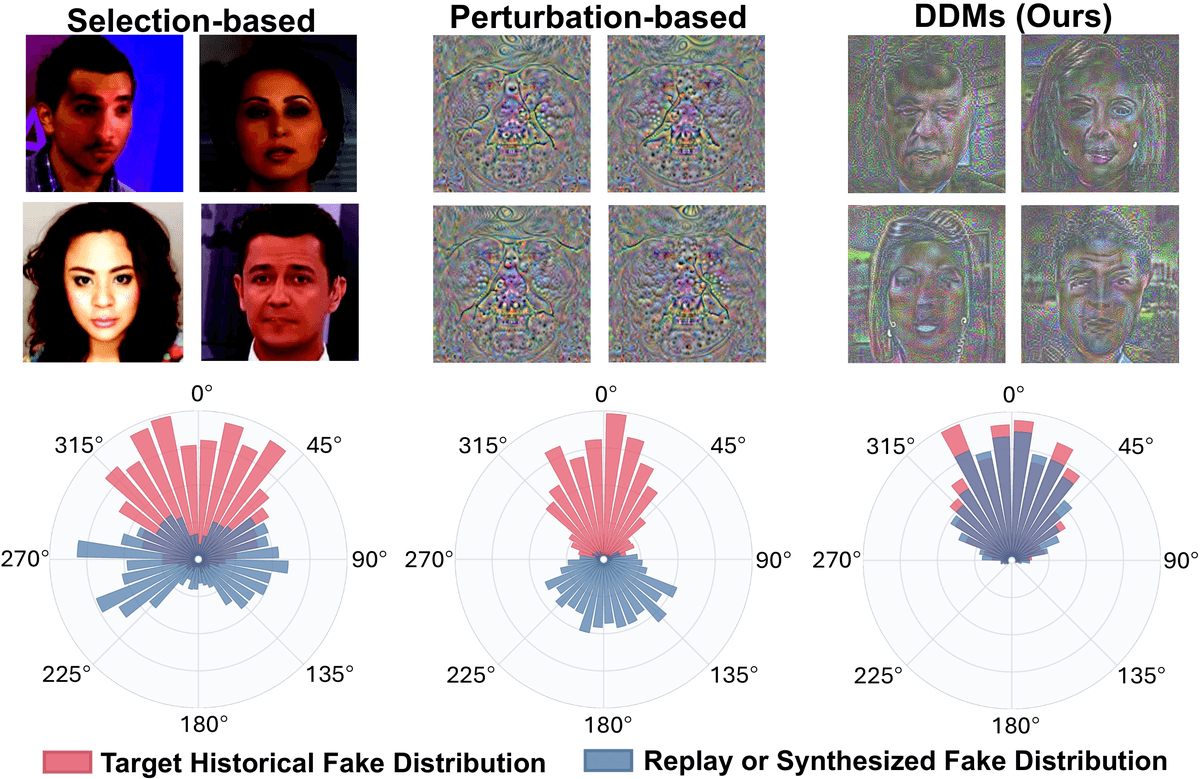
- Selection-based replay keeps a small subset of historical images. Under tight memory budgets it misses the diversity of past forgery cues, and it retains actual identifiable faces in memory.
- Perturbation-based replay, like the Historical Distribution Preserving (HDP) approach that uses universal adversarial perturbations to simulate past forgeries, avoids storing raw faces but stays tied to the previous decision boundary and drifts as the backbone updates.
This story is for Pro members
You've reached the end of the free preview. Upgrade to AlphaSignal Pro to read the full article - and everything else behind the paywall.
Comments
