

CAMEL-AI's OWL Tops Open-Source Agent Rankings With a 69.09 GAIA Score
CAMEL-AI's OWL framework crossed 19,000 GitHub stars while topping the GAIA benchmark for open-source multi-agent systems with a 69.09 average.
 PRO
- OWL is CAMEL-AI's multi-agent framework, now at 19.8k stars and on GitHub
- Scores 69.09 on GAIA, ranking #1 among open-source multi-agent frameworks
- Accepted to NeurIPS 2025, with training data and checkpoints open-sourced
- Ships toolkits for browser automation, document parsing, code execution, search, and MCP
- Apache 2.0 licensed, installable via uv, pip, Conda, or prebuilt Docker image
- Team recommends GPT-4 tier models; smaller models significantly underperform on hard tasks
Multi-agent frameworks have been piling up, but most of them stumble on the messy, multi-step tasks that come up in real work. OWL, from the CAMEL-AI team, is trying to close that gap and has the benchmark numbers to back it up. The project has crossed 19,000 GitHub stars and its accompanying paper was accepted to NeurIPS.
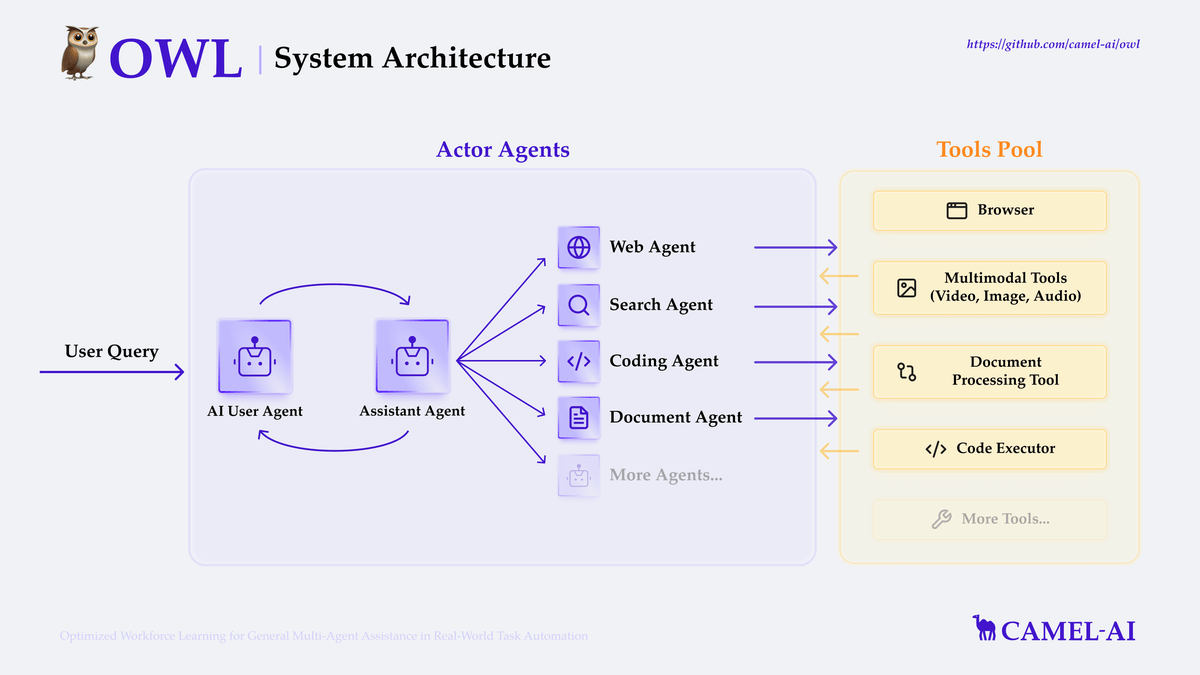
OWL is a multi-agent collaboration framework built on top of the CAMEL-AI Framework, aiming to enable more natural, efficient, and robust task automation across domains through dynamic agent interactions. Where CAMEL provides the base for communicative agents, OWL layers on an orchestration model where specialized agents plan, delegate, and verify each other's work.
Topping the open-source leaderboard
The headline result is on GAIA, a benchmark that grades agents on realistic web and reasoning tasks. Since its open-source release, OWL first ranked first among open-source frameworks on GAIA with an average score of 58.18. That number has since climbed to 69.09, still holding the #1 spot among open-source frameworks according to the project's own tracking.
The team also open-sourced the training dataset and model checkpoints via a Hugging Face collection, with training code coming soon. That makes it one of the few agent frameworks where you can actually inspect the training recipe instead of just the inference-time prompting.
This story is for Pro members
You've reached the end of the free preview. Upgrade to AlphaSignal Pro to read the full article - and everything else behind the paywall.
Comments
