

ByteDance's Seed 2.1 Pro Matches Claude Opus 4.6 on Frontend Code Before Launch
ByteDance's Seed 2.1 Pro Preview debuts at #8 on Arena's frontend code leaderboard, matching Claude Opus 4.6 on React and UI tasks before public release.
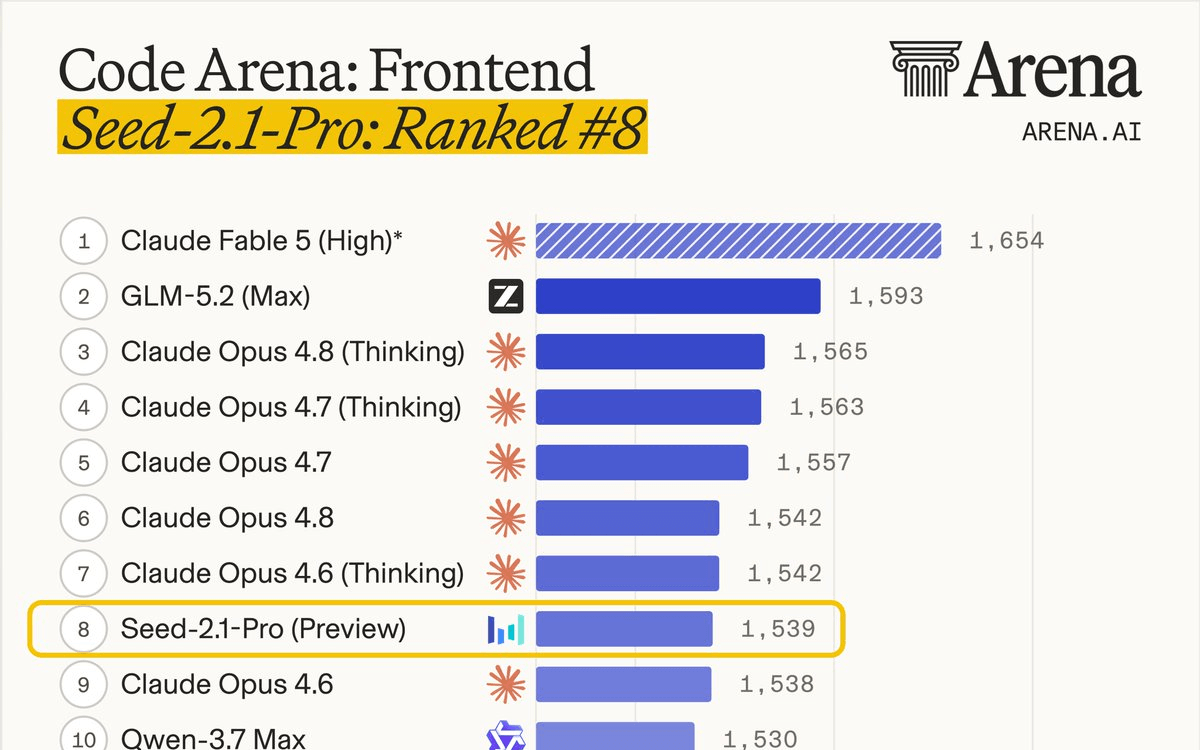
- Seed 2.1 Pro Preview debuts at #8 on Arena's Code Arena: Frontend leaderboard with a score of 1539, on par with Claude Opus 4.6.
- The model lands in the top 10 for 5 of 7 subcategories, including #7 React, #6 Brand & Marketing, and #9 Content Creation Tools.
- Only Z.ai's GLM-5.2 and Anthropic's Claude models rank above it in those subcategories — a very short list of competitors.
- Arena's leaderboard uses 381,168 human votes via a Bradley-Terry pairwise comparison system, making placements hard to game.
- The model is an early access preview from ByteDance's Seed team and is expected to go public within a few weeks.
- It enters a competitive field: GLM-5.2 (MIT-licensed, #2 overall) and multiple Claude Opus 4.x variants dominate the top of the leaderboard.
ByteDance's AI research division just quietly dropped a preview of Seed 2.1 Pro onto Arena's Code Arena: Frontend leaderboard , and it landed at #8 overall with a score of 1539, statistically on par with Anthropic's Claude Opus 4.6. The model isn't publicly available yet, but the early numbers are hard to ignore.
What Arena's Frontend Leaderboard Actually Measures
Before diving into the numbers, it's worth understanding what this leaderboard is and why it matters. Arena's Code Arena: Frontend is a human-preference benchmark where real users submit prompts, receive two anonymous model outputs side-by-side, and vote for the better one. Arena uses an Elo-style scoring system , the same framework used to rank chess players , applied to AI model comparisons. More specifically, votes directly shape model rankings through the Bradley-Terry rating system, a statistical model originally developed for paired comparison experiments, similar to the Elo rating system used for ranking players in competitive games like chess.
Evaluators compare outputs pairwise, assessing functionality, usability, and fidelity as well as design, taste, and aesthetics. Each vote is stored with full context: model version, latency, and environment. The leaderboard currently has 381,168 votes across 89 models, making it one of the most data-rich human-preference benchmarks for frontend code generation in existence.
The scoring is broken down across seven subcategories: React, HTML, Brand & Marketing, Content Creation Tools, Data & Analytics, Reference Based Design, and Consumer Product. This granularity matters , a model can be strong overall but weak in the specific task category you actually care about.
Where Seed 2.1 Pro Actually Lands
Seed 2.1 Pro Preview's score of 1539 puts it in a cluster of models that includes Claude Opus 4.6 (1538). The model places in the top 10 for five of the seven subcategories, which is the real story here. The breakdown:
- #7 on the React leaderboard, #14 on HTML
- #6 in Brand & Marketing
- #9 in Content Creation Tools and Data & Analytics
- #10 in Reference Based Design and Consumer Product
The models sitting above it in those subcategories are a short list: Z.ai's GLM-5.2 and Anthropic's Claude family. That's a tight peer group. For context, the overall leaderboard is currently topped by claude-fable-5 (1654), followed by glm-5.2 max (1595) at #2, with a cluster of Claude Opus 4.x variants filling spots 3 through 8.
The Competitive Landscape It's Entering
The timing of this preview is notable. Z.ai released GLM-5.2 as an MIT-licensed open-weight frontier model aimed at coding and long-horizon agentic work, emphasizing a 1M-token context window and two reasoning-effort modes. Released to coding plan subscribers on June 13th with full open weights following on June 16th, GLM-5.2 is a 753B parameter, 1.51TB model with 40 active parameters using a Mixture of Experts architecture. It currently sits at #2 on the same leaderboard with a score of 1595.
On long-horizon coding benchmarks, GLM-5.2 scored 62.1 on SWE-bench Pro, decisively beating GPT-5.5 (58.6). On FrontierSWE, it hit 74.4%, surpassing GPT-5.5 (72.6%) and finishing in a near-tie with Claude Opus 4.8 (75.1%). The model's key architectural innovation is IndexShare , reusing the identical indexer across every four sparse attention layers, reducing per-token compute FLOPs by 2.9 times at the maximum 1-million-token context length.
So Seed 2.1 Pro is entering a leaderboard where the non-Anthropic competition just got significantly stronger. GLM-5.2 is open-weight, MIT-licensed, and already beating GPT-5.5 on multiple benchmarks. That's the bar Seed 2.1 Pro is being measured against.
ByteDance's Broader Seed Ambitions
Seed 2.1 Pro doesn't exist in isolation. It's the next iteration of a model family that ByteDance has been aggressively building out. Seed 2.0 is ByteDance's foundation model family powering the Doubao app , China's #1 AI chatbot with 155 million weekly active users. The Pro variant scores 98.3 on AIME 2025, 3020 Codeforces rating, and 89.5 on VideoMME , directly competitive with GPT-5.2, Claude Opus 4.5, and Gemini 3 Pro.
The pricing story from the 2.0 generation is also relevant context. Seed 2.0 Pro costs ~$0.47/M input tokens and ~$2.37/M output tokens , roughly 3.7x cheaper than GPT-5.2 on input, 5.9x cheaper on output, and ~10x cheaper than Claude Opus 4.5. If Seed 2.1 Pro maintains similar pricing when it launches publicly, that cost-performance ratio will be a significant factor for teams building production frontend tooling.
Seed 2.0 Code is designed for the age of Agentic Programming, serving as the engine of choice for developers using autonomous coding agents like Claude Code, Cursor, and ByteDance's own internal dev-tools. The 2.1 Pro variant appears to extend this with a stronger focus on visual frontend tasks , React apps, marketing pages, and UI-heavy consumer products.
What This Preview Actually Signals
Arena works directly with model providers to test pre-release models. They work directly with open-source and commercial model providers to make their pre-release models available for community testing, often before they appear anywhere else. This gives early access to frontier models still in development, allowing users to explore, compare, and provide feedback while they're still being shaped.
That means the 1539 score is real human-preference data, not a synthetic benchmark. The model was voted on by the same community that ranked GLM-5.2 and Claude Opus 4.x , anonymously, without knowing which model they were evaluating. A top-10 placement across five of seven subcategories, before public release, is a meaningful signal.
The announcement says Seed 2.1 Pro will be publicly available in a few weeks. For teams building React-heavy frontends, marketing sites, or data dashboards with AI assistance, it's worth watching. The model sits in a tier where the difference between #6 and #10 in a subcategory is often within confidence intervals , meaning it's a genuine peer to the models already in production use, not a distant challenger.
Comments
