

ByteDance's Protenix-v2 Beats AlphaFold3 on Antibody Docking With 200x Less Compute
ByteDance's Protenix-v2 beats AlphaFold3 on antibody-antigen prediction and is fully free for commercial use under Apache 2.0
 PRO
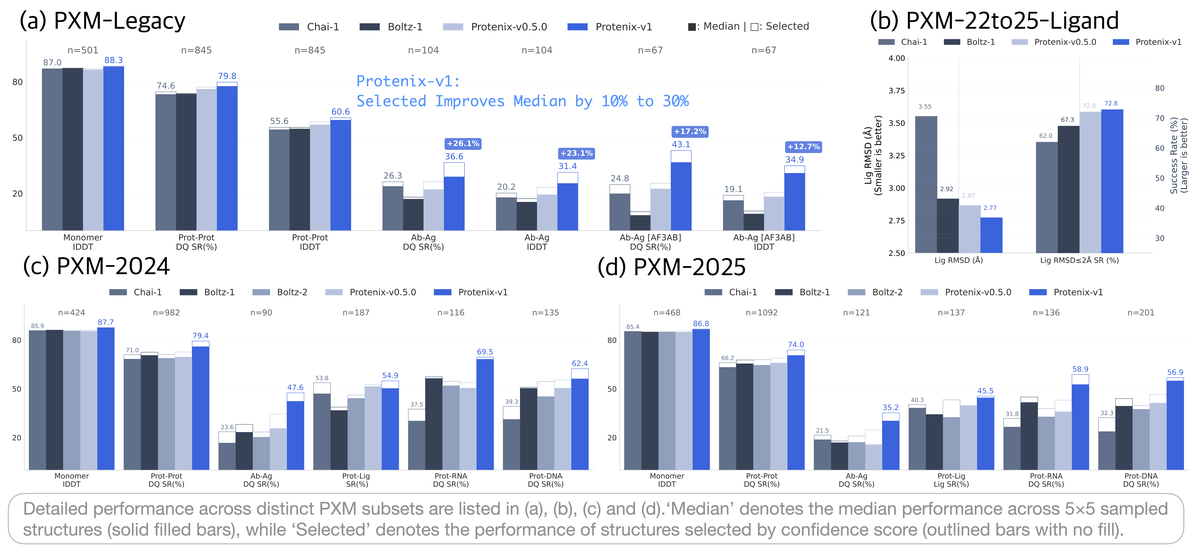
- Protenix-v2 released: ByteDance's open-source protein structure model now has 464M parameters and beats Protenix-v1 by up to 13 percentage points on antibody-antigen benchmarks.
- Dramatic efficiency gain: v2 at 5 sampling seeds outperforms v1 at 1000 seeds -- a ~200x compute reduction for equivalent accuracy.
- Fully commercial-friendly: Released under Apache 2.0, unlike AlphaFold3 and RoseTTAFold which restrict commercial use of their weights.
- PXDesign hits 20-73% success rates in experimental protein-binder design, 2-6x better than AlphaProteo and RFdiffusion.
- Training-Free Guidance (TFG): New module enforces physical constraints during diffusion sampling without retraining, improving ligand plausibility.
- Full ecosystem: Includes Protenix, PXDesign, PXMeter benchmarking toolkit, Protenix-Mini, and a free web server.
Protenix is ByteDance's open-source answer to one of structural biology's most pressing problems: the best protein structure prediction tools are either locked behind non-commercial licenses or proprietary APIs. With the release of Protenix-v2, the project has moved well past being a mere AlphaFold3 reproduction and is now a full biomolecular modeling ecosystem -- one that is free to use, modify, and deploy commercially.
The licensing problem that Protenix solves
When DeepMind released AlphaFold3, it came without its training weights, and when those eventually became available, the model was offered under specific non-commercial use restrictions, meaning use is limited to certain types of research institutions and excludes commercial applications. AlphaFold3 introduced commercial restrictions that limit how pharmaceutical companies and biotech startups can use predictions. The same story applies to RoseTTAFold All-Atom: while the code is licensed under an MIT License, the trained weights and data are only made available for non-commercial use.
In view of this restricted access, various fully open-source initiatives are underway aiming to produce programs with similar performance but freely available for use by anyone, including commercial entities. Protenix is ByteDance's entry into that race -- and with v2, it has arguably taken the lead on the most clinically relevant benchmark category: antibody-antigen structure prediction.
From reproduction to state-of-the-art
Protenix is an open-source, trainable PyTorch reimplementation of AlphaFold 3, developed by ByteDance with the goal of democratizing high-accuracy protein structure prediction for computational biology and drug-discovery research. The project has shipped three major model versions in quick succession:
- Protenix-v0 (initial release): A faithful AF3 reproduction establishing the open-source baseline, achieving state-of-the-art on PoseBusters V2, low-homology PDB sets, and CASP15 RNA benchmarks.
This story is for Pro members
You've reached the end of the free preview. Upgrade to AlphaSignal Pro to read the full article - and everything else behind the paywall.
Comments
