

Brown University's Art3D Turns Flat Cartoons Into 3D Meshes Without Retraining
A training-free pipeline injects fake 3D cues into hand drawings so off-the-shelf image-to-3D models stop producing paper-thin, broken meshes.
 PRO
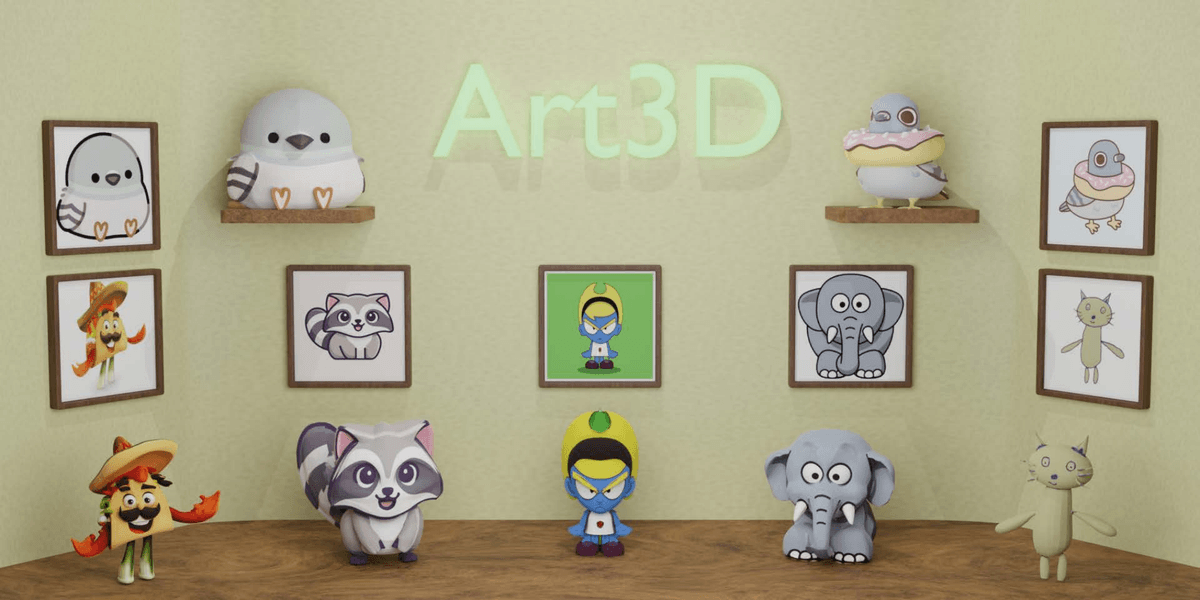
- Art3D lifts flat cartoon drawings into 3D meshes without any training, using existing image-to-3D backbones.
- ControlNet plus depth and Canny edges synthesizes multiple shaded proxy images from the flat input.
- GPT-4V picks the most 3D-looking candidate, which is then fed to Trellis for shape generation.
- Hunyuan3D 2.0 bakes the original flat drawing back onto the mesh as texture, preserving artist identity.
- New Flat-2D benchmark with 100+ hand drawings, cel paintings, icons and cartoon designs for evaluating this failure mode.
- Project page won CVPR 2025 AI4CC Best Presentation; code and dataset coming soon.
Image-to-3D models have gotten impressive at turning a single photo into a usable mesh, but hand them a flat cartoon drawing and they fall apart, extruding wafer-thin sheets of geometry that look nothing like the intended character. A team from Brown University has a fix that requires no retraining: Art3D, a pipeline that fakes 3D illusion into flat illustrations before passing them to existing generators. The work picked up the Best Presentation award at the CVPR 2025 AI4CC workshop.
Why cartoons break image-to-3D models
Existing image-to-3D methods perform well on data within their training distribution, but degenerate into abnormally thin geometric structures when fed flat-colored images. The authors trace this to a distribution mismatch: training corpora contain plentiful 3D cues like shadows, informative viewpoints, and reasonable depth structures, especially in renders from large-scale realistic object datasets such as Objaverse, OmniObject3D, and CO3D. Hand drawings, cel-shaded cartoons, icons, and flat vector art contain none of those cues, leaving the model with nothing to anchor volume estimation to.
Flat art is exactly what most creators actually draw. A pipeline that only works on photorealistic references locks out illustrators, indie game artists, and anyone sketching concepts on paper.
This story is for Pro members
You've reached the end of the free preview. Upgrade to AlphaSignal Pro to read the full article - and everything else behind the paywall.
Comments
