Brown and MIT's Steklov-CLIP Beats Laplacian Methods on 450,000 Messy 3D Shapes
Researchers from Brown and MIT introduce a Monte Carlo method for volumetric 3D shape analysis that runs orders of magnitude faster than prior approaches, scaling to 450,000 real-world meshes
 PRO
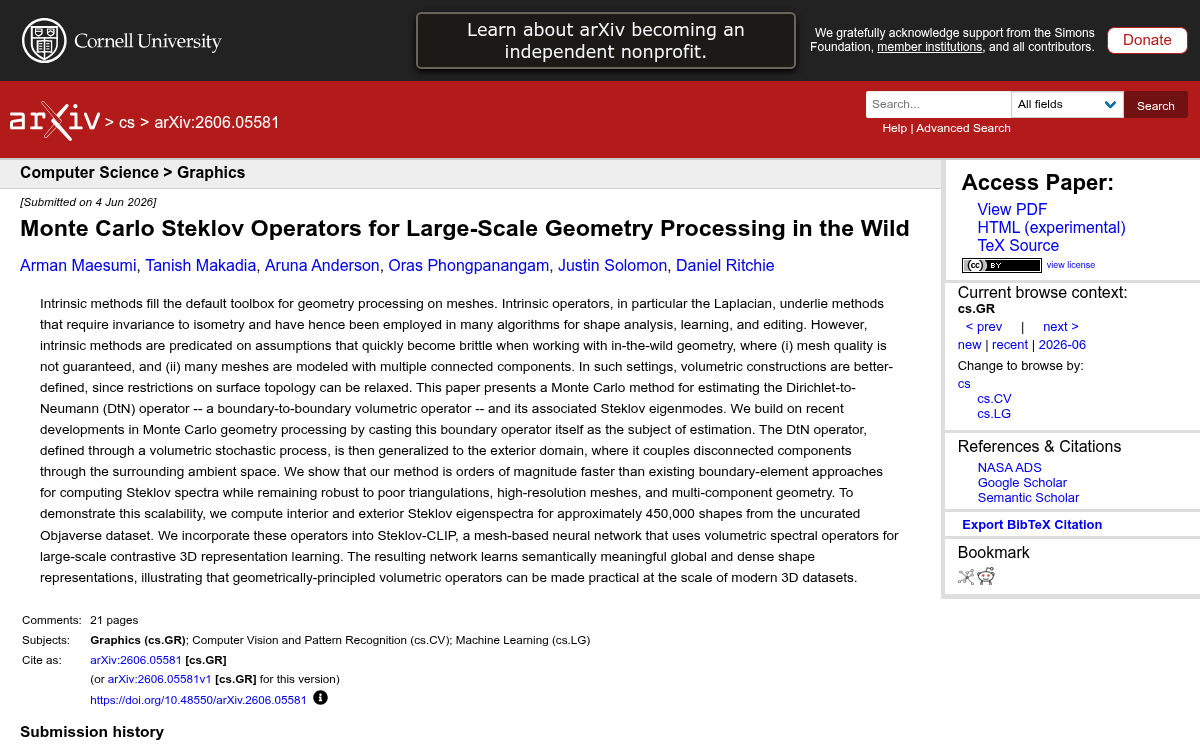
- Researchers introduce a Monte Carlo estimator for the Dirichlet-to-Neumann (Steklov) operator, orders of magnitude faster than prior boundary-element methods.
- The method is robust to poor triangulations, self-intersections, and meshes with hundreds of disconnected components, unlike standard intrinsic operators.
- An exterior DtN variant couples disconnected mesh components through ambient space using a Kelvin transform to handle the unbounded domain.
- Steklov eigenspectra were computed for ~450,000 uncurated Objaverse shapes, the first volumetric spectral analysis at this scale.
- Steklov-CLIP, a mesh-based CLIP model built on these operators, achieves 49.1% top-1 on Objaverse-LVIS zero-shot classification and 60.1% top-1 on part-caption retrieval after finetuning.
- Code is available at github.com/mc-steklov/mc-steklov.
Geometry processing has long relied on the Laplacian operator as its workhorse. It is elegant, fast, and underpins everything from shape correspondence to mesh deformation. But it has a fundamental blind spot: it only sees the surface, not the volume. Two shapes that are isometrically equivalent (think a human in different poses) look identical to the Laplacian. And when you feed it the kind of messy, multi-component, poorly triangulated geometry that comes from the real world, it often breaks entirely.
A team from Brown University and MIT has now published a paper introducing a Monte Carlo method for estimating the Dirichlet-to-Neumann (DtN) operator, a volumetric boundary operator whose eigenmodes (called Steklov modes) encode the full 3D geometry of a shape. The key result: their method is orders of magnitude faster than prior approaches, robust to degenerate meshes, and scales to datasets of nearly half a million shapes. They also release the code at github.com/mc-steklov/mc-steklov.
The problem with intrinsic operators
The standard toolkit for mesh-based geometry processing is built on intrinsic operators, meaning operators that depend only on the surface metric, not the 3D embedding. The Laplace-Beltrami operator is the canonical example. Because it is invariant to isometric deformation, it is used everywhere: shape descriptors, functional maps, spectral neural networks like DiffusionNet.
But this invariance is also a limitation. Two shapes with the same metric but different 3D embeddings are indistinguishable. More practically, intrinsic methods assume:
- Clean, manifold, single-component meshes
- Reasonable triangle quality (no degenerate slivers)
- Consistent surface orientation
Real-world 3D data, especially from sources like the Objaverse dataset, satisfies none of these. A Commodore 64 keyboard mesh, for instance, has 2,662 connected components. The cotangent Laplacian simply cannot couple them.
The Steklov spectrum: volumetric geometry on the boundary
The Dirichlet-to-Neumann (DtN) operator is a boundary-to-boundary map: given a scalar function on the surface, it returns the normal derivative of the harmonic extension of that function through the interior volume. Intuitively, it asks: if you set boundary values and let them diffuse through the interior, how much flux comes back out at each point?
This story is for Pro members
You've reached the end of the free preview. Upgrade to AlphaSignal Pro to read the full article - and everything else behind the paywall.
Comments