

Ben-Gurion's SinkSAM-Net Detects Sinkholes From Photos Without a Single Human Label
A new self-supervised pipeline combines Segment Anything Model, Depth Anything V2, and topographic priors to segment sinkholes from RGB imagery without manual labels.
 PRO
- SinkSAM-Net is the first self-supervised framework for sinkhole segmentation from RGB imagery, avoiding manual annotation entirely.
- Depth Anything V2 replaces expensive LiDAR or photogrammetric DEMs, outperforming real DEMs at F1 0.52 vs 0.21.
- Coordinate-wise bounding box jittering runs Monte Carlo SAM predictions to filter noisy prompts and refine boundaries.
- Iterative self-training reaches F1 0.62 and IoU 0.52, roughly 95% of a fully supervised EfficientNetV2-UNet baseline.
- Final model has just 6M parameters and runs at 20+ images per second, versus 3 for SAM 2.1.
- Code and demo available at the project page; paper on arXiv.
Mapping soil sinkholes from aerial imagery has stayed stubbornly manual. Boundaries are fuzzy, shadows and shrubs distort them, and every prior deep learning approach has demanded thousands of hand-drawn masks or expensive LiDAR scans. A team from Ben-Gurion University has now published SinkSAM-Net, a self-supervised framework that stitches together Segment Anything Model (SAM), Depth Anything V2, and a classic topographic algorithm to segment sinkholes from a single RGB image, hitting roughly 95% of the F1 score of a fully supervised baseline without a single human-drawn label.
Why sinkholes break the usual playbook
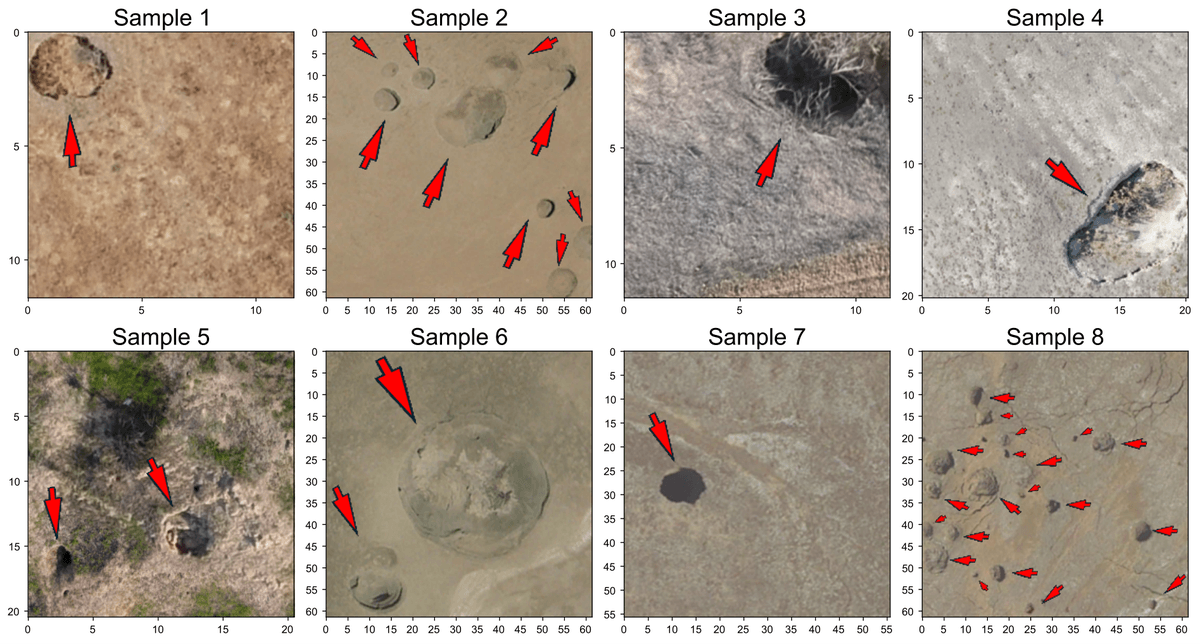
Soil sinkholes have irregular shapes, suffer from internal and external shadowing, can be masked by vegetation, and are usually spread across wide regions, representing a classic imbalanced data problem. The traditional workaround is topographic: subtract a "filled" DEM from the raw one and whatever is left is a closed depression. Features extracted this way often overestimate area and blur boundaries, and high-resolution LiDAR is rarely flown at scale because of cost. Photogrammetric DEMs are cheaper but noisy, especially around vegetation and steep terrain.
Every deep learning sinkhole paper to date has leaned on fully supervised training over thousands of expert-labeled tiles, which does not scale.
Depth guesses as SAM prompts
This story is for Pro members
You've reached the end of the free preview. Upgrade to AlphaSignal Pro to read the full article - and everything else behind the paywall.
Comments
