

Beihang University Lets Robot Swarms Hold Formation Without GPS or Compasses
A concurrent-learning estimator lets nonholonomic robots hold formation using only UWB range and inertial odometer data, no shared compass frame required.
 PRO
- New estimator recovers relative pose between UWB-equipped robots using only range and odometry, no shared compass frame needed.
- Replaces persistent excitation with a weaker sufficient excitation condition by reusing buffered historical measurements.
- Proves global exponential convergence for neighbor estimation and asymptotic convergence for leader estimation across DAG topologies.
- Outperforms prior PE-based method on noise robustness, convergence time, and trajectory smoothness across swarm sizes.
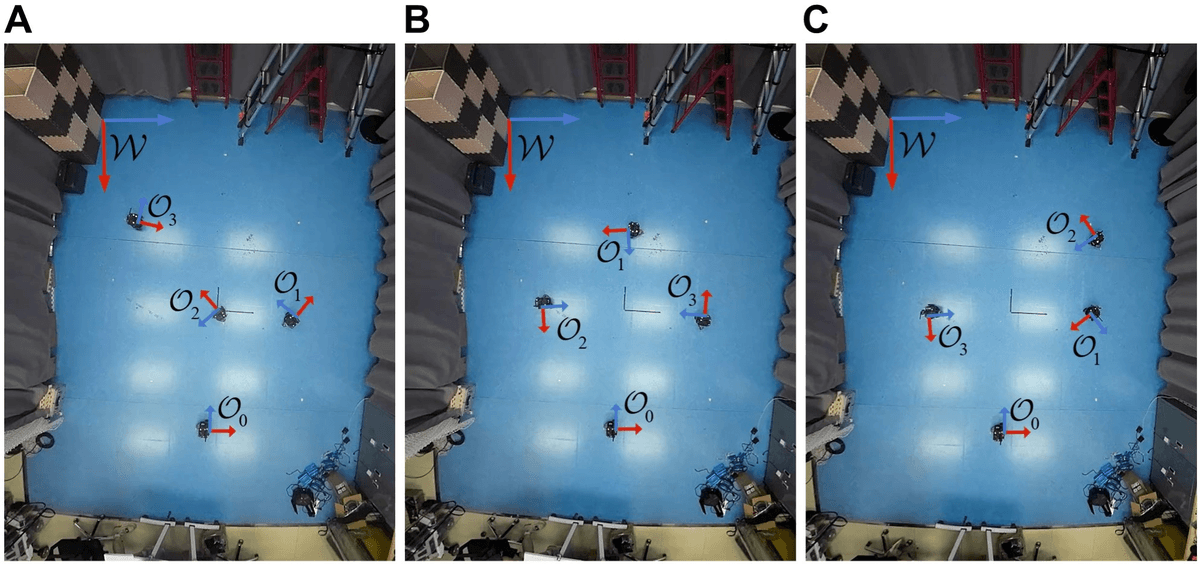
- Validated on TurtleBot3 ground robots in 2D and PX4 quadrotors in 3D, including an outdoor courtyard run.
- Full details in the arXiv paper; runs in about 0.5 ms per loop on a Jetson Orin.
Getting a swarm of ground robots or drones to hold a formation sounds simple until you realize the robots have no idea which way is north. Most existing multi-robot formation methods quietly assume every robot's inertial odometer is aligned to a common reference direction, usually via a magnetometer. That works in a lab and falls apart near power lines, rebar, or anything else that warps the local magnetic field. A new paper from researchers at Beihang University and the Zhongguancun Laboratory tackles the harder version of the problem, where each robot lives in its own drifting local frame and can only measure inter-robot distance with an ultra-wideband (UWB) radio.
The extended paper proposes a distributed estimator that recovers both relative position and relative orientation between neighboring robots using nothing more than UWB range readings and each robot's own onboard displacement measurements. The team validates the approach on TurtleBot3 ground robots in 2D and on PX4-based quadrotors in 3D.
Why the usual tricks break down
Most prior work requires each robot's pose and sensor measurements to be expressed in a common reference frame, which is impractical for nonholonomic robots because their individual inertial odometer readings cannot easily be aligned to a shared axis. Nonholonomic here just means the robot cannot move sideways, like a car or a differential-drive ground robot; its body frame rotates as it drives, so there is no fixed "forward" axis to anchor everything to.
This story is for Pro members
You've reached the end of the free preview. Upgrade to AlphaSignal Pro to read the full article - and everything else behind the paywall.
Comments
