
Baidu's PaddleX Ships 270 Open-Source AI Models Into 33 Ready-to-Run Pipelines
PaddleX 3.x is Baidu's open-source all-in-one AI toolkit with 270+ models, 33 ready-to-run pipelines, and SOTA document parsing — all behind a single Python API
 Pro
Takeaways
- 270+ models, 33 pipelines: PaddleX wraps Baidu's entire AI model catalog into one low-code toolkit accessible via a single Python API.
- SOTA document parsing: PaddleOCR-VL-1.6 hits 96.3% on OmniDocBench v1.6, beating GPT-4o and Gemini on document understanding benchmarks.
- PP-OCRv5 multilingual: 37-language OCR model with 13-point accuracy gain over the previous generation and 30%+ improvement in multilingual scenarios.
- Hardware-agnostic deployment: Supports NVIDIA, Apple M-series, Huawei Ascend, Kunlunxin, Cambricon, and more — critical for Chinese enterprise deployments.
- PDF-to-Markdown pipeline: PP-DocTranslation combines PP-StructureV3 + ERNIE 4.5 Turbo to parse and translate complex PDF layouts into clean Markdown.
- Free and open-source: Apache 2.0 license, Python 3.8–3.13 support, installable via
pip install paddlex[base].
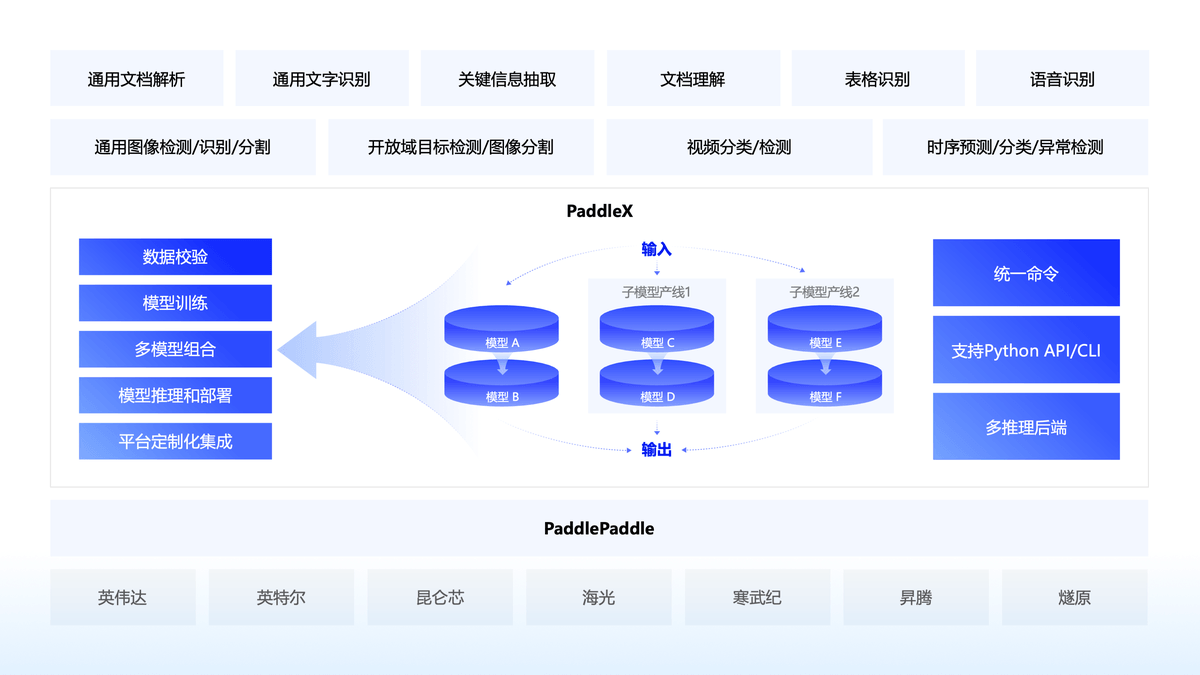
PaddleX is Baidu's open-source, low-code AI development toolkit built on the PaddlePaddle framework. It bundles over 270 pre-trained models into 33 end-to-end pipelines covering OCR, document parsing, object detection, segmentation, time-series analysis, speech recognition, and more. The pitch is simple: go from raw input to production deployment without stitching together a dozen separate libraries.
One API to rule them all
The core design philosophy of PaddleX is the pipeline , a pre-built, composable sequence of models that handles a complete task end-to-end. Over 200 PaddlePaddle models covering OCR, object detection, and time-series forecasting are integrated into 33 pipelines, accessible through easy Python API calls. There are also 39 standalone modules for developers who want to mix and match components.
Running a pipeline takes three lines of Python:
from paddlex import create_pipeline
pipeline = create_pipeline(pipeline="OCR")
output = pipeline.predict("invoice.png")
for res in output:
    res.print()
    res.save_to_json("./output/")
Or from the command line:
paddlex --pipeline OCR \
        --input invoice.png \
        --device gpu:0 \
        --save_path ./output
The document intelligence stack
The headline capability in PaddleX 3.x is its document intelligence suite, built around three flagship models that have been rapidly iterating:
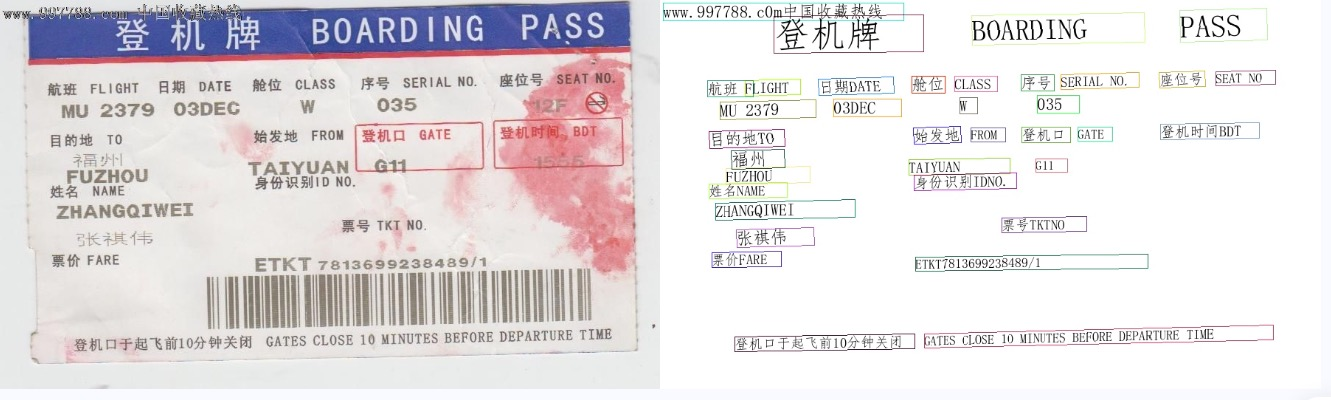
- PP-OCRv5 , a single model that handles five different text types plus complex handwriting, with overall recognition accuracy increased by 13 percentage points over the previous generation. The multilingual version supports training and inference for text recognition in 37 languages including French, Spanish, Portuguese, Russian, and Korean, with average precision increased by over 30%.
- PP-StructureV3 , a general document-parsing solution that delivers high-precision parsing of multi-layout, multi-scene PDFs, outperforming many open- and closed-source solutions on public benchmarks. It chains up to 15 models in parallel and serial configurations to handle layout detection, table extraction, formula recognition, and chart-to-table conversion.
- PP-ChatOCRv4 , integrates with PP-DocBee2 and ERNIE 4.5 Turbo, boosting key information extraction accuracy by 15.7 percentage points over the previous generation. This is the pipeline to use when you need structured data out of unstructured documents , think extracting fields from contracts, invoices, or medical records.
There is also a newer VLM-based approach: PaddleOCR-VL supports 109 languages and excels in recognizing complex elements such as text, tables, formulas, and charts, achieving SOTA performance in both page-level document parsing and element-level recognition. The latest release, PaddleOCR-VL-1.6, achieved 96.3% accuracy on OmniDocBench v1.6, setting new SOTA results on OmniDocBench v1.5 and Real5-OmniDocBench, delivering industry-leading performance in text, formula, and table recognition across both open-source and proprietary solutions.
Beyond OCR: the full pipeline catalog
Document intelligence gets most of the attention, but PaddleX covers a much wider surface area. The pipeline catalog includes:
- Computer vision: image classification, object detection, instance segmentation, semantic segmentation, small object detection, rotated object detection, open-vocabulary detection and segmentation, anomaly detection, face recognition, human keypoint detection, 3D multi-modal BEV detection
- Document/OCR: general OCR, table recognition (v1 and v2), layout parsing (v1 and v3), formula recognition, seal text recognition, document image preprocessing, document translation (PP-DocTranslation)
- Time series: forecasting, anomaly detection, classification
- Speech: multilingual speech recognition
- Video: video classification, video detection
- Multimodal: document understanding via VLM
The document translation pipeline PP-DocTranslation, based on PP-StructureV3 and ERNIE 4.5 Turbo, supports translation of Markdown documents, various complex-layout PDF documents, and document images. This is a genuinely useful addition for teams working with multilingual document corpora.
Hardware that goes beyond NVIDIA
One of PaddleX's most distinctive features is its hardware portability. Training and inference are supported on NVIDIA, Intel, Apple M-series, Kunlunxin, Ascend, Cambricon, Hygon, and Enflame chips. This matters a lot in the Chinese market, where domestic AI accelerators from Huawei (Ascend), Baidu (Kunlunxin), and Cambricon are increasingly common in enterprise deployments. On Ascend, 200+ models are fully adapted, including 21 OM-accelerated inference models, plus key solutions like PP-OCRv5 and PP-StructureV3.
Deployment options are similarly flexible. Every pipeline supports:
- High-performance inference , optimized for GPU throughput, with CUDA 12 support and ONNX Runtime backend
- Service-oriented deployment , Docker-based serving with HTTP APIs callable from any language (C++, Java, Go, C#, Node.js, PHP)
- On-device deployment , for edge and mobile targets
Where it shines, where it doesn't
PaddleX is strongest when your use case maps cleanly onto one of its pre-built pipelines. Document digitization, invoice extraction, PDF-to-Markdown conversion, industrial defect detection, and time-series anomaly detection are all well-covered. Compared to mainstream vision-language models, these models with fewer than 100 million parameters achieve competitive accuracy and efficiency, rivaling billion-parameter VLMs.
The friction points are real though. The framework is tightly coupled to PaddlePaddle, which means you're committing to a less common Python ecosystem than PyTorch. The documentation is primarily in Chinese, and while English versions exist, they sometimes lag. With 729 open issues on GitHub, the project is active but not without rough edges. Teams already invested in Hugging Face Transformers or PyTorch-native tooling will find the migration cost non-trivial.
Getting started
PaddleX is free and open-source under Apache 2.0. Installation requires Python 3.8–3.13 and PaddlePaddle 3.0+:
# Install PaddlePaddle (GPU, CUDA 12.6)
python -m pip install paddlepaddle-gpu==3.3.0 \
  -i https://www.paddlepaddle.org.cn/packages/stable/cu126/
# Install PaddleX
pip install "paddlex[base]"
The current default branch is release/3.7, with the latest tagged release being v3.7.1. An online demo is available on Baidu's AI Studio platform for trying pipelines without any local setup. Full documentation covers installation, pipeline tutorials, deployment guides, and hardware-specific setup for each supported accelerator.
For teams building document intelligence pipelines in production , especially those needing to run on non-NVIDIA hardware or requiring multilingual OCR across dozens of languages , PaddleX offers a genuinely compelling, battle-tested stack that's hard to match with point solutions.