
Baidu's FastDeploy v2.5 Ships Qwen3-VL Support and Aggressive 4-Bit Quantization
PaddlePaddle releases FastDeploy v2.5, adding Qwen3-VL support, W4AFP8 quantization, and 170+ bug fixes for production LLM serving
 Pro
Takeaways
- FastDeploy v2.5 released: PaddlePaddle's LLM/VLM serving toolkit ships Qwen3-VL support, new quantization, and 170+ bug fixes. Release notes
- Qwen3-VL and Qwen3-VL MoE: Both dense and MoE variants of Alibaba's vision-language model now supported, with CUDA Graph acceleration.
- W4AFP8 quantization: New mixed-precision format (4-bit weights, FP8 activations) for memory-efficient large MoE model deployment.
- Multimodal PD disaggregation: Prefill-Decode separation, previously text-only, now works for VLMs including RDMA and dynamic C8 IPC.
- RL training APIs: New async pause/resume/update_weights endpoints and Rollout Routing Replay for tighter RL pipeline integration.
- Blackwell GPU support: NVFP4 MoE and FusedMoE now supported on NVIDIA SM100 (Blackwell) architecture.
FastDeploy v2.5, Baidu's PaddlePaddle-based LLM and VLM inference toolkit, just shipped its most substantial release yet. The update lands Qwen3-VL deployment support, a new W4AFP8 quantization method, deeper reinforcement learning training integration, and over 170 bug fixes and performance improvements across the board.
What FastDeploy actually is
FastDeploy is an open-source, production-grade serving toolkit built on top of PaddlePaddle. Think of it as Baidu's answer to vLLM: it exposes an OpenAI-compatible API, handles batching and KV cache management, and is designed to run at scale across a wide range of hardware. Unlike vLLM, it places a heavy emphasis on Chinese-ecosystem hardware (Kunlunxin XPU, Hygon DCU, Iluvatar GPU, Enflame GCU, MetaX GPU) alongside NVIDIA GPUs and Intel Gaudi.
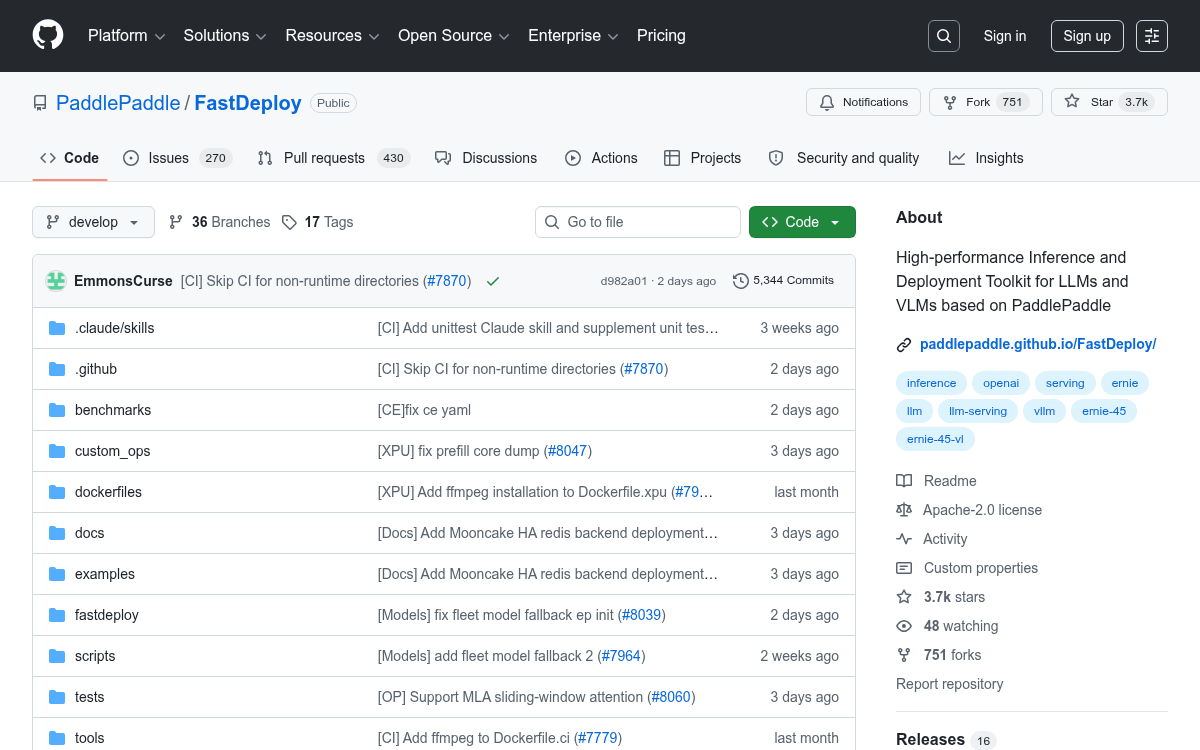
The toolkit has accumulated 3.7k GitHub stars and 751 forks, with the develop branch seeing active commits from 80+ contributors. It is free and Apache 2.0 licensed.
The headline additions
The two most visible additions in v2.5 are model support and quantization:
- Qwen3-VL and Qwen3-VL MoE: Both the dense and mixture-of-experts variants of Alibaba's Qwen3 vision-language model can now be deployed, including full CUDA Graph support for lower-latency decode.
- W4AFP8 quantization: A new mixed-precision scheme that stores weights at 4-bit integer precision and activations at FP8 (8-bit floating point). This is more aggressive than W8A8 and targets memory-constrained deployments of large MoE models. It supports tensor parallelism greater than 1 and works with both the v0 and v1 model loaders.
- NVFP4 MoE on SM100 (Blackwell): Support for NVIDIA's latest Blackwell architecture, including FusedMoE and NVFP4 quantization on SM100 GPUs.
- GLM TP+DP+EP: GLM models can now be deployed with combined tensor parallelism, data parallelism, and expert parallelism.
PD disaggregation gets more capable
PD disaggregation (Prefill-Decode disaggregation) is FastDeploy's flagship architecture feature. The idea is to split the two phases of LLM inference -- the expensive initial prompt processing (prefill) and the iterative token generation (decode) -- onto separate GPU pools. This lets you size each pool independently and avoid the two phases competing for the same hardware.
v2.5 extends this significantly:
- Multimodal models (VLMs) now support P/D separation, previously only available for text-only LLMs.
- Dynamic C8 IPC and RDMA dynamic C8 are both supported in disaggregated mode.
- Configuration has been simplified, with port management refactored to reduce setup friction.
CUDA Graph coverage expands
CUDA Graph is a technique where you record a sequence of GPU operations once, then replay the recording on subsequent iterations rather than re-issuing each kernel individually. This cuts CPU overhead dramatically for the decode phase, where the same operations repeat thousands of times.
In v2.5, CUDA Graph support was extended to:
- Qwen3-VL and Qwen3-VL MoE models
- P/PD mixed batches using SOT (sub-graph) splitting mode
- Prefill-phase capture via new
max_capture_shape_prefillandcudagraph_capture_sizes_prefillconfig options - Kunlunxin XPU hardware
RL training integration
One of the less-discussed but increasingly important use cases for inference engines is serving as the rollout engine during reinforcement learning from human feedback (RLHF) or similar RL-based training pipelines. FastDeploy v2.5 adds several features targeting this workflow:
- Rollout Routing Replay (R3) for routing rollout requests back to specific workers
- Async pause/resume/update_weights API endpoints (
/v1/pause,/v1/resume,/v1/is_paused) for coordinating weight updates between the trainer and the inference server - GLM MTP RL model support
- SM100 FP8 quantization support within RL workflows
This is a pattern vLLM has also been building toward, and it signals that production RL training pipelines increasingly need tight coupling between the trainer and the serving engine.
KV Cache storage backends
A new KV cache storage layer was introduced, with two backends: attention_store (in-memory) and file_store (disk-backed). This enables hierarchical caching strategies where hot KV blocks stay in GPU memory while cold blocks are offloaded, which is particularly useful for long-context workloads with repeated system prompts.
Getting started
FastDeploy requires Linux, Python 3.10-3.12, and targets NVIDIA GPUs as the primary platform. Installation is via pip after setting up the PaddlePaddle environment:
# Install for NVIDIA GPU (see official docs for other hardware)
pip install paddlepaddle-gpu
pip install fastdeploy-gpu
# Launch a server (OpenAI-compatible)
fastdeploy serve \
  --model Qwen/Qwen3-VL-7B-Instruct \
  --port 8080
The 10-minute quick start guide walks through the full setup. Docker images are available for NVIDIA GPU deployments and are the recommended path for production use.
Where it fits
FastDeploy's strongest differentiator relative to vLLM is its multi-hardware support and its PD disaggregation architecture, which is more mature and configurable than what vLLM currently offers. The tradeoff is that it is tightly coupled to the PaddlePaddle ecosystem, which means less community tooling and fewer third-party integrations than the PyTorch-native alternatives.
For teams already in the PaddlePaddle ecosystem, or those deploying on Chinese-domestic accelerators like Kunlunxin XPU or Hygon DCU, v2.5 is a meaningful upgrade. For teams building RL training pipelines that need a tightly integrated rollout server, the new async RL APIs are worth a look regardless of your primary framework.