

AT&T's Open-Source OTel-2.0 Beats Larger AI Models on Telecom Benchmarks
AT&T and GSMA release OTel 2.0, a 31B Gemma-4 fine-tune trained on 440B telecom tokens, topping the Open Telco AI leaderboard.
 PRO
- AT&T and GSMA released OTel 2.0, an open telecom LLM post-trained from Gemma 4 31B-IT.
- Trained on ~440B telecom tokens, sampled from over 1 trillion processed with Red Hat's SDG Hub.
- Raw 15B-token corpus sourced from 3GPP, ETSI, GSMA, CAMARA, ITU, O-RAN, and TM Forum.
- Data processed on ~530 AMD MI300X GPUs in Azure; training ran on on-prem AMD MI355X with Dell.
- Currently ranked #1 on the Open Telco AI leaderboard, ahead of larger general models.
- Apache 2.0 licensed, English text only, available via vLLM, SGLang, Microsoft Foundry, Featherless AI, Red Hat.
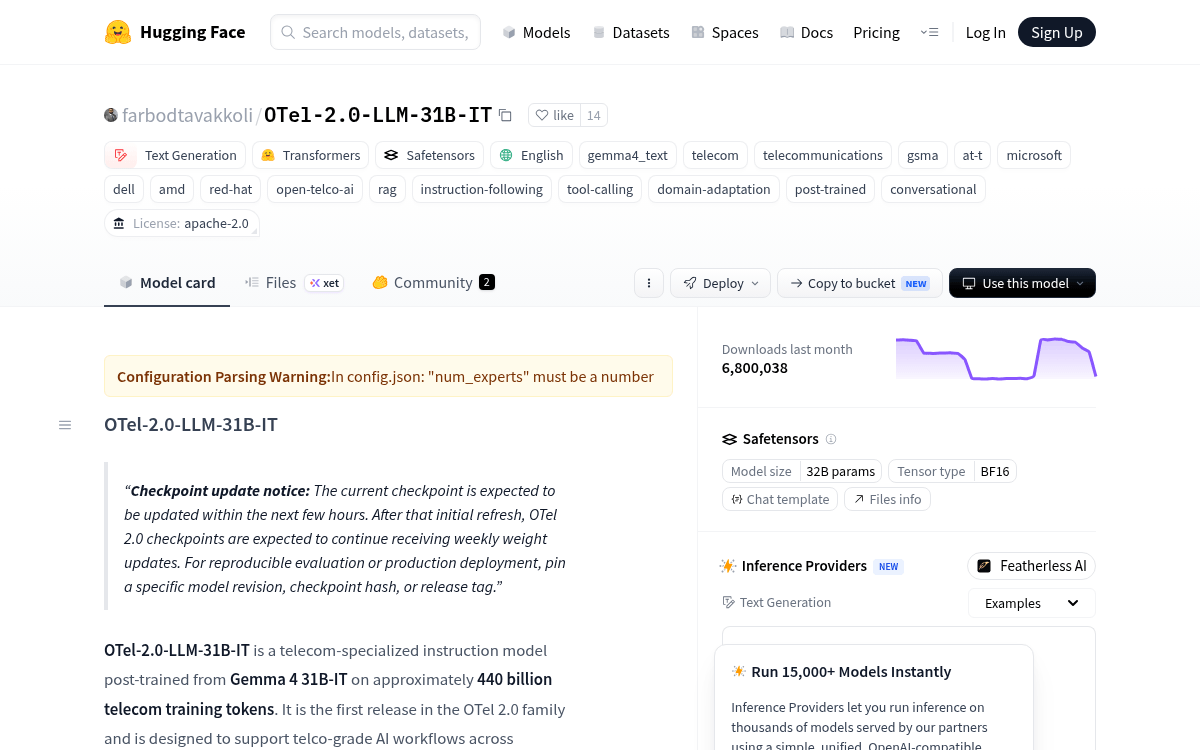
A coalition led by AT&T and the GSMA has released OTel-2.0-LLM-31B-IT, an open-source large language model post-trained for telecommunications workloads. Built on Google's Gemma 4 31B-IT and shipped under an Apache 2.0 license, it is the first release in the OTel 2.0 family and currently sits at the top of the Open Telco AI leaderboard. The weights have already crossed 6.8 million downloads on Hugging Face, a signal that operators and vendors are actively pulling domain-specific checkpoints into their stacks.
Why bother with a telecom-only LLM
Frontier models are strong at generic reasoning but weak on the specialized vocabulary that runs mobile networks. They still stumble on complex network topologies and vendor-specific telemetry unique to the sector. Telco-tuned models anchor the AI in the actual realities of network operations, letting the system interpret nuanced technical logs, diagnose performance bottlenecks, and reason about industry protocols with the precision real-time systems demand.
The leaderboard evidence backs the pitch. The top three performers on the Open Telco AI benchmarks are all domain-adapted models rather than general-purpose ones, with the new OTel 2.0 model on top. A 31B specialist is outrunning much larger generalists on standards interpretation and network Q&A.
The data pipeline behind the weights
OTel 2.0 starts from a curated corpus of telecom standards, then multiplies it through synthetic data generation. The model was post-trained on a 400 billion token telecom dataset filtered from more than 1 trillion processed tokens, incorporating a 15-billion-token base provided by the GSMA and compiled from seven major standards development organisations (SDOs): 3GPP, ETSI, GSMA, CAMARA, ITU, O-RAN, and TM Forum. Those 15B raw tokens were expanded past a trillion using Red Hat's open-source Synthetic Data Generation Hub, from which roughly 440B were sampled for post-training.
This story is for Pro members
You've reached the end of the free preview. Upgrade to AlphaSignal Pro to read the full article - and everything else behind the paywall.
Comments
