

Artificial Analysis Rebuilds Its Image Arena to Rank Models by Real Work
Artificial Analysis rebuilds its image arena around 10 real-world use cases and 9 model capabilities, revealing where GPT Image 2's dominance ends and cheaper models take over
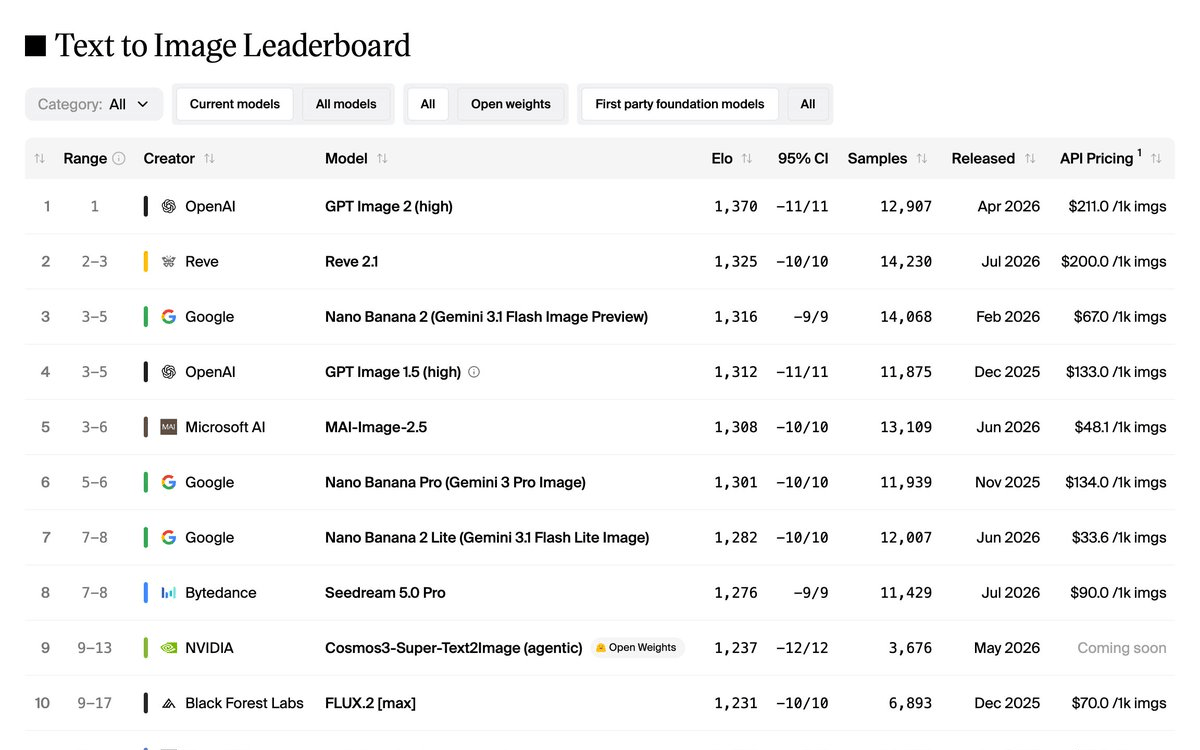
- Artificial Analysis has overhauled its Text to Image Arena to rank models across 10 use cases and 9 capabilities, not just a single overall score.
- GPT Image 2 (Elo 1339) leads every sub-leaderboard, but costs $211 per 1,000 images vs. $67 for Nano Banana 2.
- Reve 2.1 (Elo 1299) holds #2 overall and ties GPT Image 2 on UI/UX; it is a 4K layout-first model from a ~65-person lab trained on 10x fewer GPUs.
- Nano Banana 2 is the value pick for most use cases including UI/UX, Text Rendering, and Animation & Gaming at one-third the price of GPT Image 2.
- Physics is the weakest capability across all top-10 models; no model ranks it as its strongest area.
- Prompts are refreshed monthly from anonymized real-user data and retired when they stop discriminating between models, preventing leaderboard overfitting.
Most image generation benchmarks answer one question: which model is best? For a product team prototyping UI mockups, a game studio generating concept art, and a marketing agency building campaign visuals, that question is nearly useless. Artificial Analysis has overhauled its Text to Image Arena to answer a more useful one: which model is best for your specific work?
A taxonomy, not a single score
The updated evaluation measures models across 10 real-world use cases and 9 model capabilities. One model may lead on text rendering, another on complex layouts or photorealistic human characters. The new leaderboard makes that variation explicit rather than collapsing it into a single aggregate score.
The use cases covered:
- Marketing & Advertising
- Retail & E-commerce
- Live-Action Film
- Animation & Gaming
- Architecture & Real Estate
- Productivity & Knowledge Work
- UI/UX Design
- Social Media & Creator Content
- Consumer
- Frontier
The capability axes:
- Reasoning
- Knowledge
- Text Rendering
- Layout
- Complex Compositions
- Lighting
- Material
- Physics
- Human Anatomy
How the scoring works
Prompts are sampled evenly across every use case and capability combination, so each contributes equal weight to the overall leaderboard rating. The arena runs blind pairwise votes: users compare two images generated from the same prompt without knowing which model produced each. Models are then ranked using an Elo rating system derived from those comparisons. Several design choices sharpen the signal:
- Judging hints surface short cues tied to the prompt's use case and capability, directing voter attention to what actually matters on complex prompts
- Engagement gate: votes can only be cast after a minimum time spent examining each output
- Bot and anomaly filtering runs before any vote enters the Elo calculation
- Monthly prompt rotation: prompts are retired based on how well they discriminate between models and how accurately they reflect real user behavior, which also prevents the leaderboard from being overfit
Prompts follow strict authoring standards: plain natural language, a single positive prompt with the negative-prompt field left empty, and architecture-neutral phrasing that does not favor any model family. They draw on anonymized crowdsourced data from real users rather than prompts invented by the benchmark authors.
The overall picture
The top five models by Elo rating:
| Model | Elo |
|---|---|
| GPT Image 2 (high) | 1339 |
| Reve 2.1 | 1299 |
| MAI-Image-2.5 | 1270 |
| Nano Banana 2 Lite | 1263 |
| GPT Image 1.5 (high) | 1263 |
GPT Image 2 tops every individual use case and capability sub-leaderboard, but the gap to second place varies enormously by task, and the value calculation shifts completely once price enters the picture. GPT Image 2 (high) runs at $211 per 1,000 images via API; Nano Banana 2 costs $67. That 3x price difference is the central tension the new leaderboard is built to expose.
Where the rankings actually diverge
UI/UX Design is the single strongest use case for both GPT Image 2 and Reve 2.1, which tie at first. Nano Banana 2 follows at third, at one-third the price of either leader. The use case is demanding on both Text Rendering and Layout, but performance on each capability in isolation does not fully predict UI/UX score. GPT Image 1.5 ranks fourth overall but drops to sixth on UI/UX despite ranking fourth on Text Rendering and fifth on Layout, because assembling those two into a coherent screen is harder than excelling at either alone.
Live-Action Film is where Nano Banana Pro makes its case. GPT Image 2 leads, but Nano Banana Pro sits at second, its single strongest use case, and undercuts the other top performers on price. The tradeoff is real: Nano Banana Pro's best capability is Human Anatomy and its worst use case is Animation & Gaming. Photorealistic humans and stylized illustration pull in opposite directions.
Text Rendering shows the widest quality gap of any capability: 178 Elo points separate the top ten models. GPT Image 2 achieves 99% text rendering accuracy, closing the long-standing reliability gap that made AI image tools awkward for branding and advertising. Signs, labels, UI text, and multi-word strings all render accurately, including CJK characters, Devanagari, Arabic, and other non-Latin scripts.
Physics is a weak point across the board. No model in the top ten has physics as its strongest capability. Reve 2.1 ranks second overall, yet physics is its weakest of nine capabilities, dropping it to fifth on that sub-leaderboard. Text-to-image models still struggle with plausible mechanics, gravity, and state change.
Value picks by use case
| Use Case / Capability | Best Overall | Best Value | Price (per 1k images) |
|---|---|---|---|
| Overall | GPT Image 2 | Nano Banana 2 | $67 vs $211 |
| UI/UX Design | GPT Image 2 / Reve 2.1 (tied) | Nano Banana 2 (#3) | $67 |
| Live-Action Film | GPT Image 2 | Nano Banana Pro (#2) | ~$140 |
| Retail & E-commerce | GPT Image 2 | MAI-Image-2.5 | lower tier |
| Text Rendering | GPT Image 2 | Nano Banana 2 (#3) | $67 |
| Physics | GPT Image 2 | Nano Banana 2 (#3) | $67 |
What this changes about model selection
Picking the top of the overall leaderboard made sense when models were close in capability and the frontier was thin. Today the challengers increasingly come from smaller teams making sharper architectural bets rather than simply outspending on compute, and the gaps between use cases are wide enough to matter in production.
Reve 2.1's layout-first approach, for example, replaces the text prompt with a structured layout where every element carries a position, a size, and a local description, making the image addressable and editable like code. That is a fundamentally different workflow from GPT Image 2's reasoning-first approach, and the Artificial Analysis taxonomy is one of the first benchmarks structured to surface that difference.
The arena is live and open for voting at artificialanalysis.ai/image/arena. The full methodology, covering prompt authoring, retirement criteria, and Elo calculation, is documented at artificialanalysis.ai/image/methodology. The leaderboard is also available on Hugging Face. If you are building a production pipeline that spans more than one use case, the sub-leaderboards are now specific enough to justify routing different request types to different models rather than defaulting to a single provider.
Comments
