

Arcee's Trinity-Large-Thinking Brings 398B Open Reasoning to Self-Hosted AI Agents
Arcee's 398B sparse Mixture-of-Experts reasoning model targets agentic workloads with visible think blocks, 512k context, and Apache 2.0 weights.

 PRO
PRO- Arcee released Trinity-Large-Thinking, a 398B sparse MoE reasoning model with 13B active parameters
- Extreme 4-of-256 expert routing (1.56% sparsity) delivers 2-3x throughput over dense equivalents
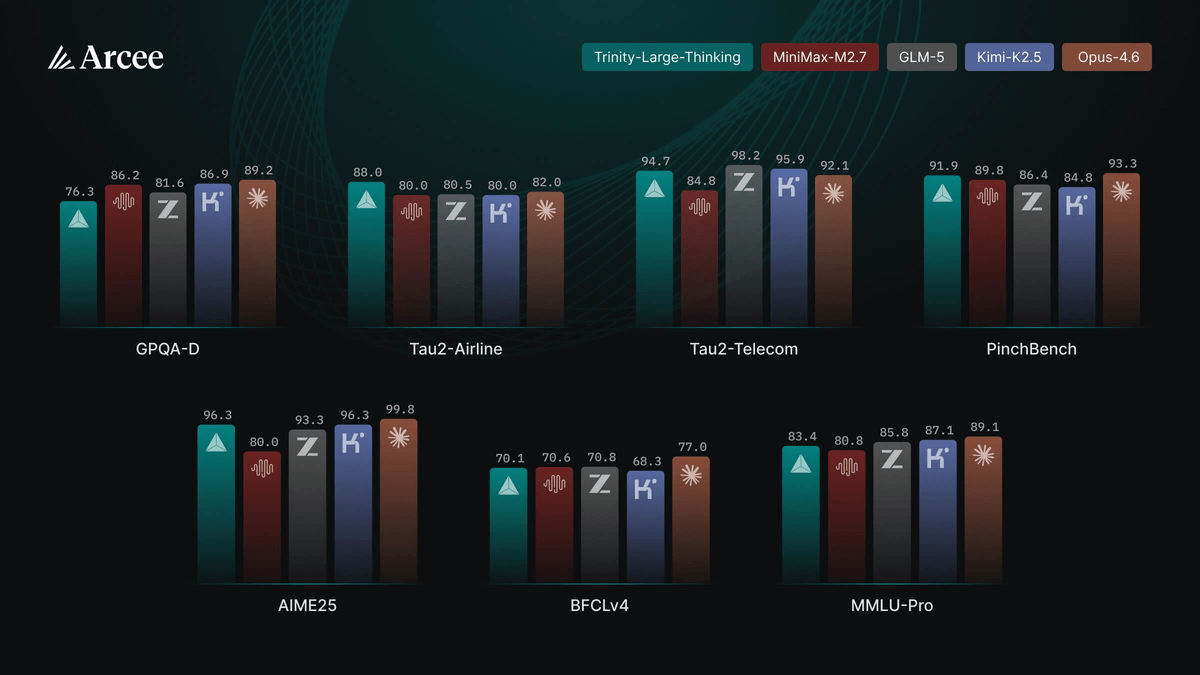
- Beats Opus-4.6 on Tau2-Airline (88.0) and posts 91.9 on PinchBench, 96.3 on AIME25
- Weak spots: 63.2 on SWE-bench Verified and 52.3 on IFBench instruction following
- Available via OpenRouter, vLLM 0.11.1+, and Hugging Face weights under permissive open license
- Trained on 17T tokens across 2,048 NVIDIA B300 GPUs with Prime Intellect on a $20M budget
A small U.S. lab just dropped one of the largest open-weight reasoning models the American side of the industry has produced. Trinity-Large-Thinking is a 398 billion parameter open-source frontier reasoning model built for complex, long-horizon AI agents, with roughly 13B active parameters per token. The pitch is straightforward: give Western teams a downloadable, self-hostable alternative to closed frontier APIs and the wave of Chinese open releases that has dominated the last year.
Arcee describes it as their reasoning model built to close the gaps the earlier Preview left open, and on many axes it lands as the strongest open model released outside of China. The weights are available now on Hugging Face, through OpenRouter, and directly on chat.arcee.ai.
A radically sparse MoE tuned for agents
Trinity-Large-Thinking is built on a sparse Mixture-of-Experts design with 256 experts, only 4 active per token, and a routing fraction of just 1.56%, making it notably sparser than most competing MoE models. One expert is shared, six layers stay dense, and pretraining ran at an 8,192 context window before being extended out to 512k.
That extreme sparsity has a practical payoff. Despite its scale, the model delivers roughly 2 to 3 times faster inference throughput than similarly-sized dense models, since the majority of weights are idle at any given step. The team also introduces a new load-balancing trick called SMEBU (Soft-clamped Momentum Expert Bias Updates), paired with the Muon optimizer, which keeps expert utilization stable and prevents performance degradation on complex reasoning tasks.
Attention itself was tuned for long agent traces. Interleaved local and global attention sits alongside gated attention to sharpen recall across large contexts, which matters when a tool-calling loop starts stacking dozens of turns of thinking tokens.
This story is for Pro members
You've reached the end of the free preview. Upgrade to AlphaSignal Pro to read the full article - and everything else behind the paywall.
Comments
