

Arcee's mergekit Lets Developers Merge AI Models Without Writing Training Code
mergekit lets you combine multiple open-source LLMs into a single model on CPU, no training required, using 15+ merging algorithms

 PRO
PRO- Free model upgrades without training: mergekit combines pretrained LLMs directly in weight space, no GPU or training data required.
- 15+ merge algorithms: Includes Linear, SLERP, Task Arithmetic, TIES, DARE, DELLA, Arcee Fusion, and more, each targeting different interference patterns.
- Runs on CPU: Out-of-core tensor loading means merges work on any hardware; GPU with 8GB VRAM accelerates the process.
- MoE + evolutionary merging: Build Mixture-of-Experts models from dense models, or let an automated evolutionary search find optimal merge configs against benchmarks.
- TokenSurgeon tool: Transplants tokenizers between models, enabling cross-architecture merges and cheap speculative decoding draft models.
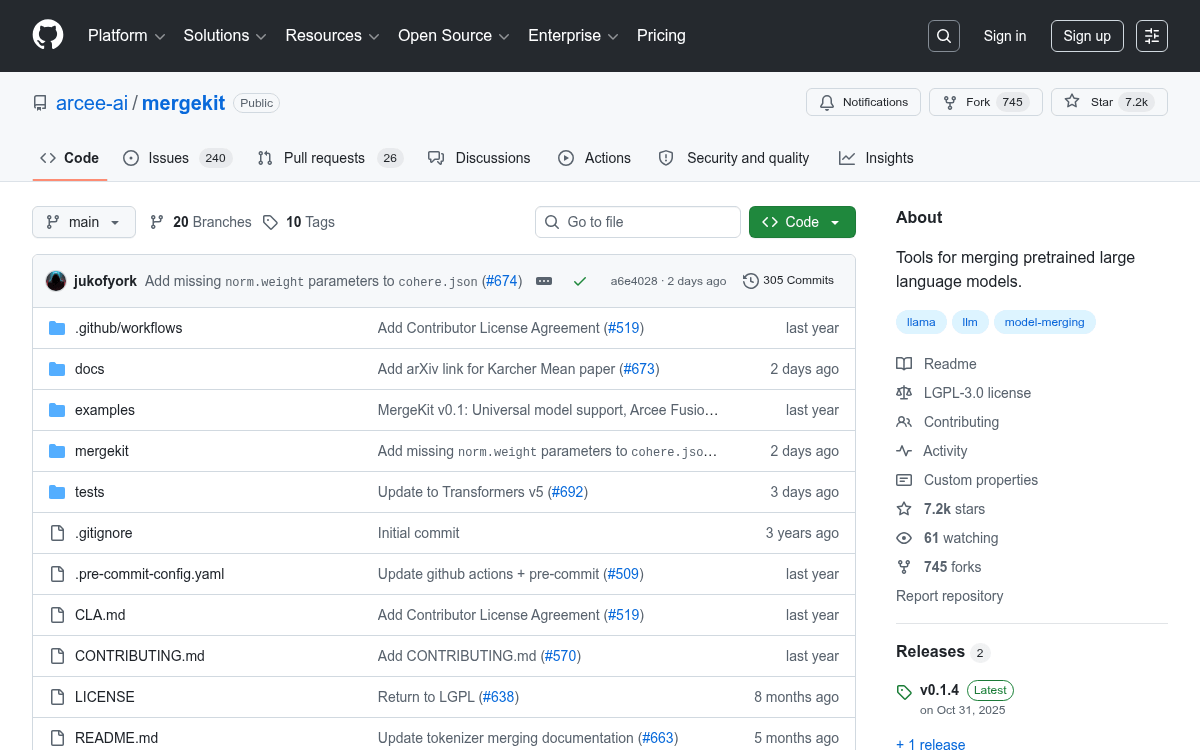
- 7,100+ stars, EMNLP 2024 paper: Used in production by Arcee AI to build their own foundation models and cited across the research community.
mergekit is the open-source toolkit that has quietly become the backbone of the model-merging movement. With over 7,100 GitHub stars and 700+ forks, it lets you take two or more pretrained language models and combine their weights into a single, more capable model, without writing a single line of training code. The whole thing can run on a CPU.
The problem it solves
The rapid expansion of the open-source language model landscape presents an opportunity to merge model checkpoints by combining their parameters. Advances in transfer learning have led to vast amounts of task-specific models, typically specialized in individual tasks and unable to utilize each other's strengths. The usual solution, ensembling, means running multiple models in parallel, which multiplies your inference costs. Unlike traditional ensembling, merged models maintain the same inference cost as a single model while often achieving comparable or superior performance.
By preserving the intrinsic capabilities of the original models, model merging addresses complex challenges in AI, including the difficulties of catastrophic forgetting and multitask learning. In plain terms: you can take a model that is great at coding and another that is great at reasoning, merge them, and get a single model that is decent at both, at no extra inference cost.
How it actually works
Model merging operates directly in weight space. The simplest version is just averaging the weights of two models. But that naive approach causes interference, where updates that helped one model conflict with updates that helped another. The more sophisticated methods in mergekit are designed to resolve this.
The central concept behind most advanced methods is the task vector: the difference between a fine-tuned model's weights and the base model's weights. Task Arithmetic computes the difference between each fine-tuned model and the base model, averages these deltas, and adds the result back to the base model. This means you can literally add or subtract capabilities from a model like vectors.
This story is for Pro members
You've reached the end of the free preview. Upgrade to AlphaSignal Pro to read the full article - and everything else behind the paywall.
Comments
