

Apodex 1.1 Beats DeepSeek on Real-World Agentic Work With a 35B Open Model
Apodex 1.1 lands with an Elo of 1348 on GDPval-AA v2, beating DeepSeek V4 Pro and Kimi K2.6 on real-world agentic work.
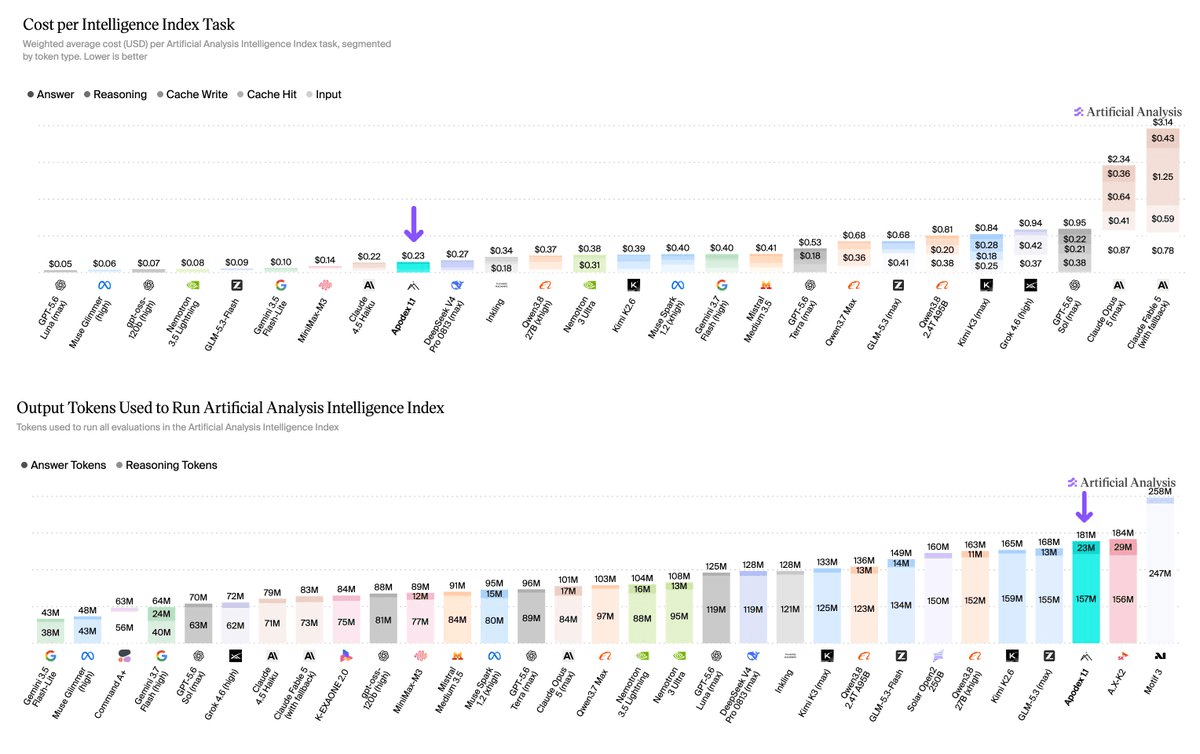
- Apodex 1.1 scores 44 on the Artificial Analysis Intelligence Index, tier with Kimi K2.6 and MiniMax-M3.
- Hits Elo 1348 on GDPval-AA v2, beating DeepSeek V4 Pro (1333) and Kimi K2.6 (1202).
- Priced at $0.30/$3.00 per 1M input/output tokens with 256K context, ~$0.05 per Index task.
- Weak on knowledge: -21.9 AA-Omniscience score with a 78.4% hallucination rate on attempted answers.
- Open-weights 35B Mini variant ships for local vLLM or SGLang deployment.
- Technical report details AgentOS runtime, PIVOT-RL training, and multi-agent verification with up to 150 sub-agents.
A new agentic model is quietly making noise on the leaderboards. Apodex 1.1 just got its first independent evaluation on the Artificial Analysis Intelligence Index, and while its overall score is mid-tier, the underlying breakdown tells a more interesting story: the model is tuned aggressively for long-horizon agentic work rather than raw exam-style reasoning.
Where it lands on the leaderboard
The Intelligence Index combines nine evaluations: GDPval-AA v2, tau-cubed Banking, Terminal-Bench v2.1, SciCode, Humanity's Last Exam, GPQA Diamond, CritPt, AA-Omniscience, and AA-LCR. Apodex 1.1 scores 44 on that composite, putting it in a tier with Kimi K2.6 (45), MiniMax-M3 (45), and Inkling (42). That trails the current top of the board by 19 points, where Claude Opus 5 in Adaptive Reasoning Max Effort mode leads at 63.
The agentic numbers are where Apodex 1.1 punches above that tier:
- GDPval-AA v2 (real-world agentic work): Elo of 1348, ahead of DeepSeek V4 Pro (1333), Qwen3.7 Max (1308), and Kimi K2.6 (1202).
- TerminalBench v2.1 (agentic coding and terminal use): 70%, ahead of Kimi K2.6 at 66% and just behind Qwen3.7 Max at 75%.
- AA-Omniscience (knowledge reliability): -21.9, with 32% raw accuracy and a 78.4% hallucination rate on the 87% of questions it chose to answer.
Translation: the model works well when the task is "go do a bunch of steps in a real environment and produce a deliverable," and works badly when the task is "do you know this obscure fact without checking." It also runs long, burning around 17k output tokens per Intelligence Index task, compared to 9,391 for Qwen3.7 Max and 8,133 for MiniMax-M3.
Pricing and access
Apodex 1.1 is proprietary and served through the vendor's first-party API. Pricing runs $0.30 per million input tokens, $3.00 per million output tokens, and $0.03 per million on cache hits, with a 256K context window. That works out to roughly $0.05 per Intelligence Index task, cheaper than Kimi K2.6 (~$0.06) and Qwen3.7 Max (~$0.07). The verbosity partially offsets the cheap per-token rate, but the model still lands in the attractive quadrant of the cost-vs-intelligence plot even though it is not on the Pareto frontier.
An open-weights sibling ships alongside it. The 35B-parameter Apodex 1.1 Mini retains strong working capability in a locally deployable form, and the weights are published on Hugging Face. Mini supports a 262,144-token context and can be served via SGLang or vLLM using the qwen3_coder tool-call parser and qwen3 reasoning parser. A typical launch looks like this:
vllm serve apodex/Apodex-1.1-mini \
  --tensor-parallel-size 8 \
  --max-model-len 262144 \
  --enable-auto-tool-choice \
  --tool-call-parser qwen3_coder \
  --reasoning-parser qwen3
Under the hood
The technical report frames the design around a specific bet: high-quality reasoning is necessary but insufficient for complex work, especially when a task unfolds over a long horizon, and scaling agentic intelligence requires a model to act in an environment and preserve authoritative state. The team is chasing the benchmark where a model opens files, runs code, retries when something breaks, and hands back an artifact a human can actually use, rather than trying to win Humanity's Last Exam.
Four pieces of the system matter:
- AgentOS runtime. Maintains tool calls, file state, and task progress, giving the model persistent workspace state across long trajectories.
- Environment and Coordination Scaling. Environment Scaling expands the file, search, and code execution environments, while Agentic Coordination Scaling handles dynamic task decomposition across agents.
- PIVOT-RL. A reinforcement-learning recipe targeting long-horizon tasks, training on environment trajectories and coordination traces rather than static preference data.
- Verification-centric agent team. Verification is split out into an independent agent team that audits the work of other agents rather than relying on the same model to generate and check its own outputs, backed by a structured evidence graph that provides traceability from conclusions to supporting evidence.
Multi-agent coordination reportedly supports up to 150 concurrent sub-agents, which is the mechanism behind the strong GDPval showing.
Who should care
Workloads that look like "produce a spreadsheet from a mess of PDFs," "run a survival analysis with citations," or "complete a multi-step terminal task without a human babysitter" are worth benchmarking against your current stack. Advertised use cases include liability assessment, financial instrument valuation, molecular dynamics modeling, survival analysis, and statistical processing.
For workloads closer to "answer trivia accurately" or "summarize a document without inventing facts," the AA-Omniscience score is a warning sign. A 78.4% hallucination rate on attempted answers means you almost certainly want retrieval, a verifier step, or a different model in that path. Same story for pure academic reasoning, where the gap to frontier models like Claude Opus 5 is substantial.
The 35B Mini is the more interesting angle. If it holds up in independent testing at anywhere near the working-capability numbers the team claims, a locally deployable agentic model that can drive a real filesystem and code sandbox becomes a meaningful addition to the on-prem stack, especially for regulated domains where sending legal or financial data to a hosted API is not an option.
Comments
