
Aperant Runs 12 Claude Agents in Parallel to Build Software Autonomously
Aperant (formerly Auto Claude) brings a Kanban-driven multi-agent pipeline to your local desktop, running up to 12 parallel Claude agents in isolated git worktrees to plan, build, test, and ship software autonomously.
 Pro
Takeaways
- What it is: Aperant (formerly Auto Claude) is an open-source desktop app that orchestrates up to 12 parallel Claude agents to plan, build, test, and ship software.
- Core mechanic: Each agent runs in an isolated git worktree, preventing file conflicts; an AI-powered merge step integrates work back to main.
- Rebrand: The project renamed from "Auto Claude" to Aperant in March 2026, partly driven by Anthropic's new OAuth usage restrictions.
- Current state: v2.7.6 is stable on Windows, macOS, and Linux; v3.0 is being rebuilt from scratch with cloud features, still AGPL-3.0.
- Requirements: Claude Pro/Max subscription + Claude Code CLI; note the new monthly Agent SDK credit cap introduced June 15, 2026.
- Pricing: The desktop app is free and open source; Aperant 3.0 cloud tiers are forthcoming with pricing to be announced at launch.
Aperant is an open-source, autonomous multi-agent coding framework that orchestrates Claude agents to handle the full software lifecycle: architecture planning, parallel implementation, self-validating QA, and AI-assisted merging. It started life as "Auto Claude" and quietly accumulated over 14,000 GitHub stars before rebranding in March 2026. The project is now actively rebuilding toward version 3.0, which will add cloud features on top of the existing local desktop experience.
The problem it actually solves
Single-agent AI coding tools are fast but sequential. You wait for one task to finish before the next begins, and you're still the one doing the architecture, writing the tests, and managing the merge. If you've used Claude Code for serious development work, you've probably hit the same wall: one agent, one terminal, one branch, one task at a time. You wait for the agent to finish the auth system before it can start on the API layer. You sit idle while it works through a refactor. The model is fast, but the workflow is sequential.
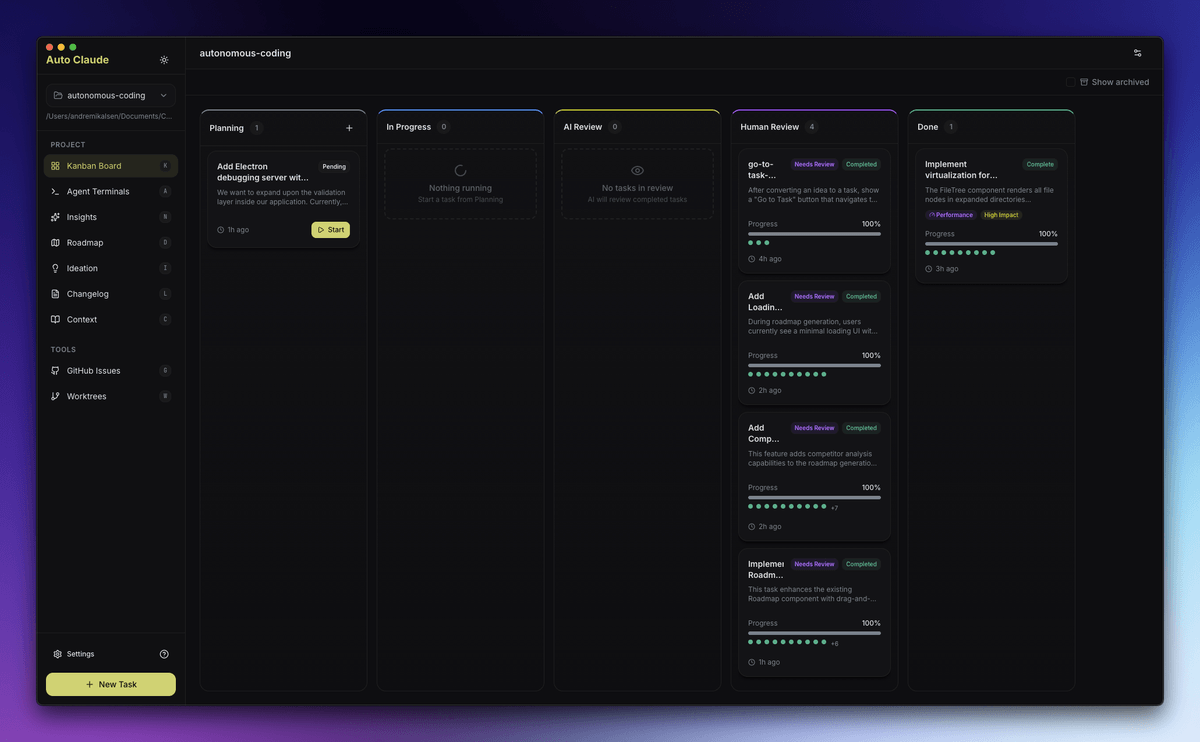
Aperant's answer is to turn that single-agent loop into a managed pipeline. You describe what you want to build, and a team of agents handles the breakdown, implementation, and validation in parallel, while a Kanban board gives you a live view of what each agent is doing.
How the parallel execution actually works
The core technical trick is git worktrees. Git worktrees give each AI coding agent its own isolated codebase so parallel sessions never overwrite each other's changes. Instead of cloning the repo multiple times, git worktrees enable parallel AI agent execution by giving each agent its own isolated working directory and git index while sharing a single object store, preventing file-level conflicts, context contamination, and lock contention when multiple agents operate on the same repository.
Aperant runs multiple builds simultaneously with up to 12 agent terminals, and all changes happen in git worktrees so the main branch stays safe. When agents finish, an AI-powered merge step handles conflict resolution before the code lands on your main branch.
The workflow from the user's perspective looks like this:
- Describe a goal in plain language
- Aperant breaks it into tasks on a Kanban board
- Agents pick up tasks, each working in its own isolated worktree
- A self-validating QA loop runs checks before you review
- AI-assisted merge integrates everything back to main
What's in the box
The desktop app (built on Electron, written in TypeScript) ships with a set of integrated views beyond just the task board:
- Kanban Board -- visual task management from planning through completion with real-time agent progress
- Agent Terminals -- AI-powered terminals with one-click task context injection; spawn multiple agents for parallel work
- Roadmap -- AI-assisted feature planning with competitor analysis and audience targeting
- Insights -- chat interface for exploring your codebase
- Ideation -- surfaces improvements, performance issues, and vulnerabilities
- Changelog -- auto-generates release notes from completed tasks
- GitHub/GitLab/Linear integration -- import issues, investigate with AI, create merge requests
There is also a persistent memory layer. Your architecture decisions, coding conventions, and patterns are stored as persistent memory. Agents reference them in every session -- so they follow your rules, use your existing utilities, and get smarter with your codebase over time.
Getting started
The requirements are minimal but specific.
You need a Claude Pro/Max subscription, the Claude Code CLI (npm install -g @anthropic-ai/claude-code), and your project must be initialized as a git repo.
From there, download the desktop app for your platform, connect via OAuth, and start creating tasks.
One important cost note:
starting June 15, 2026, Agent SDK usage and non-interactive claude -p runs on subscription plans draw from a monthly Agent SDK credit separate from interactive limits ($20 on Pro, $100 on Max 5x, $200 on Max 20x).
Running 12 agents in parallel will burn through that credit faster than a single interactive session, so budget accordingly.
The stable release is v2.7.6, available for Windows, macOS (Apple Silicon and Intel), and Linux (AppImage, Debian, and Flatpak). A beta track at v2.8.0-beta.6 is also available for those who want the latest features.
The rebrand and what it signals
On March 7, 2026, the project formerly known as "Auto Claude" officially became Aperant. The commit message was succinct: "docs: rebrand Auto Claude to Aperant in README, co-authored by Claude Opus 4.6." This wasn't just a name change -- it represented a fundamental shift in the project's identity and ambition.
Part of the motivation was practical. In February 2026, Anthropic updated their legal and compliance documentation with explicit restrictions on OAuth token usage. Issue #1871 raised concerns about Auto Claude's OAuth-based authentication model: "OAuth authentication is intended exclusively for Claude Code and Claude.ai. Using OAuth tokens obtained through Claude Free, Pro, or Max accounts in any other product, tool, or service is not permitted." This policy challenge may have accelerated the rebranding effort, positioning Aperant as a distinct platform with broader authentication options including API key authentication from Claude Console.
Version 3.0 and what's coming
Aperant is alive and under active development. The team is rebuilding the entire app from the ground up for Aperant 3.0, which adds cloud features on top of the local desktop experience. Aperant 3.0 will stay fully open source under AGPL-3.0.
Most of the 3.0 work is happening in a separate development repository right now and will be merged back once it's ready. So even though commits look sparse on the surface, the project is very much alive and moving fast behind the scenes. Pull requests are currently paused while the rebuild is underway -- the team asks contributors to open issues and join the Discord instead.
Where it fits in a crowded field
Aperant is not alone in this space. Tools like parallel-code, sortie, and amux all tackle the same problem of orchestrating multiple AI coding agents in isolated git worktrees. What distinguishes Aperant is the full-lifecycle framing: it's not just a worktree manager or a terminal multiplexer, but an opinionated end-to-end platform with planning, QA, merge, memory, and project management baked in.
The evolution from Auto Claude to Aperant reflects a broader trend in AI development tools: moving from code completion and assistance to autonomous, lifecycle-aware platforms that can meaningfully participate in the entire software development process. The 14,000+ stars and nearly 2,000 forks suggest there is genuine demand for this kind of opinionated, batteries-included approach -- even as the underlying Claude Code primitives it builds on continue to evolve rapidly.
The current 2.x app is stable and usable today. If you want the full vision -- cloud features, a rebuilt architecture, and a more polished experience -- that is what 3.0 is being built for. Star the repo or join the Discord to follow progress, and check aperant.com for early access to the next version.