

ANU Fixes AI's Blind Spot by Injecting 3D Shape Into Video Models
A CVPR 2026 paper shows that borrowing shape priors from a 3D foundation model fixes the broken rear views that plague single-image orbital video generators.
 PRO
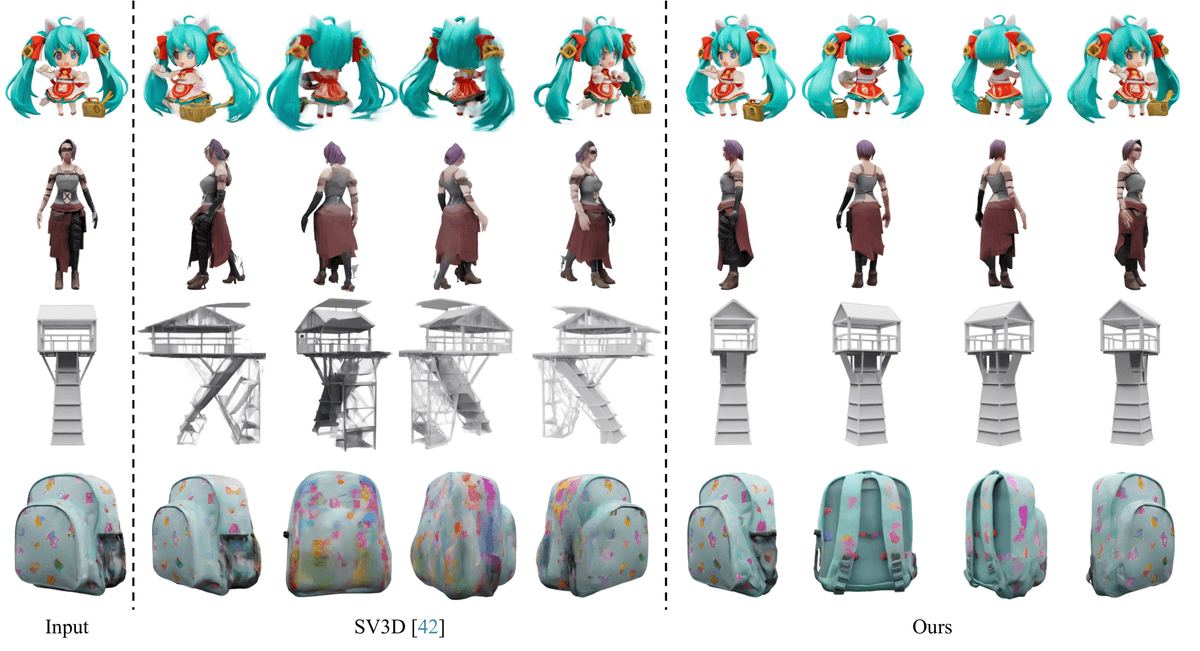
- CVPR 2026 paper from ANU and Amazon fixes rear-view failures in single-image orbital video generation.
- Injects 3D foundation model features into a video diffusion backbone via a multi-scale cross-attention adapter.
- Uses a global latent for structure plus per-view volumetric latents for fine geometry, skipping mesh extraction.
- Beats SV3D, Hi3D, Trellis, Hunyuan3D-2, Wonder3D, and Era3D on Objaverse-XL and GSO benchmarks.
- Hits 25.05 PSNR on GSO versus 21.72 for the strongest prior baseline, with LPIPS nearly halved.
- Preprint available at arxiv.org/abs/2604.12309; no code release announced yet.
Generating a full 360-degree video around an object from a single photo looks almost solved until you actually watch the back of the object. Front views stay sharp, but as the camera swings behind the subject, most models start hallucinating melted geometry, extra limbs, or textures that never quite close the loop. A new CVPR 2026 paper from researchers at the Australian National University and Amazon proposes a fix: stop asking a video model to invent 3D structure on its own, and instead feed it shape priors from a dedicated 3D foundation model.
The work, Towards Realistic and Consistent Orbital Video Generation by Rong Wang, Ruyi Zha, Ziang Cheng, Jiayu Yang, Pulak Purkait, and Hongdong Li, targets what the authors call the rear-view problem in orbital video synthesis. Existing video generation approaches lean on pixel-wise attention to enforce consistency across frames, but that mechanism does not impose enough constraint for long-range extrapolation like rear-view synthesis, where correspondences to the input image are limited and results often lack coherent structure.
Why pixel attention runs out of road
Orbital video generation, popularized by models like Stable Video 3D (SV3D), treats novel view synthesis as a video problem: give a diffusion model one image and a camera trajectory, and let it roll out the frames. SV3D, developed by Stability AI, builds on the Stable Video Diffusion architecture to synthesize short clips of a camera smoothly circling an object, simulating a 3D view from 2D data.
The trick works because adjacent frames share most of their pixels, so attention can copy features across time. That assumption collapses when the camera reaches the far side. The model has never seen the back of your teapot, and pixel correspondences to the input image no longer exist, so it invents whatever the 2D prior finds plausible. The output looks like a video, but the object it depicts stops being a coherent 3D thing.
This story is for Pro members
You've reached the end of the free preview. Upgrade to AlphaSignal Pro to read the full article - and everything else behind the paywall.
Comments
