

Anthropic's Model Hardware Standard Lets Claude Control Lab Robots Overnight
Anthropic unveils a shared specification that lets AI agents discover and safely operate lab and factory hardware, cutting weeks of integration to hours.
- Anthropic opens research preview of Model Hardware Standard, a shared spec for AI agents to operate lab and factory hardware.
- MHS uses a standardized driver with read/write primitives, natural-language device tags, and MCP-compatible control.
- QuEra's Claude-built laser relock hit 99.3% success in 700 trials, up from 58% with a bespoke script.
- Genentech, CMU, HHMI Janelia, UW, and Tetsuwan cut instrument integration from weeks to hours.
- AWS, Tecan, Universal Robots, Hugging Face LeRobot, QIAGEN, and Raspberry Pi among launch partners.
- Waitlist access at modelhardwarestandard.com; Anthropic plans open source after safety work.
Anthropic has opened a research preview of the Model Hardware Standard (MHS), a specification that lets AI agents talk to physical equipment through a single common interface. Connecting a language model to a microscope, liquid handler, or robotic arm today usually means bespoke glue code and weeks of vendor wrangling. MHS reduces that plumbing to a shared driver format and a handful of primitives, then lets agents like Claude orchestrate everything on top.
The standard grew out of a collaboration between Anthropic's Beneficial Deployments team and a postdoc at HHMI Janelia Research Campus, whose brain-imaging rig combined lasers, motorized focusers, and cameras from different vendors with no common interface. His fix, a shared memory dictionary that lets instruments communicate at memory speed, became the seed for MHS. Anthropic is now inviting labs, robotics companies, and manufacturers into a research preview before open-sourcing the specification.
The integration tax MHS is trying to kill
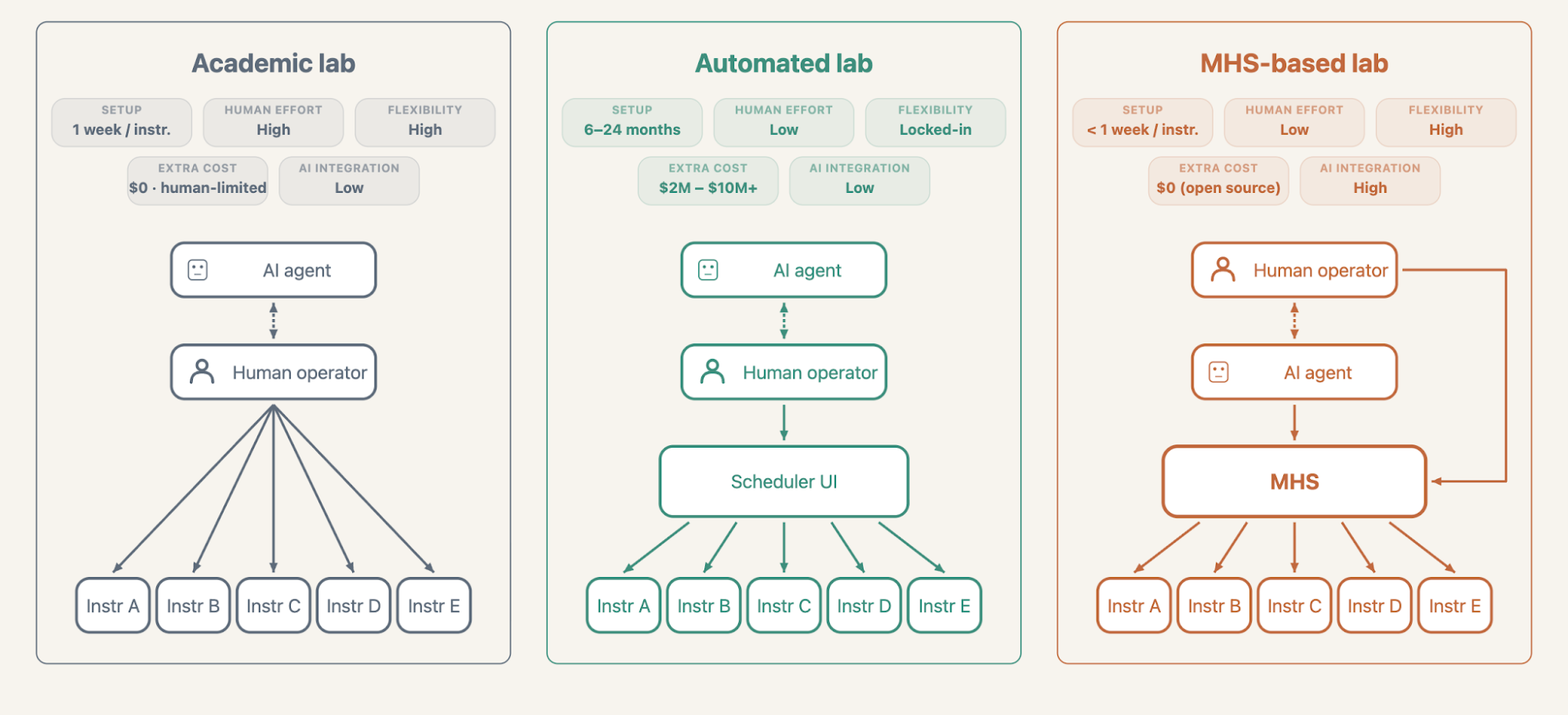
If you have ever tried to script a lab rig, the problem is familiar. Every instrument ships with its own SDK, GUI, or ancient COM interface. Getting three of them to cooperate typically means a specialist writing translator code for weeks or months, and adding an AI agent on top means a second layer of custom integration for each device.
MHS attacks this at three levels:
- A standardized driver that exposes each device through simple primitives like
read(get temperature) andwrite(set temperature), regardless of what interface sits underneath. - Discoverability, so devices and agents can find each other across a network without a bespoke translator program in between.
- Natural-language tags in the driver that capture the tacit knowledge usually buried in PDFs and user manuals, like the weight of a robotic arm or safety limits an agent must respect.
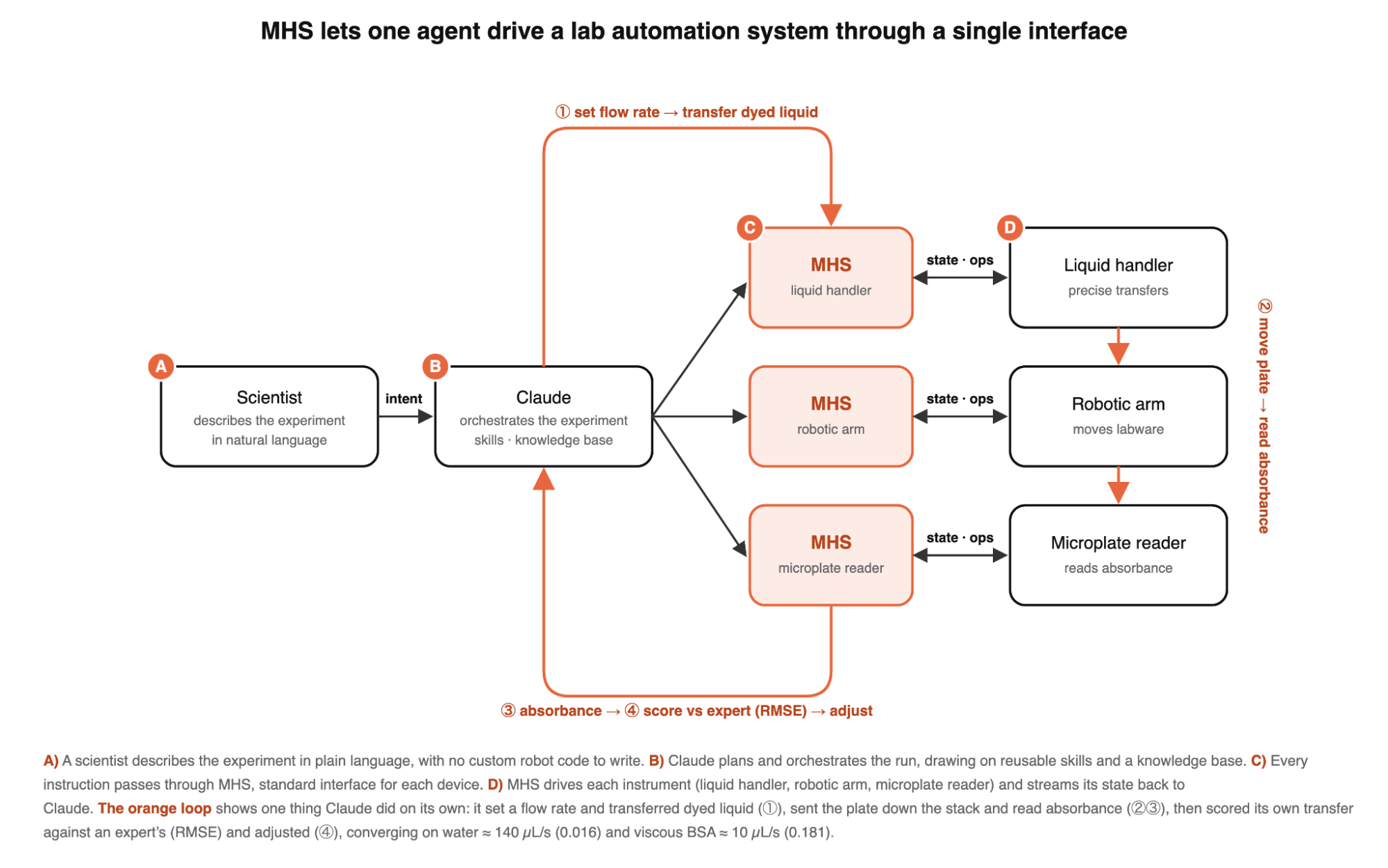
Agents then control the hardware through three mechanisms: MCP, a command line interface, and code files that behave as APIs. Because MHS is model-agnostic and works with any device that has a programmable interface, any agent harness can access it using standard protocols like the Model Context Protocol.
What actually happened in the pilots
Anthropic shared MHS with a small group of labs and manufacturers, and the case studies go beyond the usual demo reel:
- Genentech ran the BCA protein assay across a liquid handler, robotic arm, and plate reader, with Claude autonomously optimizing pipetting flow rates for water (around 140 microliters per second) and viscous BSA (around 10 microliters per second) by comparing its transfers against an expert baseline. It recovered from tip pickup and fluid detection errors on its own, though it needed guidance when bubbles caused physical failures it could not reason about from code alone.
- QuEra Computing pointed Claude at automatic laser relocking on its neutral-atom quantum computer. A prior team of four engineers had spent months on a bespoke script that recovered the laser 58% of the time in about 150 seconds. Overnight, Claude iteratively rewrote it as a decision tree and hit a 99.3% success rate across 700 blind trials, with the hardest cases resolving in 10 to 14 seconds.
- HHMI Janelia compressed a two-photon microscopy rig that previously required launching seven vendor programs in a fixed order down to a single click, with Claude able to align beams and adapt imaging parameters as biology varied.
- Carnegie Mellon wired a CyBio liquid handler, Varioskan plate reader, robotic arm, and monitoring cameras across three computers with fundamentally incompatible interfaces, including a plate reader that only exposes a GUI. Integration took roughly eight hours instead of the multi-week vendor path, and the agent independently rejected a saturated dose-response curve and reran with a compressed concentration range.
- Tetsuwan Scientific combined MHS with its ResearchOS platform to run qPCRs profiling fecal contamination in San Pedro Creek, using a camera to detect pipetting bubbles and letting Claude route the affected tube to a centrifuge for recovery.
The QuEra result is the one to stare at
Most of the pilots demonstrate faster integration, which is useful but not shocking. The QuEra experiment stands apart because it shows an agent producing artifacts that a specialist could not easily match. Claude ran a four-role loop where one instance proposed hypotheses, another wrote code changes, a third executed against the live laser, and a fourth read the logs and decided the next move. Hundreds of iterations later, the output was a deterministic, fully inspectable Python script that runs in production without an agent in the loop.
On PID tuning for the servo loop, Claude captured an oscilloscope trace and computed a full Fourier spectrum after every one of 363 experiments, bringing residual error from a specialist's baseline of 15.7 mV down to 1.55 mV. A phase noise analyzer showed Claude's tune matched the expert across the band except at a 220 kHz resonance, where the manual tune had about a thousand times more noise. Over a 19-hour test, Claude's parameters never lost lock, while the expert-tuned parameters unlocked roughly 1.6 times per hour.
Where it breaks
Anthropic is candid that language models still lack physical intuition. Genentech saw Claude default to retrying failed operations in the same plate well when bubbles formed, which only made things worse until researchers explicitly told it the failure was physical rather than a software bug. QuEra reports that Claude often paused overnight to wait for human confirmation before doing anything it judged risky, which is preferable to recklessness but a real productivity cost. And MHS itself only works with devices that expose some programmable interface, so anything driven purely by knobs and switches is still out of scope.
Who is signing on
The partner list is the tell that this is meant to become infrastructure rather than a one-off demo:
- AWS is adding MHS support through Strands Robots, its library for connecting agents to physical devices.
- Tecan is adding MHS to its Fluent liquid handling platforms, and Automata is integrating it into LINQ for autonomous lab error handling.
- Universal Robots and Doosan Robotics are testing MHS with their robotic arms.
- QIAGEN is running a proof of concept on its QIAsymphony Connect nucleic acid purification platform.
- MBF Bioscience is building an MHS driver for ScanImage, the software running laser-scanning microscopes in hundreds of neuroscience labs.
- Hugging Face is adding MHS support in LeRobot, and Raspberry Pi is enabling MHS integration across its products after successful tests with a Camera MHS Driver.
How to get in, and what to watch
Access is gated through a waitlist on the Model Hardware Standard site. Anthropic says it plans to open-source MHS after the research preview, using the interim to build safety evaluations and extend coverage from lab and manufacturing gear to the boards, cameras, and hobbyist hardware that developers already drive with Claude Code. The open question is whether MCP-style standardization can survive the jump from software APIs to physical actuators, where a bad command breaks glass instead of throwing an exception.
Comments
