

Anthropic's EMA Removes MCP's Biggest Enterprise Blocker for 2,000-Person Teams
MCP's Enterprise-Managed Authorization goes stable, letting IT admins provision all Claude connectors org-wide through Okta with zero per-user OAuth setup
- Zero-touch MCP auth is now stable: Enterprise-Managed Authorization (EMA) lets IT admins provision all MCP connectors org-wide via Okta SSO, no per-user OAuth required.
- Broad day-one ecosystem: Okta (IdP), Claude + VS Code (clients), and 7 MCP servers (Asana, Atlassian, Canva, Figma, Granola, Linear, Supabase) all support EMA at launch.
- Built on open IETF standard: EMA uses the ID-JAG spec — any IdP or MCP server can implement it independently.
- Real production deployments already live: Ramp provisioned 2,000 employees through Okta with zero extra steps; HubSpot and Webflow also rolling out.
- Security gaps it closes: Centralized revocation, single audit trail, and structural enforcement of work/personal account separation.
- Limits to know: Okta-only at launch (Azure AD/Google Workspace coming), and EMA governs access — not what agents do once connected.
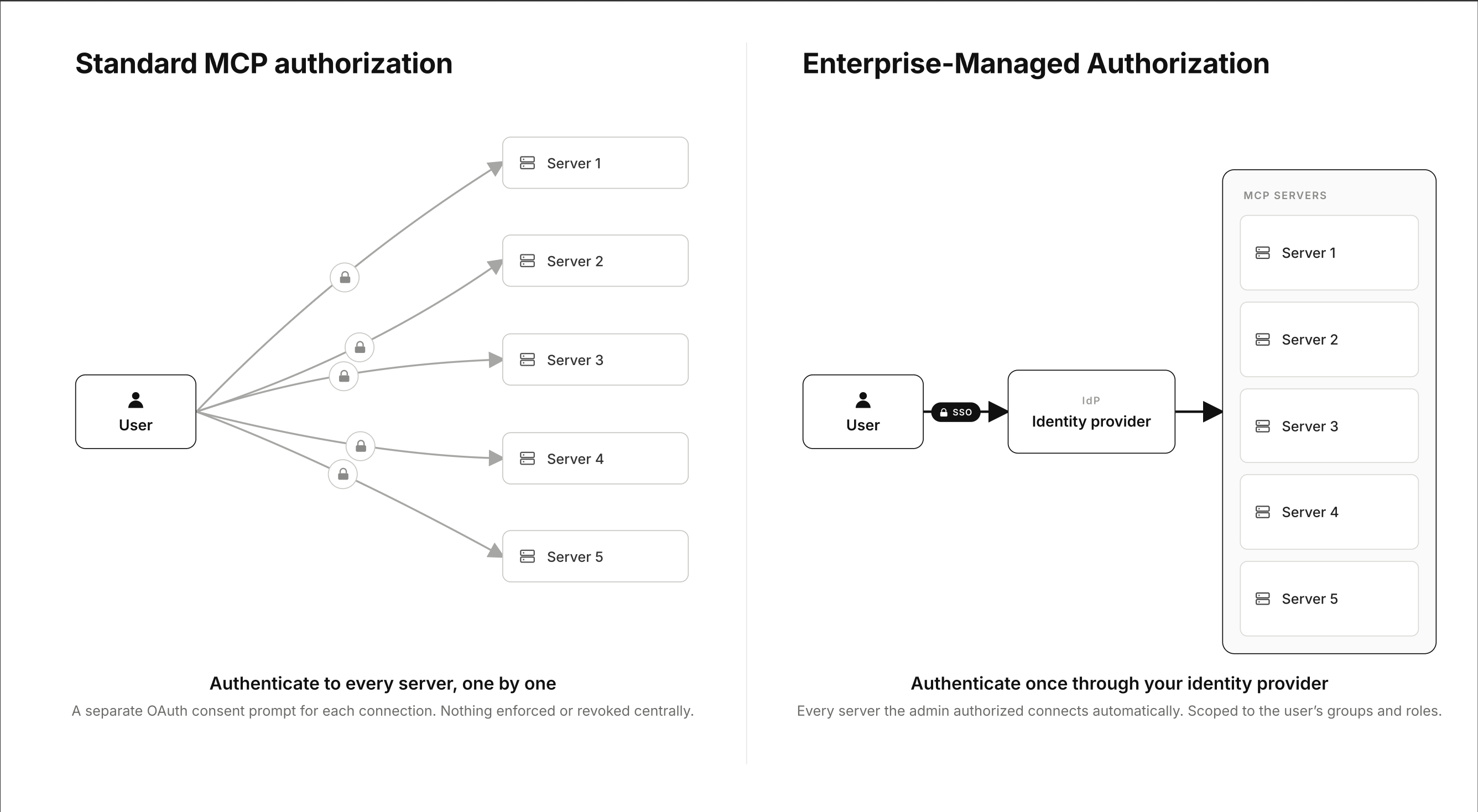
If you've ever tried rolling out MCP tools to a team larger than a handful of people, you know the pain: every new hire has to manually authenticate to every MCP server one by one. Figma, Linear, Atlassian, Supabase , each one a separate OAuth consent screen, a separate IT ticket, a separate headache. The MCP team has now published Enterprise-Managed Authorization (EMA) as a stable extension, removing what has been MCP's biggest enterprise deployment blocker. Previously, every employee had to manually OAuth into each MCP server individually , a process that created ticket queues for IT teams and left security with no centralized control, no audit trail, and no reliable way to revoke access when someone left the company.
EMA allows organizations to control MCP server access centrally through their trusted identity provider. For end-users, this means a zero-touch setup: the MCP servers they need are connected on first login, with no per-app OAuth and nothing to configure as a one-off. The spec is now stable, and the first wave of real production deployments is already live.
The Problem That Needed Fixing
The standard MCP authorization model required every employee to authorize every server individually , onboarding meant manually connecting service after service. Security teams couldn't enforce consistent policy: access was whatever each user authorized, with no central control or audit trail. Work and personal accounts blurred together, with no way to require a corporate identity.
For security teams, the pre-EMA state created a category of risk documented by the National Security Agency in a May 2026 advisory on MCP security: agent-driven connections established outside IT visibility, often with hardcoded credentials or long-lived personal OAuth tokens, constituted an unmanaged attack surface. EMA closes the specific gap that advisory identified , the absence of centralized identity governance over AI agent tool connections , by routing all access decisions through the IdP's existing policy engine.
How It Actually Works
The mechanism is built on a new IETF standard called the Identity Assertion JWT Authorization Grant (ID-JAG) , a signed token that your identity provider issues during SSO, which MCP servers can then exchange for an access token without ever prompting the user. A user logs into their MCP client , Claude or VS Code , via corporate SSO. The identity provider evaluates policy (group membership, role assignments, conditional access rules) and issues a short-lived ID-JAG token. The MCP client exchanges this for an access token from the MCP server's authorization server. The user never sees a per-server consent screen.
Okta's implementation of ID-JAG is marketed as Cross App Access (XAA). XAA is the branded name for one implementation; ID-JAG is the vendor-neutral specification that any identity provider can adopt. The underlying spec is open, meaning any IdP, MCP server, or client can implement it independently of Anthropic or Okta.
Three concrete security properties fall out of this flow:
- Faster revocation: Because the consent decision is now held by the IdP's policy engine rather than the user's memory, administrators can shorten access token lifetimes significantly , fast revocation means that when an employee is deprovisioned, their MCP connector access expires within the token's lifetime rather than persisting on an old, forgotten grant.
- No personal/work account mixups: The enterprise account/personal account boundary is enforced structurally: without an interactive account-selection step, there is no mechanism for a user to accidentally route work data through a personal OAuth grant.
- One audit trail: All access decisions are recorded in the IdP's admin console , one auditable trail across every connector, subject to the same governance and compliance reporting that covers all other enterprise access.
Who's In at Launch
The ID-JAG protocol was adopted by the IETF OAuth working group in September 2025, incorporated into the MCP specification in November 2025, and declared stable as a formal MCP authorization extension on June 18, 2026. Anthropic's EMA is the first live production implementation of that stable extension. The launch coordinates three groups:
- Identity providers: Okta is the first supported identity provider. Organizations using Okta can provision MCP access to supported servers through any supported client, using Okta's Cross App Access (XAA). Azure AD and Google Workspace SSO are on the roadmap but not yet available.
- Clients: Anthropic has implemented the extension in its shared MCP layer for Claude. Admins can authorize MCP servers for users across Claude, Claude Code, and Cowork. Additionally, Visual Studio Code has also added support for EMA right in the IDE.
- MCP servers: Asana, Atlassian, Canva, Figma, Granola, Linear and Supabase now support EMA, with Slack and more actively adding support.
HubSpot, Ramp, and Webflow are among the organizations already rolling out enterprise-managed auth across their teams. Ramp's case is particularly telling: Ramp already deployed this to 2,000 employees with zero additional steps.
The Bigger Picture for MCP Adoption
MCP is now a Linux Foundation project , donated to the Agentic AI Foundation in December 2025, with OpenAI and Block as co-founders and AWS, Google, Microsoft, Cloudflare, and Bloomberg as members , and the enterprise authorization extension completes a roadmap item that maintainers flagged as a top priority in March 2026. EMA isn't just a quality-of-life improvement; it's the missing piece that lets enterprise IT actually govern AI tool access the same way they govern everything else.
With 25+ early adopters including Anthropic, Zoom, and Slack, Okta's open XAA protocol is standardizing secure, identity-governed agent connections. Okta Workforce customers will be able to access supported XAA applications through the Okta Integration Network starting in August. For Auth0 B2B SaaS customers, XAA is slated for early access at the end of July.
There's a clear winner in the ecosystem play here: Okta gets to position itself as the identity control plane for the entire MCP ecosystem, not just for human workforce identity. IdPs like Okta will act as the control plane for the AI enterprise, delivering unified governance by making connections auditable and manageable, while helping improve the user experience by removing repetitive authorization consent screens.
What EMA Doesn't Solve
It's worth being clear about the limits. EMA does not address the broader class of runtime risks: prompt injection attacks that manipulate an agent into misusing the access it legitimately holds, and supply chain risks from malicious third-party MCP servers. EMA governs who can connect to what; it does not govern what an agent does once connected. Those are separate problems requiring separate tooling.
Okta is the only IdP shipping EMA today, so plan a fallback for orgs that aren't on it. Each ID-JAG is scoped to one server, so there's no universal cross-server token , it's one exchange per target. The server has to implement the grant, which is a code change, not a config flip. MCP server builders who want enterprise customers to adopt their tools will increasingly need to add EMA support , it's becoming a table-stakes requirement.
Getting Started
Anthropic's EMA documentation is available now; customers on Team and Enterprise plans can apply for beta access directly. Because the specification is open, any MCP connector , including custom-built internal tools , can adopt EMA support without going through Anthropic. The full spec lives in the ext-auth repository on GitHub, and Okta's TypeScript and Java SDKs already include XAA support. Developers working in those languages can implement the authentication standard with minimal additional integration work.
The official MCP blog post and Anthropic's announcement both link to the beta waitlist. If you're building an MCP server and want enterprise customers, implementing EMA support now , before it becomes a procurement checkbox , is the right call. The EMA extension spec documents the full flow for clients, servers, and authorization servers.
Comments
