

Anthropic's Claude Science Hackathon Offers Researchers $100K to Reinvent Biomedicine
Anthropic and Gladstone Institutes launch a week-long virtual hackathon to push Claude Science into biomedical research, with $100K in credits on the line.
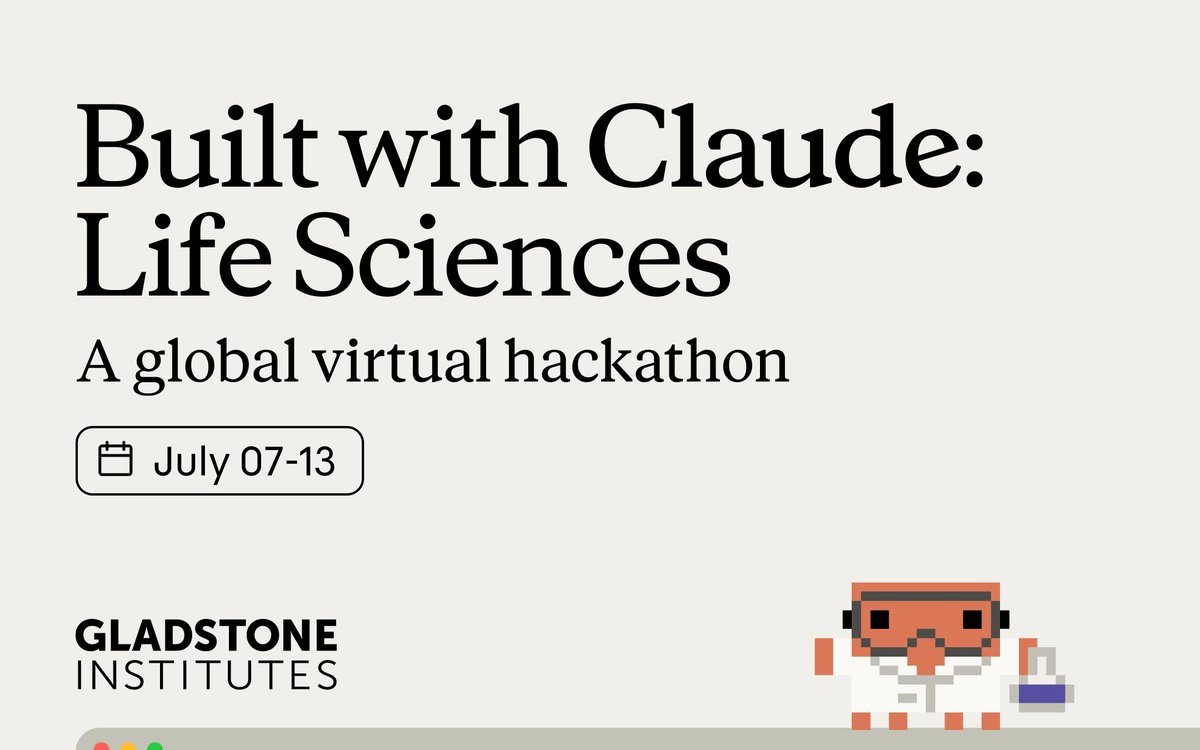
- What happened: Anthropic and Gladstone Institutes announced Built with Claude: Life Sciences, a global virtual hackathon running July 7-13 with a $100K prize pool.
- The tool: Participants build with Claude Science, Anthropic's new AI research workbench connecting 60+ scientific databases, just launched in beta.
- The partner: Gladstone Institutes is a nonprofit biomedical research org home to Nobel laureates Jennifer Doudna and Shinya Yamanaka, with scientists already using Claude Science.
- Apply by Sunday: Applications close this Sunday; the hackathon runs July 7-13 fully virtually via Cerebral Valley.
- Broader push: Anthropic also has a separate AI for Science grants program offering up to $30K in credits for 50 research projects, with applications open through July 15.
- Pattern from past events: Previous hackathons in this series drew 20,000+ applicants; winners have consistently been domain experts (doctors, teachers, engineers) rather than professional developers.
Anthropic just announced Built with Claude: Life Sciences, a global virtual hackathon running July 7-13 in partnership with the Gladstone Institutes. The prize pool is $100,000 in API credits, applications close this Sunday, and the tools at the center of it are Claude Science and Claude Code. This is not a general-purpose build competition -- it is a focused push to get researchers and builders working at the intersection of AI and biomedicine.
The Setup
The hackathon is organized through Cerebral Valley, the same community behind Anthropic's previous virtual build weeks. Previous events in this series selected 500 builders from more than 20,000 applicants and gave them a week to build with Claude Code. The Life Sciences edition narrows the focus: participants will build with Claude Science, Anthropic's brand-new AI workbench for researchers, and Claude Code.
The timing is deliberate. Since launching its life sciences efforts last fall, Anthropic has worked to improve model capabilities, make connections to the scientific ecosystem via MCPs and skills, and launch partnerships -- and Claude Science is its most significant expansion of those efforts: an app that integrates the tools and packages researchers most commonly use, produces auditable artifacts, and provides flexible access to computing resources.
What Is Claude Science, Exactly?
Claude Science is not a new model. The platform leverages existing Claude models like Claude Opus 4.8. What it adds is a purpose-built research environment. Scientific research is often tedious -- researchers must work across dozens of databases, each with their own schema, contend with file formats that require bespoke data pipelines and viewers, and transition between a roster of tools: PubMed, Jupyter, R, a cluster terminal, and more. Claude Science collapses that stack into a single agent-driven workspace.
The key capabilities worth knowing:
- Claude Science connects to over 60 databases and offers pre-built toolkits for genomics, protein structure, and chemistry.
- It generates figures and manuscripts alongside the code that created them, and natively renders 3D protein structures, genome browser tracks, and chemical structures.
- Claude Science runs on scientists' own infrastructure instead of sending data to Anthropic's servers.
- The main AI assistant acts as a project manager, creating sub-assistants to delegate tasks, while a separate fact-checker AI double-checks citations and calculations before publication.
The platform also integrates NVIDIA's BioNeMo Agent Toolkit, giving it native access to life sciences models including Evo 2, Boltz-2, and OpenFold3 -- tools for sequence modeling, protein structure prediction, and more.
The Partner: Why Gladstone Matters
Gladstone Institutes is an independent, nonprofit life science research organization established in 1979, located in the Mission Bay neighborhood of San Francisco. It is not a peripheral player in biomedical AI. Home to Nobel laureates Jennifer Doudna and Shinya Yamanaka, Gladstone is at the forefront of CRISPR-based genome editing and pluripotent stem cell biology, and is a global leader in using AI to study the mechanisms underlying disease.
Gladstone scientists have already been using Claude Science in beta. Sean Whalen, a principal scientist in machine learning and functional genomics at Gladstone Institutes, used the tool to build a genome browser from scratch in days. That kind of early validation from an institution with Gladstone's credibility is exactly the signal Anthropic needs to attract serious researchers to the hackathon.
This also fits a broader pattern. The Allen Institute and Howard Hughes Medical Institute (HHMI) serve as founding partners in Anthropic's life sciences push, with each collaboration bringing together Anthropic's expertise in foundation models, agentic systems, and interpretability with world-class research institutions tackling distinct problems in biology and biomedical science. Gladstone adds another anchor institution to that network.
What the Previous Hackathons Tell Us
The prior editions of this series produced some genuinely surprising results. The top three prizes in the Opus 4.7 hackathon went to a doctor-turned-engineer in Istanbul, a former microsoldering technician in a small town in the French Alps, and a computer science teacher in Chile -- none based in Silicon Valley or any of the usual centers of AI development. The pattern suggests that domain expertise, not software engineering background, is the real competitive advantage in these events.
For a Life Sciences hackathon, that framing is even more relevant. The people most likely to build something meaningful are biologists, chemists, and clinicians who understand the actual research problems -- not necessarily those who are most fluent in Python. As one previous winner put it, hackathon week showed her that the gap between understanding a problem and shipping a tool for it has collapsed: "I shipped a working full-stack product in a week because the tools let me stay in the role I'm genuinely expert in while they handle the rest. The people closest to real problems can now build for them directly."
The Bigger Picture
The hackathon is a distribution strategy as much as a community event. Anthropic is looking for projects that span domains and explore the boundaries of science, with an early focus on biology and biomedical research -- applications are open through July 15, with projects running from September 1 to December 1, 2026. The hackathon serves as a top-of-funnel for that longer-term program.
The real story is that Anthropic is trying to establish Claude Science as the default AI research environment before competitors can. The goal is for agentic AI systems to compress months of manual analysis into hours while surfacing patterns human researchers might otherwise miss -- designed to amplify scientific intuition rather than replace it, keeping researchers in control of scientific direction while handling computational complexity. A week-long hackathon with $100K in prizes and Gladstone's name attached is a fast way to generate real-world use cases, stress-test the platform, and build a community of power users who will shape what the product becomes.
One concrete example of what that acceleration looks like in practice: a neuroscientist at the Allen Institute used Claude Science to build a multi-agent pipeline where sub-agents read through thousands of papers, pull the central claim and key quantitative finding, and construct a full narrative review section by section -- a process that previously took his team as many as two years.
Who Should Apply
The application deadline is this Sunday. The event runs fully virtually July 7-13. Based on the format of previous Cerebral Valley hackathons, expect 500 selected participants, each given API credits and one week to build. If you are a researcher, bioinformatician, computational biologist, or a developer with a life sciences problem you have been sitting on, this is the most resourced and credentialed venue Anthropic has created for it yet.
Apply at cerebralvalley.ai before Sunday. Claude Science is available in beta for Pro, Max, Team, and Enterprise users at claude.com/science. The full Claude Science announcement from Anthropic covers the platform's capabilities in detail.
Comments
