



Anthropic has just launched Claude Science, a purpose-built AI workbench for scientific research. It is not a new model -- it is a new app that wraps Claude's existing models in a full research environment: one that can run analyses, manage compute, query scientific databases, and trace every figure back to the exact code that generated it. It is available now in beta for macOS and Linux.
The timing is deliberate. Last October, Anthropic launched Claude for Life Sciences -- a suite of connectors and skills that made Claude a better scientific collaborator. Claude Science is the next, much bigger step: a standalone desktop application that brings the entire research pipeline under one roof.
The problem it is solving
Scientific research is often tedious. Researchers must work across dozens of databases, each with their own schema, contend with file formats that require bespoke data pipelines and viewers, and transition between a roster of tools: PubMed, Jupyter, R, a cluster terminal, and more. Claude Science is built to collapse that fragmentation.
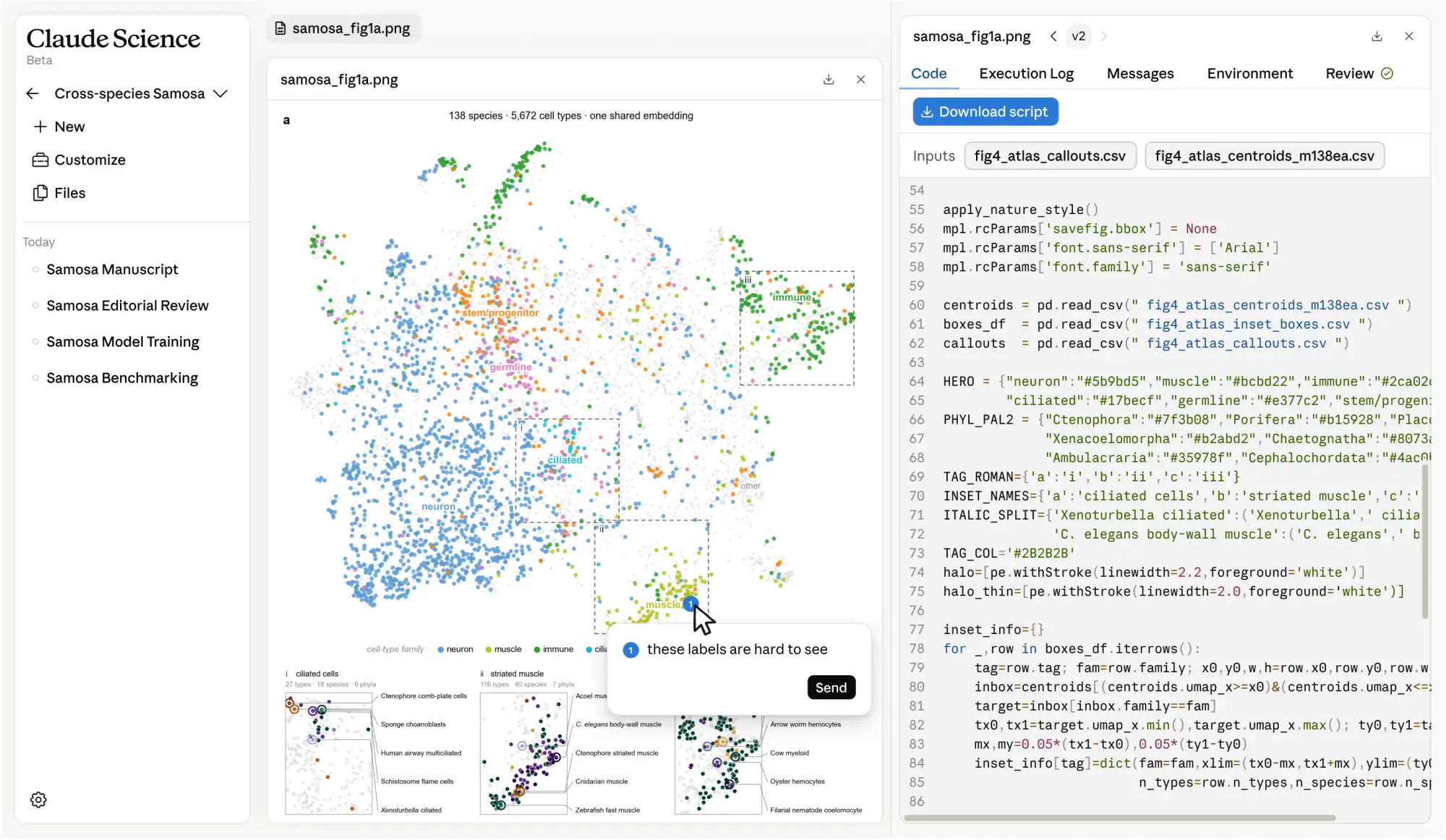
Claude Science brings these fragmented tools into a single research environment where scientists can conduct all stages of their work. It helps you analyze literature and execute multistep research, produces detailed artifacts, and lets you iteratively refine figures and manuscripts until they're ready for publication.
What it actually does
Claude Science is built around three core pillars:
- Reproducible artifacts. Every output carries an auditable history of how it was made, so you can validate and reproduce the results. When Claude Science generates a figure, it bundles the exact code, the environment it ran in, a plain-language description, and the full conversation history. You can ask it to edit a figure in plain English -- "remove the gridlines" or "switch the y-axis to log scale" -- and the agent edits its own code directly.
- Compute orchestration. Claude Science handles the process of drafting a plan, asking before reaching new resources, and letting you review or revoke any decision before writing and submitting the job to the computing resources your lab already uses -- your own HPC cluster over SSH, or your Modal account for compute on demand -- scaling the analysis from a single GPU to hundreds as needed.


Don't miss what's next in AI
Join 300,000+ engineers and researchers who get the signal, not the noise.
- Full access to in-depth AI research breakdowns
- Be the first to know what's trending before it hits mainstream
- Daily curated papers, repos, and industry moves